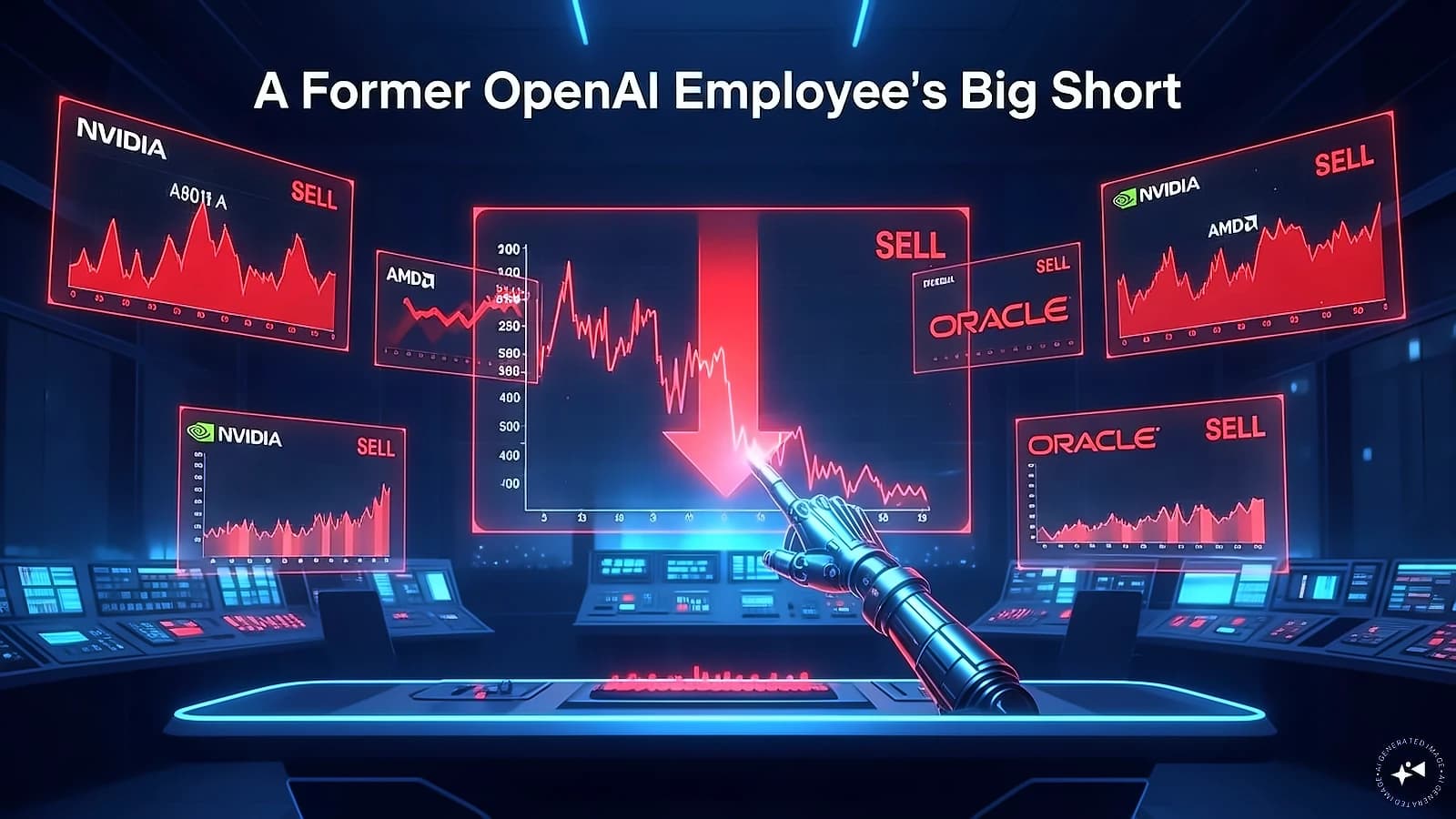
Former OpenAI researcher Leopold Aschenbrenner has positioned his hedge fund Situational Awareness LP against major technology companies through significant short positions. According to latest 13-F disclosures, the firm disclosed a $2.04 billion short position on the VanEck Semiconductor ETF, a benchmark for semiconductor stocks. The short positions are structured as put options and are at least $1 billion or more in size each, targeting chip and AI infrastructure giants including Nvidia, Oracle Corp., Broadcom, and AMD.
A German-born AI researcher and Columbia University valedictorian, Aschenbrenner joined OpenAI's 'Superalignment' team in 2023, tasked with ensuring superhuman AI systems remain safe and aligned with human interests. However, his tenure ended abruptly in April 2024 when he was fired over an alleged information leak, a claim he disputes. Aschenbrenner maintains that his dismissal was actually retaliation for an internal memo warning of insufficient security and potential industrial espionage by foreign entities at OpenAI. After leaving OpenAI, Aschenbrenner published a 165-page essay, 'Situational Awareness: The Decade Ahead,' in which he predicted that Artificial General Intelligence (AGI) could arrive as early as 2027.
Despite the short positions against major technology companies, Aschenbrenner maintains long positions in energy-intensive infrastructure sectors. According to reports, the fund has long positions in energy-intensive infra, such as Bloom Energy ($878 million), along with Bitcoin mining firms such as IREN and Core Scientific. CoreWeave also features as one of his long positions. As of March 31, the equity exposure of his fund has more than doubled in value to $13.6 billion from $5.5 billion at the end of December 2025.
Aschenbrenner's investment strategy reflects his view that the biggest bottleneck for AI development will be physical infrastructure, particularly electricity and computing power. According to reports, he is of the view that the infrastructure needed to support AI development will be the limiting factor rather than technological advancement itself. This perspective drives his focus on energy-intensive infrastructure companies over traditional technology giants in his investment approach.