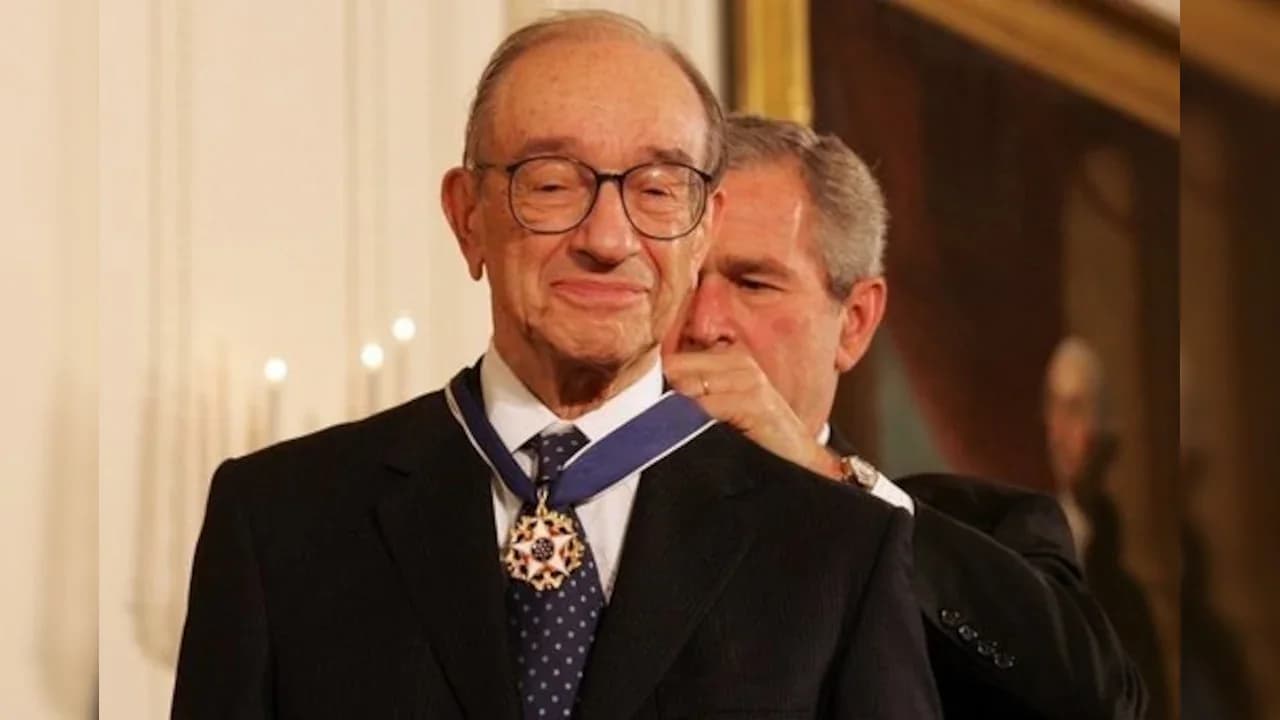
Alan Greenspan, the influential economist who served as chairman of the Federal Reserve for nearly 19 years under four presidents, has died at 100 years old due to complications from Parkinson's Disease, according to reports from NBC News. Greenspan's tenure spanned from August 11, 1987, to January 31, 2006, making him one of the most significant figures in modern U.S. monetary policy history. His wife Andrea Mitchell confirmed he passed away at their home from Parkinson's complications, with Mitchell stating he was 'a giant of a man who helped shape the U.S. economy for decades under presidents of both parties, but was always honest in acknowledging his mistakes.' The Federal Reserve issued a statement acknowledging Greenspan's passing, noting he 'helped cement the Fed as a trusted institution during a time of economic uncertainty' and 'brought rigorous analytical discipline to monetary policymaking and helped establish the credibility that remains one of the Federal Reserve's most important assets.'
During his nearly two decades as Fed chair, Greenspan steered U.S. monetary policy through some of the most challenging economic periods in American history, including the second-longest economic expansion in U.S. history - an uninterrupted decade of growth from March 1991 to March 2001. His decision to let the economy run despite pressure to raise interest rates against an inflation threat that never materialized helped foster years of U.S. prosperity and earned him rock-star status as an economic "maestro." The era was marked by his prescient judgment that a productivity surge in the mid-1990s would keep inflation contained, with his intuition cited by former Federal Reserve Chair Jerome Powell as an example of how judgment can sometimes outperform technical models of the economy. Greenspan served as the head of the United States' central bank for five terms from 1987 until he retired in 2006, working under Presidents Ronald Reagan, George H.W. Bush, Bill Clinton and George W. Bush. He has the second-longest tenure in the role, behind William McChesney Martin Jr., who served from 1951 to 1970.
Greenspan's tenure ended in 2006, two years shy of the 2007-08 global financial crisis that led to a global recession, as reported by NBC News. Critics held him partly responsible for the crisis, citing his stance on deregulation of the financial sector and his strong advocacy for light regulation of financial markets. A bipartisan Financial Crisis Inquiry Commission later said that decades of deregulation and reliance on self-regulation by financial institutions had removed safeguards that could have reduced the damage from the crisis. In testimony before Congress in 2008, Greenspan admitted he had underestimated the scale of the crisis, stating 'The crisis, however, has turned out to be much broader than anything I could have imagined.' Despite his later criticisms, Greenspan maintained his defense of monetary policy decisions, arguing in his 2013 book 'The Map and the Territory' that traditional economic forecasting was no match for irrational risk-taking that can feed catastrophic price bubbles. 'Bubbles go up very slowly as euphoria builds,' Greenspan said in a 2013 interview with The Associated Press. 'Then fear hits, and it comes down very sharply. When I started to look at that, I was sort of intellectually shocked.'
The phrase 'irrational exuberance' that became a talking point in equity markets for years was first coined by Greenspan in a televised speech on December 5, 1996. In the interview, he stated 'How do we know when irrational exuberance has unduly escalated asset values, which then become subject to unexpected and prolonged contractions as they have in Japan over the past decade? ... We should not underestimate or become complacent about the complexity of the interactions of asset markets and the economy.' The phrase suggested to many that Greenspan believed the market was overvalued, leading to a 3% decline in the Tokyo stock market and subsequent drops in other markets. Despite this initial reaction, markets rebounded and continued to rise until the dot-com bust in 2001. Greenspan's unusual frankness regarding monetary policy challenges triggered a brief market frenzy, demonstrating his ability to influence financial markets through his words. His intense scrutiny of economic data earned him the nickname 'The Oracle' and 'Maestro', with the "Briefcase Indicator" folklore emerging - a stuffed briefcase carried into Fed meetings implied changes might be afoot because Greenspan carried with him charts and research to make his point.
Greenspan is survived by his wife of 29 years Andrea Mitchell, who is also the chief Washington correspondent and chief foreign affairs correspondent for NBC News. Mitchell described him as 'my husband, who shaped my life from our very first date in 1984.' She added that he had 'irrational exuberance' for baseball, the Washington Commanders, tennis, golf and music, especially jazz. Mitchell concluded that 'he will be remembered for his brilliance and his kindness. Being his life partner was the joy of my life.' After retiring from the Federal Reserve in January 2006, Greenspan launched a consulting company and wrote several books, including his memoir, 'The Age of Turbulence: Adventures in a New World.' He also signed onto opinion articles and statements defending the Federal Reserve's political independence from President Donald Trump's ongoing attacks, including a January 2026 statement criticizing the Trump administration's investigation of Fed Chair Jerome Powell. The statement, which was also signed by two other former Fed chairs and five former Treasury secretaries, called the investigation 'an unprecedented attempt to use prosecutorial attacks to undermine' the Fed's independence and warned it would have 'highly negative consequences for inflation.'
Greenspan received several major international honors during his lifetime, including France's Legion of Honor in 2000, Queen Elizabeth II naming him an honorary Knight of the British Empire in 2002, and President George W. Bush presenting him with the Presidential Medal of Freedom in 2005. His political career began in the late 1960s as an adviser to Richard Nixon's presidential campaign and later served in President Gerald Ford's administration as chairman of the Council of Economic Advisers, supporting policies aimed at reducing inflation. Greenspan entered politics during the early 1950s, becoming associated with novelist and philosopher Ayn Rand, whose belief in free markets and limited government influenced his economic thinking for the rest of his life. According to an obituary shared by his family, Greenspan received honorary degrees from Harvard, Yale, the University of Pennsylvania, the University of Edinburgh, New York University, Notre Dame, Boston College and Wake Forest University. Greenspan's tenure as Fed chairman - from August 1987 through January 2006 - was just five months shy of the longest Fed chairman's tenure, with that distinction belonging to William McChesney Martin, who served from 1951 until early 1970.