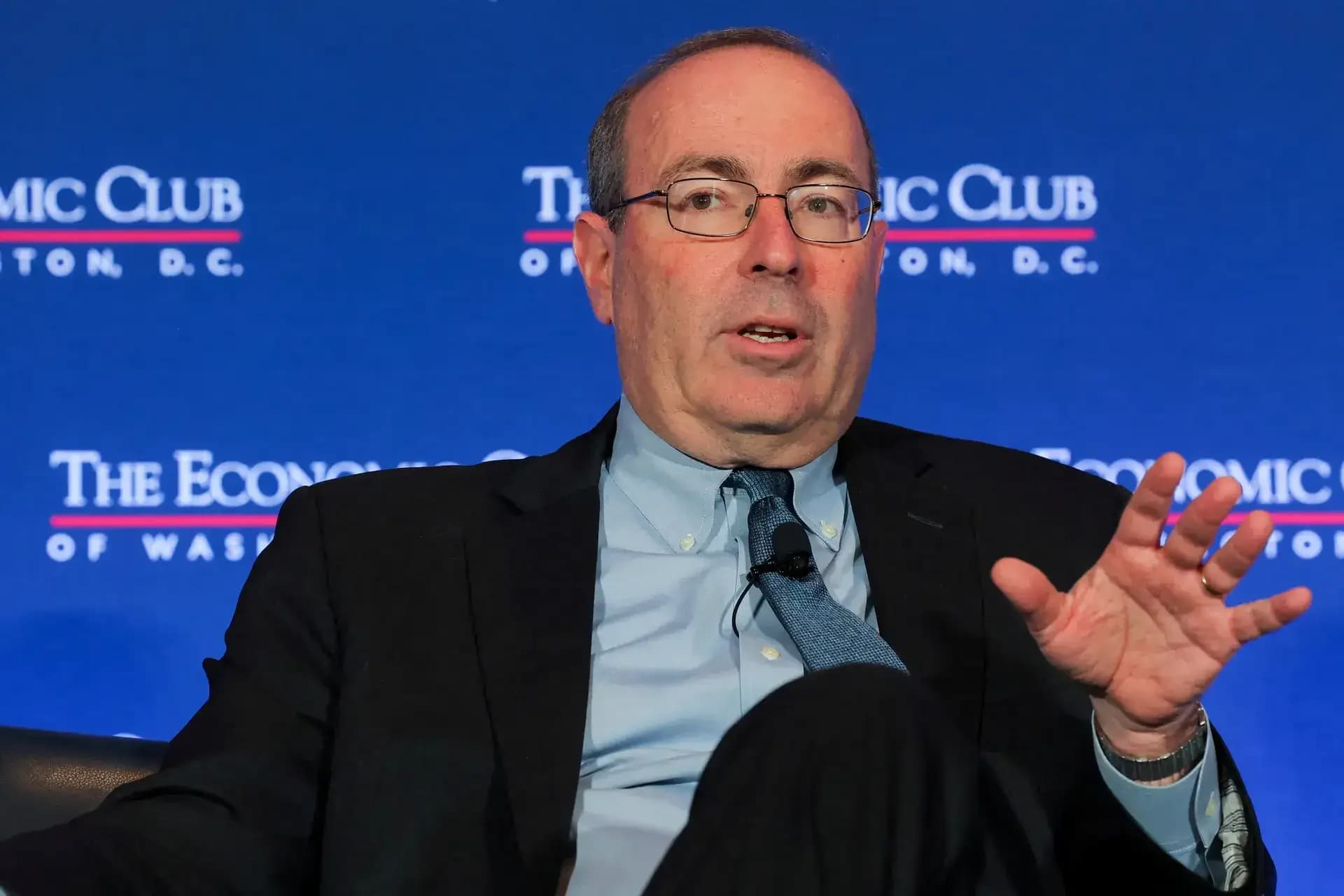
Richmond Fed President Thomas Barkin emphasized that the Federal Reserve's approach to interest rate adjustments will depend on how effectively businesses and consumers navigate current economic challenges. Speaking to an economic group in Raleigh, North Carolina, Barkin stated that the Fed's decision to hold rates steady at its last meeting made sense as policymakers gathered more information on employment and inflation amid diverse economic developments including high oil prices and artificial intelligence technology rollout. "It made sense to give ourselves time," Barkin said, adding he expected that in coming months the Fed could see further developments that "pressure the employment side of our mandate, the inflation side of our mandate, or conceivably both. If we do, the Fed is well positioned to respond as appropriate." As reported by Investing.com, Barkin noted that the Fed is actively collecting data on employment figures and inflation rates to inform future policy decisions.
Barkin acknowledged that the current oil price surge represents the latest in a series of supply shocks over the past five years, following the COVID-19 pandemic, Russian invasion of Ukraine, Silicon Valley Bank collapse, tariff tumult, and most recently, the conflict in the Middle East. "If that occurs, does the Fed have the luxury of riding out all the waves that come our way?" Barkin asked, emphasizing that the central bank's approach depends on how much businesses, consumers, and inflation expectations can withstand. The oil shock, driven by the war in Iran which has effectively shut down the critical Strait of Hormuz, is now rippling through global supply chains. Headline measures of inflation have jumped due to the energy price increases, with headline PCE jumping to 3.5 percent year-over-year in March 2026, while core inflation increased more modestly to 3.2 percent. Barkin suggested the Fed could look past this temporary shock if long-term inflation expectations don't rise, explaining that "Raising rates to weaken demand doesn't address the root cause behind supply shock-driven inflation."
Despite consumer frustration with higher prices, personal consumption has not slowed significantly, with consumers continuing to spend and this resilience tightly bound to a stable labor market. According to recent analysis, consumers are "not happy" but maintain their spending patterns, demonstrating remarkable economic resilience. However, Barkin expressed growing concerns about the labor market, stating he was "nervous about both inflation and the labor market." Speaking with reporters following his speech, Barkin said he was encouraged by recent unemployment data but concerned by the anecdotal information he hears from business leaders. "I'm still in a world where everyone I talk to is talking about AI and AI-related job loss," he said, highlighting the ongoing impact of artificial intelligence on employment patterns. The latest Middle East conflict has had less impact on demand than might have been imagined, with consumer spending remaining up and non-gas spending growth staying solid.
A growing number of Fed policymakers at the April meeting felt a rate hike might be necessary to address inflation that has risen due to high energy costs, an investment boom around AI, and unexpectedly resilient household consumption. As reported by Investing.com, Barkin noted that the Fed is actively collecting data on employment figures and inflation rates to inform future policy decisions. He expects the central bank could see further developments that pressure both employment and inflation mandates in coming months. The risk that inflation expectations de-anchor from the 2% target is high now, particularly given the Fed's five-year track record of missing its inflation target. However, Barkin reported that forward inflation compensation beyond the next year and survey-based measures of long-term inflation expectations remain well anchored. Historical data shows that the 10-year breakeven was around 2.9% in March 2022 when US headline CPI Y/Y was at 8.5% and Core CPI Y/Y was at 6.5%. Barkin stressed that looking through temporary shocks works as long as inflation expectations remain anchored, with businesses and consumers understanding that temporarily elevated inflation does not mean sustained inflation in the long term.
The Fed's policy path will hinge on several key factors according to Barkin's comments prepared for delivery to an economic group. According to Investing.com, these include whether consumers remain resilient in spending, whether businesses use rising productivity as a reason to lay off workers, and whether inflation expectations can remain anchored after more than five years in which the Fed has missed its target. Barkin noted that looking through supply shocks has worked well for a generation, but future conditions may present more challenging scenarios. "Looking forward, it's easy to imagine more challenging conditions: heightened geopolitical tensions, trade fragmentation, more frequent severe weather events, rising government debt, cyber risk, slowing workforce growth and more," Barkin said, adding "It's worth asking whether the cumulative impact of so many waves risks loosening the anchor." Since the Fed has been missing its target for 5 years now, people might start to expect more frequent shocks in the future and persistently higher inflation. Minutes from the Fed's last policy meeting revealed that officials are looking at holding rates longer than previously thought, with several thinking they could still lower rates once there are clear indications that inflation is firmly back on track or if solid signs emerge of greater weakness in the job market. Investors now see a quarter-point rate increase by the end of 2026 as probable, according to federal funds futures, as an energy-price shock triggered by the Iran war has shifted sentiment among Fed officials away from any consideration of rate cuts in the near term.