Global semiconductor stocks experienced a brutal U-turn on Monday, with the sector initially riding high on pre-market optimism before suffering a sharp selloff. The market euphoria was fueled by easing geopolitical tensions in Iran and a blockbuster Wall Street Journal report revealing that Nvidia is in talks to guarantee a massive $250 billion in financing for an OpenAI data center project. However, this AI-driven optimism evaporated instantly when ASML erased early gains of over 2% and dragged U.S. peers Applied Materials (AMAT), Lam Research (LRCX), and KLA Corp (KLAC) down with it. The selloff was triggered by a breaking report by The Information revealing that a Shanghai-based, state-backed company has successfully started mass-producing homegrown immersion DUV (deep ultraviolet) lithography machines for the first time. According to the report, this company assembled DUV development teams from other Chinese firms, including state-backed startup Shanghai Yuliangsheng Technology, to achieve the milestone.
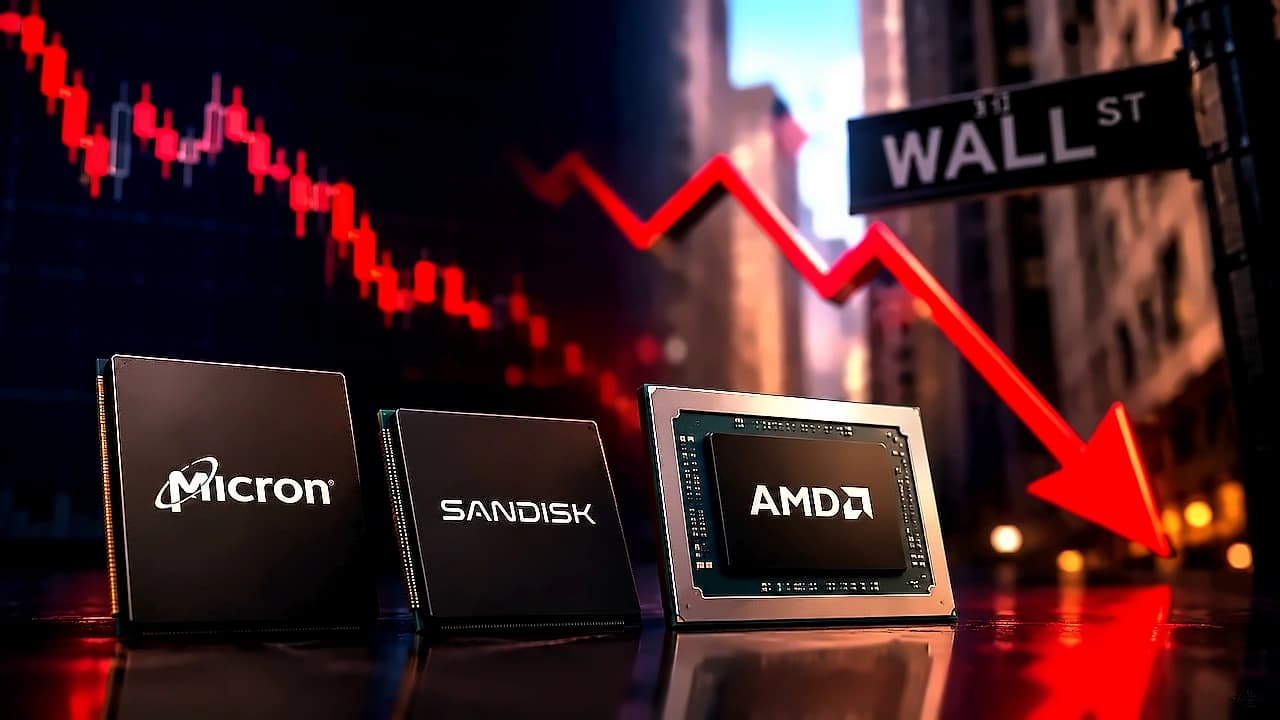
The semiconductor selloff has intensified across Asian markets, with South Korea's benchmark Kospi declining as much as 8.1% to the lowest level since April 20, as reported by Moneycontrol. The nation's memory powerhouses Samsung Electronics Co. and SK Hynix Inc. slumped at least 9% each, while Japan's chip-heavy Nikkei 225 Stock Average declined 4%. The market selloff was broad-based, affecting major semiconductor companies across the board. Nvidia, AMD, SK Hynix and Micron shares plunged up to 9% during trading hours on Wall Street, with Nvidia alone falling 3% and dragging the Nasdaq 100 to its lowest level since early May. As reported, the selling pressure spread across leading chipmakers and memory manufacturers, reflecting investor concerns about the potential impact on Western chip equipment suppliers. The latest developments have extended the selloff to European chip equipment suppliers, with BE Semiconductor Industries tumbling about 8.5%, Soitec falling 5%, and Infineon Technologies dropping nearly 3%. The decline in semiconductor linked stocks was led by CG Power & Industrial, falling nearly 4% to ₹842.2 apiece, followed by Bharat Electronics (BEL), dipping 3.7% to ₹392.1 per share, Moschip Semiconductor Technology, down 2.85% to ₹202.37 apiece and SPEL Semiconductor dropping 2.27% to ₹155 during Tuesday's trading session.
The semiconductor selloff was compounded by China's rapid expansion in the memory market through ChangXin Technology Group (CXMT), which made a blockbuster debut on Shanghai's STAR Market. According to Counterpoint Research, CXMT's share of the global DRAM market nearly tripled over the past year to approximately 8% during the first quarter, while the company's shares surged nearly 466% on their first trading day. Nomura estimates CXMT could increase its global DRAM market share from roughly 10% today to about 18% by the end of 2028, supported by significant production expansion. Monthly capacity is projected to rise from 280,000 12-inch wafers at facilities in Hefei and Beijing by the end of 2025 to 350,000 by the end of 2026 and approximately 550,000 by the end of 2028 through additional production lines in Shanghai. Investor concerns have intensified following reports that Apple is testing DRAM chips supplied by CXMT, raising expectations that the Chinese supplier could win higher-profile customers more quickly than previously anticipated.
The breakthrough represents a significant milestone as China begins manufacturing domestically developed immersion DUV lithography machines, a key chipmaking tool long dominated by Dutch supplier ASML. According to The Information, the machines are expected to be delivered this year to leading Chinese chipmakers, including Semiconductor Manufacturing International Corp (SMIC), Hua Hong Semiconductor, and ChangXin Memory Technologies. Production will be limited initially, with about five DUV machines this year and roughly 20 in 2027. The technology could give Chinese chipmakers an alternative source of critical equipment as the U.S. considers tighter restrictions on foreign lithography tool exports and servicing in China. However, the system still lags on performance and reliability and needs further testing before mass production, leaving ASML's advantages intact for now. This development may eventually challenge ASML's dominance in China, but the breakthrough arrives just as U.S. Congress advances the MATCH Act — bipartisan legislation aimed at blocking China from buying or servicing these exact DUV machines. The development holds significance as chipmaking relies on lithography machines that use precisely focused light to etch microscopic circuits onto silicon wafers, with the finer the etching, the more powerful the chip. ASML has long dominated the most advanced versions of this technology, making it an unavoidable chokepoint for global chipmakers.