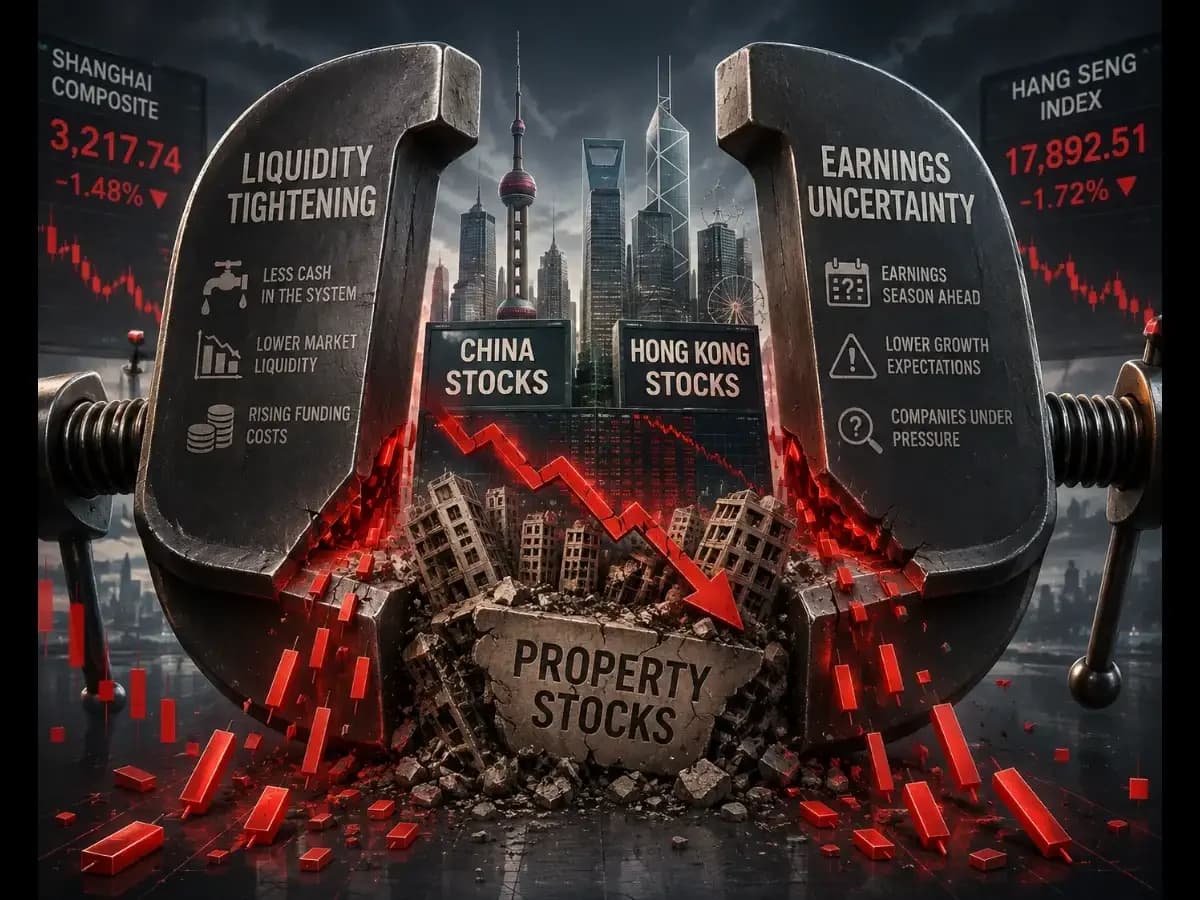
Chinese blue-chip stocks fell to their lowest level in over a year on Monday as government support measures failed to restore investor confidence amid rising global bond yields and geopolitical tensions. According to Reuters, the CSI300 Index declined 0.2% in the morning session, struggling near its one-year low, while the Shanghai Composite Index dropped 0.1%. In contrast, Hong Kong's Hang Seng Index edged up 0.2%, supported by gains in banking and biotechnology stocks. The subdued market reaction to Beijing's support measures underscores the challenge facing policymakers as they seek to restore investor confidence amid global financial uncertainty, elevated energy prices and growing trade tensions.
Technology shares remained under severe pressure in mainland China, with the 5G Communication Index falling as much as 6% to a two-month low, while the tech-heavy STAR50 Index slid nearly 4%, extending its decline to a five-month low. Zhongji Innolight, a major supplier of optical transceivers used in AI data centres, fell 5.4%, while memory chipmaker CXMT lost nearly 5%. The selloff reflects investor concerns over stretched valuations in China's technology sector, with the STAR 50 index having lost more than one-third of its value since July 1. As reported by Reuters, the index still trades at around 100 times earnings, highlighting concerns that valuations remain excessive despite the recent correction.

Technology stocks were among the biggest drags on Chinese equities on Monday after the United States launched patent infringement investigations into Luxshare Precision Industry and Foxconn Industrial Internet. According to Reuters, Foxconn shares fell as much as 7% to their lowest level in six months, while Luxshare declined 2%, approaching its lowest level since March. The investigations added to concerns over Chinese technology companies' exposure to regulatory and geopolitical risks. In another development, European Trade Commissioner Maros Sefcovic said on Friday that China and the European Union had reached a deal that could reduce Chinese hybrid car exports to the bloc by more than half, highlighting the challenges facing Chinese manufacturers in overseas markets.
Currency concerns also weighed on sentiment as China's central bank pushed back against foreign criticism of its exchange-rate policy on Thursday, maintaining that Beijing had never pursued competitive currency depreciation. The response came as European policymakers called for a stronger yuan to help address China's record trade surplus and export surge. A stronger yuan could create additional earnings pressure for Chinese companies with significant overseas revenue, particularly those that have not adequately hedged their foreign-exchange exposure. According to Reuters, the U.S. Federal Communications Commission announced it would vote on October 29 on a proposal to prevent Chinese laboratories from testing electronic devices for use in the United States, adding to geopolitical friction.
Sector performance was mixed across mainland markets, with consumer electronics, telecommunications and real estate stocks among the biggest decliners, while banking and consumer shares advanced. In Hong Kong, banking and biotechnology stocks gained, while chipmakers and artificial intelligence-related shares fell. Investors rotated towards more defensive sectors amid the technology selloff, with the Coal Index gaining 1.4% and consumer staples shares rising 0.6%. As reported by Reuters, government efforts to stabilise the market have so far produced a muted response, with China's top securities regulator Wu Qing holding a seminar with market participants on Saturday to gather suggestions for improving the country's capital markets.