Asian banks are significantly increasing provisions to prepare for potential credit losses as the Iran conflict enters its 11th week. According to Reuters, Australia's top lender Commonwealth Bank of Australia lost nearly $22 billion in market value after setting aside more cash to prepare for risks linked to the Middle East conflict. Over the past two weeks, Australia's other three leading banks raised provisioning by $757 million to cover future potential bad debts arising from the war. Singapore's OCBC set aside $216 million in provisions, while London-headquartered HSBC and Standard Chartered booked $300 million and $190 million charges respectively in the March quarter. India's about half a dozen lenders, including HDFC Bank, Axis Bank, and Federal Bank, have created provision buffers, though they have not seen any deterioration in asset quality yet.
The global energy crisis caused by President Trump's Iran war is accelerating at an unprecedented pace, with oil inventories declining by nearly 250 million barrels in just the first two months of the conflict. According to The Wall Street Journal, the world is 'burning through its oil safety net' as crude surpluses that temporarily mitigated price increases are being rapidly depleted. US diesel reserves are set to fall below 100 million barrels for the first time in 23 years by the end of this month, according to consulting firm Eurasia Group. Brent crude futures surged on Friday, topping more than $108 per barrel, with average gas prices in the US remaining above $4.50 and petroleum industry analysts estimating prices could soon jump to over $5 per gallon if the Strait of Hormuz remains shut. Ellen Wald, senior fellow at the Atlantic Council's Global Energy Center, warned that "at some point the market is going to collide and prices are going to shoot up," as consumption decreases can only offset the supply crunch to a limited extent.
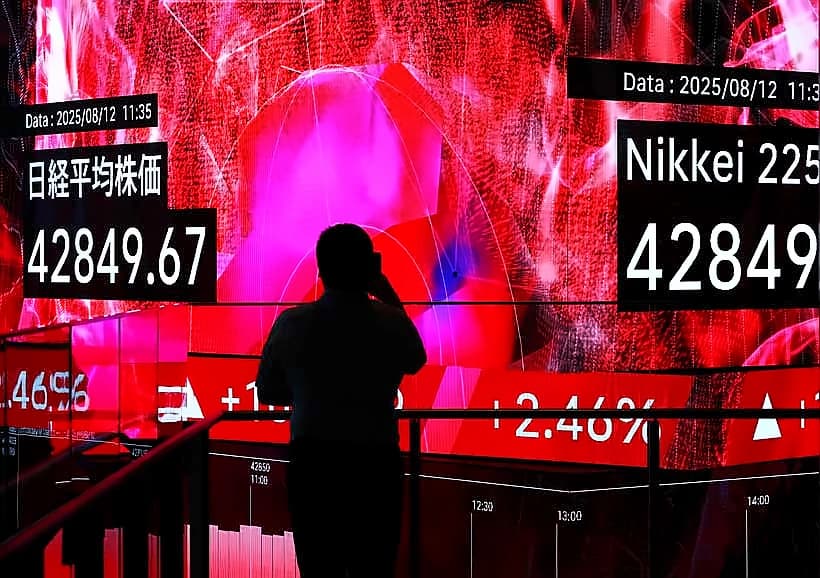
Asian markets experienced broad-based declines on Friday as investor optimism around artificial intelligence stocks faded amid mounting concerns. According to reports from Reuters, Japan's Nikkei 225 fell 1.2% to 61,880.04, while South Korea's Kospi dropped 3.2% to 7,727.34 after briefly crossing the 8,000 mark for the first time. Hong Kong's Hang Seng slipped 0.9% to 26,145.66, and China's Shanghai Composite edged up 0.1% to 4,183.05. Australia's S&P/ASX 200 also dipped 0.1%, while MSCI's broadest index of Asia-Pacific shares outside Japan fell 2.3%, putting it on track for a weekly decline. Shares of Australian banks have taken the biggest hit in the Asian banking sector, with National Australia Bank falling 21.2% and Westpac dropping 12.4% since the U.S. and Israel's war on Iran started on February 28.

US President Trump has significantly escalated tensions with Iran, stating "It's just a question of time regarding Iran, but added that he is not going to be much more patient with Iran." According to Reuters, Trump said he was published, adding that he is not going to be much more patient with Iran. Zeteo reported on Thursday that "preparations for an imminent new phase of Trump's Iran war have accelerated," as the president "has grown increasingly frustrated by the state of peace talks." According to Zeteo's sources, the US military campaign is set to ramp up shortly after Trump returns from his visit to China, with options that include "a potential massive new bombing campaign against the Iranians." Iran's Ambassador to Belarus criticised the US negotiation stance and said US President Trump's excessive ambitions hinder US-Iran talks, according to TASS. Former IRGC commander Jafari said "If the enemy does not accept Iran's preconditions, there will be no negotiations." Jafari added that if the war starts again, they will strike harder blows at the enemy than ever before.
The economic toll of the conflict is mounting across the region, with analysts warning of potential credit market disruptions. Gary Ng, senior economist for Asia Pacific at Natixis CIB, said "More Asian banks have increased provisions and forward-looking overlays to reflect the risks from the Iran war," though as yet there has not been a wave of credit defaults. The regional banking sector's earnings are set to worsen next quarter in light of the elevated oil prices, weaker currencies, and soaring bond yields, according to Interactive Brokers senior economist José Torres. Current credit loss provision levels at Asia Pacific banks are much smaller compared to the charges they took to cope with the COVID-induced economic shocks five years ago. For the top four Australian banks, the total of $957 million in provisions set aside for war-related risks is 80% lower than the buffer created in 2020, while for eight large Asian banks excluding China and Japan, it's 70% lower at $2.8 billion. The crisis could be further exacerbated if Trump decides to renew attacks on Iran, which could lead to devastating Iranian counterstrikes on oil production facilities throughout the region.