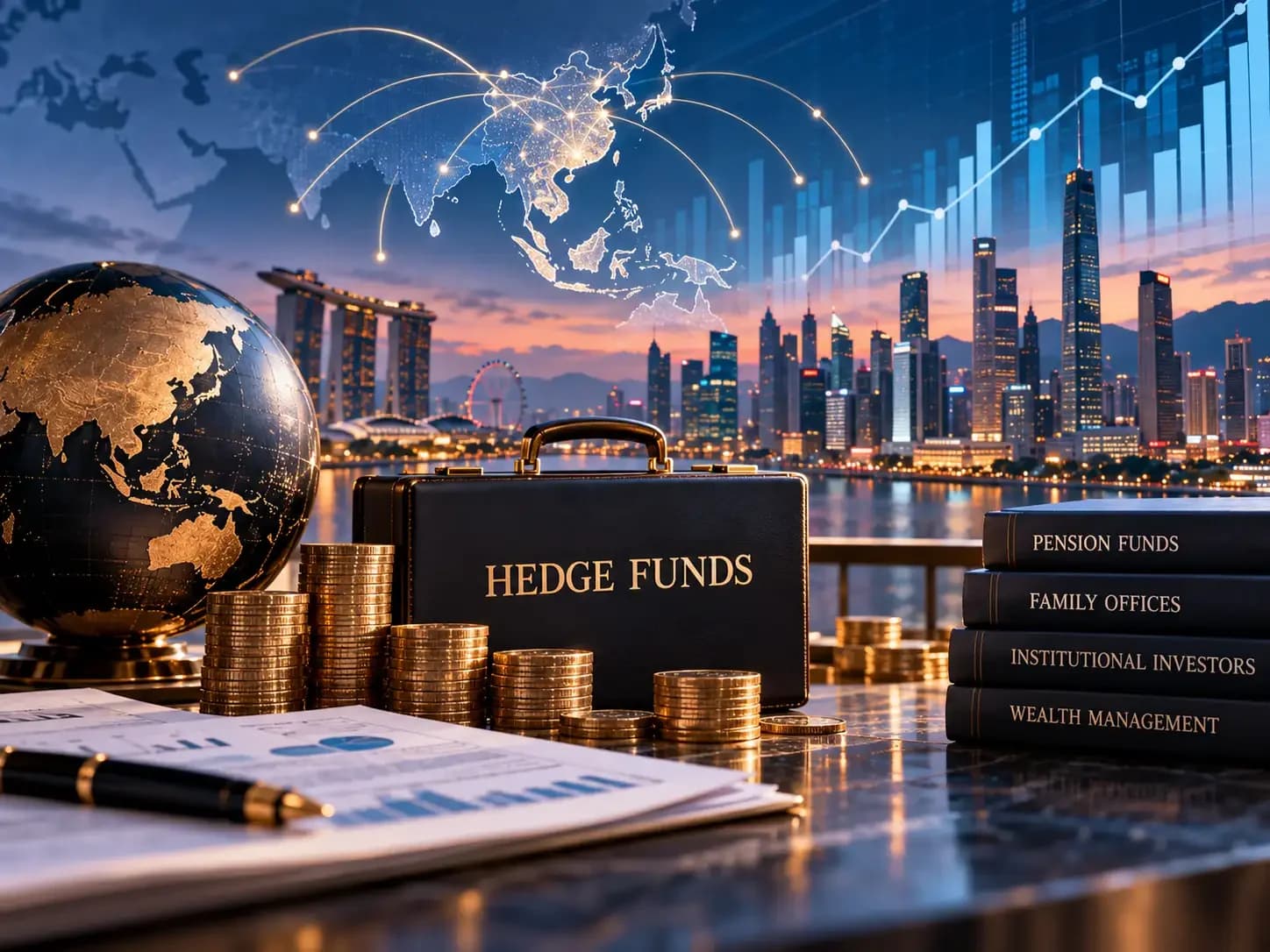
Asian investors are significantly increasing allocations to hedge funds as traditional investment strategies face scrutiny. According to reports from The Economic Times, global hedge fund assets increased by a record $409 billion in the second quarter of 2026, reaching $5.6 trillion. Swiss private bank UBP reported that the share of hedge-fund-only mandates among its Asia-based discretionary portfolio management clients had more than tripled since the end of 2024, though specific figures were not disclosed. This shift challenges traditional long-only investment managers whose performance has faced greater scrutiny during market turbulence.
Hedge fund returns have demonstrated resilience during challenging market conditions. As reported by The Economic Times, a global hedge fund index tracked by HFR gained 12.4% in 2025, marking its third consecutive annual increase and strongest performance since 2009. The index has risen a further 7% year to date. By comparison, global equities measured by the MSCI World Index have gained around 36% since the end of 2024, while the FTSE World Government Bond Index's total return measure has declined 7%. This performance gap has contributed to growing institutional interest in alternative strategies.
Major institutional investors are reassessing their allocation strategies as volatility in bond markets and concentration risks in equities drive demand for alternative investments. According to The Economic Times, Niall O'Sullivan, global chief investment officer at strategic adviser Marsh, reported that some institutional investors previously avoiding hedge funds were now considering allocations of around 10%, particularly to multi-strategy funds with low correlations to broader financial markets. Indonesia's sovereign investment platform Danantara Investment Management is targeting a 5% allocation to hedge funds, with senior director Rani Piputri citing objectives to achieve more stable returns while limiting losses during market downturns.
Investors are capitalizing on increasingly uneven market performance driven by artificial intelligence developments, geopolitical divisions, and regional economic disparities. As reported by The Economic Times, Daryl Ho, senior investment strategist at DBS Bank, highlighted the divergence between semiconductor and software stocks, as well as US market outperformance relative to other regions. Growing dispersion between AI-related winners and losers, alongside geopolitical uncertainty, is also creating opportunities for long-short equity managers. Japanese pension funds, family offices and private wealth clients are among those increasing their interest in hedge fund strategies.
Multi-strategy, macroeconomic, and quantitative funds are gaining particular traction among Asian investors. According to The Economic Times, Acadian Asset Management, which oversees $233 billion in assets, has recorded a fourfold increase in Asian assets over the past four years. The firm analyzes data on tens of thousands of companies and runs strategies designed for modest but consistent outperformance relative to equity benchmarks. Chief Executive Officer Kelly Young said investor interest was at its highest level in two decades, with demand particularly strong for managers offering low correlations to traditional markets.