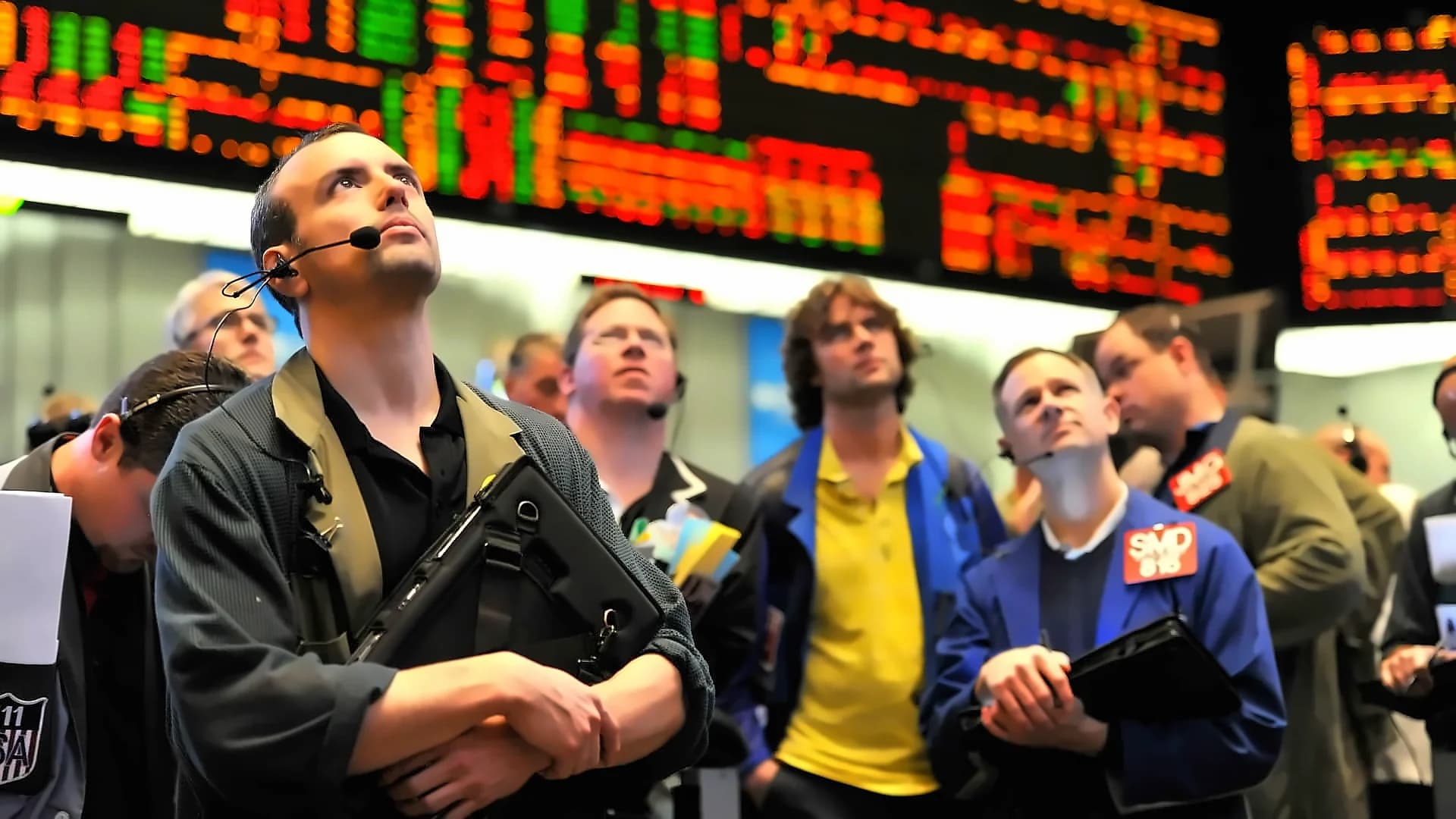
The AI trade is experiencing a fundamental shift as investors question whether core businesses can sustain the massive capital expenditure required for artificial intelligence development. According to market analysis from Investing.com India, the technology selloff continued Monday with Japan, South Korea and Australia all softer from the opening bell, while the Nasdaq 100 dropped 3.5% on Friday and the Philadelphia Semiconductor Index fell 7.2%. Intel suffered one of the ugliest one-day moves in its history, and the VIX finally showed some teeth as the market moved from rewarding AI existence to demanding justification for every dollar spent. As reported by BlackRock's Jeffrey Rosenberg, a 12% down day in Google is "not even on the chart" historically, moving into a different world of market pricing and volatility. The AI boom has been "incredibly positive," but investors are now experiencing the balance with AI pessimism, with the market equating AI trade weakness as broader U.S. economic weakness.
The AI selloff could provide significant relief for the Federal Reserve's inflation fight, according to BMO Capital Markets senior economist Jennifer Lee. Speaking on Bloomberg This Weekend on November 1, Lee explained that hyperscalers' massive demand for corporate debt has been one of the key factors driving interest rates higher. The building spree for data centers has drawn land, skilled workers and materials away from other sectors, adding to inflation and keeping it stickier for longer. "If they're pulling back a little bit, it shows that there could be some cool down in this," Lee noted, suggesting that reduced AI construction demand would actually help the Fed bring inflation down. Last week, the Nasdaq-100 entered its third correction of 2026, while the S&P 500 fell 1.8% on Friday, as reported by BMO.
Despite the significant selloff, market experts are still waiting for the definitive capitulation signal that would mark a tech bottom. Jim Cramer on CNBC's Mad Money noted that the question of whether tech is cheap enough has circulated for three months, but the missing signal remains a crescendo - a day that opens weak and closes strong on heavy volume, indicating sellers have capitulated. On November 2, the Nasdaq 100 fell 4.1% with no such reversal, bringing despair without the telltale capitulation. Cramer calls this pattern a crescendo, referencing discussions with the late CNBC anchor Mark Haines. Oracle fell almost 9% on November 2 after announcing a $20 billion debt and stock sale, while AMD dropped 7.5% and Marvell Technology fell 13% after agreeing to an all-stock deal. Still, Cramer allowed that the correction itself may have set the low, with buyers potentially accepting tech names that avoid heavy debt or equity issuance.
The AI trade's retracement is creating significant implications for bond markets, with bond yields declining as the market equates AI weakness as broader U.S. economic weakness. According to BlackRock's Jeffrey Rosenberg, the AI trade itself is a very big piece of the bond market, and this showed up dramatically over the past week with Microsoft coming back into the public bond market after being absent for close to a decade. The public bond markets are coming to terms with an expected flood of issuance as tech giants' capex needs overwhelm free cash flow more regularly. While Rosenberg notes that a $40 trillion to $60 trillion global bond market can absorb an expected $4 trillion in AI debt over the next four years, the market is not unlimited in capacity, leading to lower prices and higher spreads. Microsoft's deal was oversubscribed, but spreads on Microsoft credit default swaps are currently trading near a five-year high of roughly 55, compared to Oracle CDS spreads closer to 300, presenting trading opportunities for investors. As Investing.com reports, credit default swap spreads were constantly quoted in the financial press, even before outright post-earnings crashes in stocks like Alphabet and Intel.
The Q3 GDP report showed AI-related growth across multiple sectors, with business investment of 12.7% representing the biggest increase outside the pandemic since 2011, led by a 37% rise in information processing equipment. Industrial equipment investment rose nearly 25%, partially reflecting spending on data centers. As reported by BlackRock's Jeffrey Rosenberg, AI is everything, everywhere, all the time, with both investment side growth and consumption well above expectations fueled by the AI wealth effect. However, the capex story is not just robust but broadening, making it harder to argue that strength is only in narrow AI pockets. Despite this AI-driven growth, Rosenberg remains cautious about bonds as a safe hedge, noting that oil price increases and persistent inflation above target continue to challenge fixed-income assets, limiting the efficacy of bonds as a hedge. This week's payroll report and earnings from Apple, AMD and Qualcomm will test whether the AI cooldown holds.
With Q3 numbers in hand, the upcoming conference season becomes crucial for setting market direction. CEOs have just weeks to properly set the tone before the sell side litters the street with its 2027 outlooks, with multiple high-profile events scheduled. Key conferences include Microsoft Ignite on November 17, NVIDIA earnings, and Anthropic's IPO potentially before Thanksgiving. As Investing.com reports, the November-December conference stack is loaded with over 100 major conferences across sectors including technology, healthcare, consumer discretionary, and financial services. Capex trends and consumer health are the key themes to watch, as hyperscaler debt financing could pressure rates and negative real income trends raise the risk of a holiday spending pullback. The consumer faces a higher cost of living and wage gains that simply don't keep up with inflation, with gas prices dipping but at a seemingly slow pace. Consumer company and bank leaders' commentary at investor conferences will be particularly revealing ahead of the holidays, providing crucial insights into whether the AI correction has fundamentally shifted market dynamics or represents a temporary correction in the broader AI investment cycle.