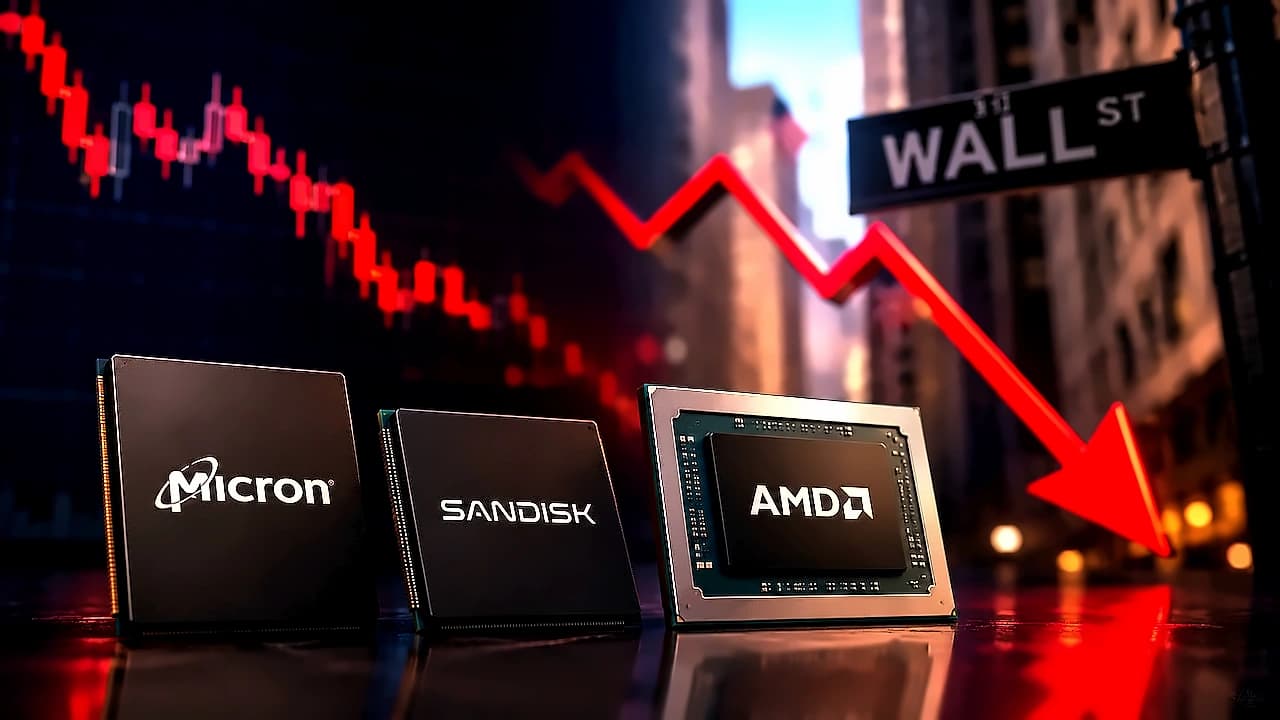
Micron Technology (NASDAQ: MU) closed at $823 per share on Friday, July 31, down 5.90% on the day and as much as 39% below its high this year. The memory giant's dramatic decline has rattled the entire semiconductor sector, with SanDisk falling 41% in the past month and the Philadelphia Stock Exchange Semiconductor Index (SOX) plunging 21% in July for its worst month since October 2008. According to UBS's Mark Haefele, this week's chip weakness stems from fragile investor sentiment ahead of hyperscaler earnings, layered on ongoing CXMT competition overhang and rotation out of crowded AI trades. The memory group's recent fundamentals have been blowout, but today's decline is momentum-driven rather than fundamentally driven. Polymarket's intraday market gives Micron stock a 60% probability of closing down today, with traders clustering conviction around $840 for the week with 95% probability, implying further downside room.
SK Hynix and Samsung's plan to spend up to $1.3 trillion combined on new capacity is adding pressure to US chipmakers, just as the sector faces unprecedented demand-supply imbalances. South Korean officials have tied the expansion to a national plan to secure the country's position in AI-era chip supply. Reports on the combined Samsung and SK Hynix investment have ranged from $575 billion to $1.3 trillion, reflecting how quickly spending plans have escalated this year. Demand for high bandwidth memory used in AI accelerators has outpaced supply for more than a year, a shortage that Micron's own management does not expect to ease before 2028. That squeeze helped push SK Hynix stock down 13% on capex concerns even as Samsung posted an 1,800% profit jump last quarter, and it is also fueling the rise of Chinese challenger CXMT, whose stock has kept climbing since its IPO.
The semiconductor selloff has been unprecedented in its magnitude and frequency. The SOX's realized volatility over the last 60 days has soared to its highest reading since the start of the Covid pandemic, with nearly half of trading days seeing the index close up or down by at least 4%. All 22 sessions had intraday swings of at least 2%, something that hasn't happened since 2020. The July selloff erased $2.2 trillion from the SOX's market capitalization, with particular losers including Taiwan Semiconductor Manufacturing Co. falling 15% in July, erasing more than $380 billion in market value. Micron Technology suffered a 29% drop, its steepest monthly decline in more than a decade, erasing $374 billion in valuation. Intel Corp. sank 35% over the month, erasing about $247 billion, marking its biggest monthly drop since September 2000.
According to a recent Federal Reserve analysis, the AI infrastructure cycle is driving significant growth in the US economy. Current technology investment could add close to one percentage point to 2026 US GDP growth, concentrated among a handful of major technology firms. The Fed's estimate combines software, data centre, power, and computing investment, then adjusts for associated import increases. While software and computing equipment have driven the largest gains since 2025, much of the equipment is imported, so net exports offset part of the domestic investment boost. The analysis notes that gross investment is large, while the net GDP contribution is more uneven, reflecting import content and measurement limits rather than doubts about the cycle's strength.
The semiconductor sector faces growing skepticism about the sustainability of current AI spending levels. Charles Lemonides, chief investment officer at Valueworks, stated that the earnings explosion is just not sustainable, questioning whether margins can be sustained given their out-of-sync levels with historic norms. Some investors think the selloff has become so extreme that it has created a short-term dip buying opportunity, but longer-term prospects remain dicey. Micron trades at a forward price to earnings ratio near 19.8, with a market capitalization of about $930 billion, and Wall Street analysts rate the stock a strong buy, even as short-term technical indicators point toward a sell signal. The industry's growth outlook over the coming year remains rosy, with analysts calling for earnings to continue to balloon at firms like Nvidia Corp. and Broadcom, but the fundamental picture beyond that is coming into question. Micron's next earnings report, due September 29, will show whether US chipmakers can hold their pricing power as SK Hynix, Samsung, and CXMT race to close the capacity gap.