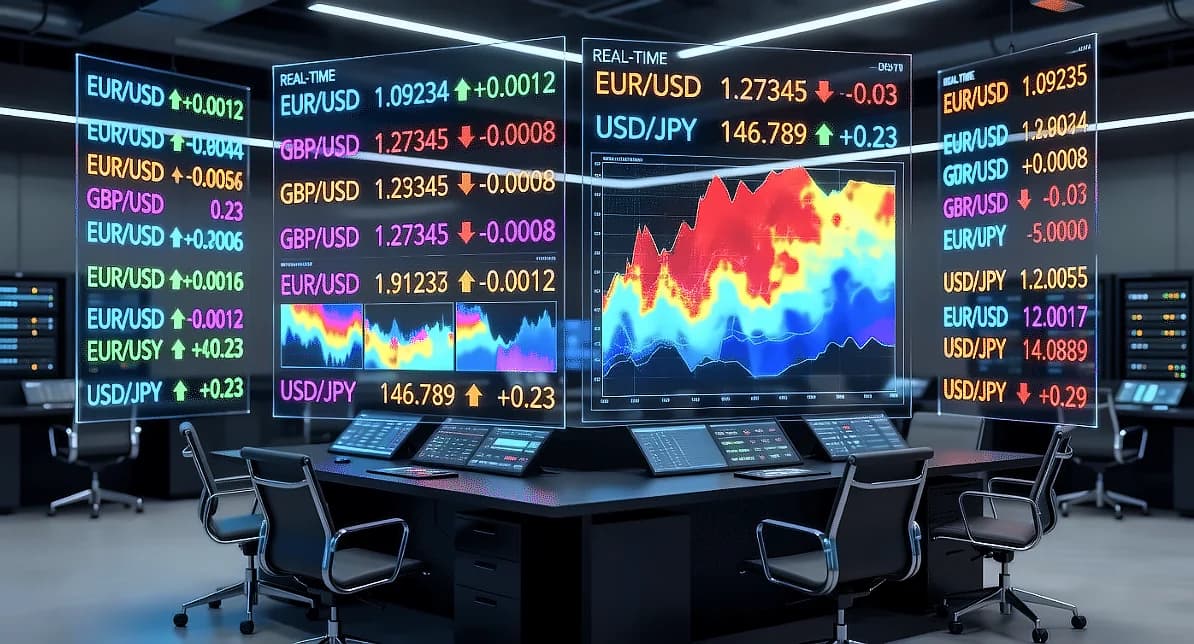
The cryptocurrency and forex trading markets have experienced significant growth, with global OTC foreign exchange turnover reaching $9.6 trillion per day in April 2025, representing a 28% increase from 2022 levels, according to the Bank for International Settlements. The U.S. dollar remained on one side of 89% of all FX trades, demonstrating how deeply connected forex is to global liquidity, risk management, and capital flows. This substantial market size explains why automation is becoming increasingly relevant for traders seeking to manage the complexity and speed of trading across both crypto and forex markets. Around 75% of Forex spot trading is already automated, establishing a baseline where human discretion is the exception, as reported by recent market analysis. However, as more traders enter the fray, the competition for execution speed has intensified, with algorithmic trading no longer the exclusive domain of high-frequency funds and institutional players, as sophisticated tools now accessible to anyone with a strategy and an internet connection.
According to comprehensive analysis by Traders Union, the automated trading landscape offers nine distinct solutions for 2026. Bybit Aurora AI leads as a fully managed AI trading automation tool with guided workflows and beginner-friendly setup, offering free access built into the Bybit platform with support for spot, futures, options, and crypto pairs. Cryptohopper provides comprehensive crypto trading capabilities with monthly pricing from $19 to $99, supporting spot, futures, options, and crypto pairs across 15 exchanges with customizable strategies and social trading features. 3Commas offers flexible pricing from $14.5 to $49.5 monthly with integration across 17 major exchanges, including Binance, Bybit, and Coinbase Pro. Other notable options include Pionex for free exchange-based automation, TradeSanta for rule-based grid and DCA strategies, and MetaTrader 5 Expert Advisors for experienced traders seeking custom forex robot capabilities. However, most retail algo trading platforms pass the backtest but fail the live market because they ignore the infrastructure layer, with success in 2026 depending on more than just strategy logic - it requires deep understanding of the hardware and execution environment that powers automated trading bots.
Leading AI trading agents have demonstrated exceptional performance metrics, with annualized returns exceeding 40% and profit factors above 4.0, meaning they generate over four dollars in profit for every dollar of loss. The ITA model delivered a profit factor of 4.4, generating $4.40 in profit for every dollar of loss, providing a verified benchmark for what automated systems can achieve in terms of consistency and efficiency. These performance standards are set by the most advanced AI agents and represent verified results from recent performance snapshots, establishing clear metrics for evaluating any trading system's ability to generate alpha and manage risk at scale. However, traders should remember that AI crypto trading bots are most effective when treated as execution assistants rather than profit generators, with performance depending on strategy design, market environment, and user oversight rather than autonomous decision-making capabilities. Hardware-level latency can be the silent killer of profitable strategies, with platforms like NinjaTrader and Sierra Chart highly dependent on single-core performance to handle live tick feeds and order calculations, making AMD Ryzen 9 9950X processors with clock speeds up to 5.7GHz essential for optimal execution.
AI trading bots should prioritize transparency and safety over complexity, with key requirements including clear trading logic that explains when the bot enters, exits, or stops trading, safe testing spaces through demo trading and backtesting, real risk control with stop-loss settings, position size limits, and maximum drawdown controls, and reliable execution with clear spreads, slippage, and execution rules. The analysis emphasizes that beginners should start small, test first, and avoid any bot or strategy that promises fixed daily profits, treating AI as a tool to execute tested strategies rather than a guaranteed money-making machine. For flow traders, the Sharpe Ratio should be optimized to balance return against volatility, forcing disciplined risk management approach. Safety depends more on setup and platform choice than on the bot itself, with bots that operate within exchanges or use restricted API permissions reducing exposure to unauthorized actions. Users should always avoid granting withdrawal access, monitor bot activity regularly, and understand how strategies behave under stress. 24/7 VPS compatibility is non-negotiable for your strategies to capitalize on global market moves while you sleep, with Chicago VPS hubs delivering verifiable 0.82ms average latency ensuring orders hit the book before market moves.

AI trading bots are expected to evolve significantly in 2026 and beyond, with more no-code forex and crypto automation as users increasingly want to automate ideas without programming, more mobile-based bot control as mobile access becomes essential for risk monitoring and strategy adjustment, more hybrid human + AI workflows combining AI execution with human judgment, more focus on risk transparency as regulators scrutinize AI-related financial claims, and more strategy personalization with bots adapting to individual user goals, preferred trading sessions, and risk tolerance. The report concludes that the best AI trading bot depends on individual trading style, market knowledge, risk tolerance, and need for control rather than feature complexity, while monitoring specific signals including the share of automated vs. manual execution in major pairs and tracking the gap between backtested and live results for effective risk management. AI crypto trading bots are primarily used to improve execution efficiency and reduce the impact of human error, with automation offering practical advantages when applied correctly and monitored regularly, though they cannot eliminate market risk or guarantee profits. Platforms that provide beautiful interfaces but lag during high-volatility events are liabilities, with success in 2026 requiring deep understanding of the infrastructure that powers automated trading, including native C++ support for ultra-low latency setups, robust data management tools, and API reliability that can handle FOMC announcements and other market stress events.