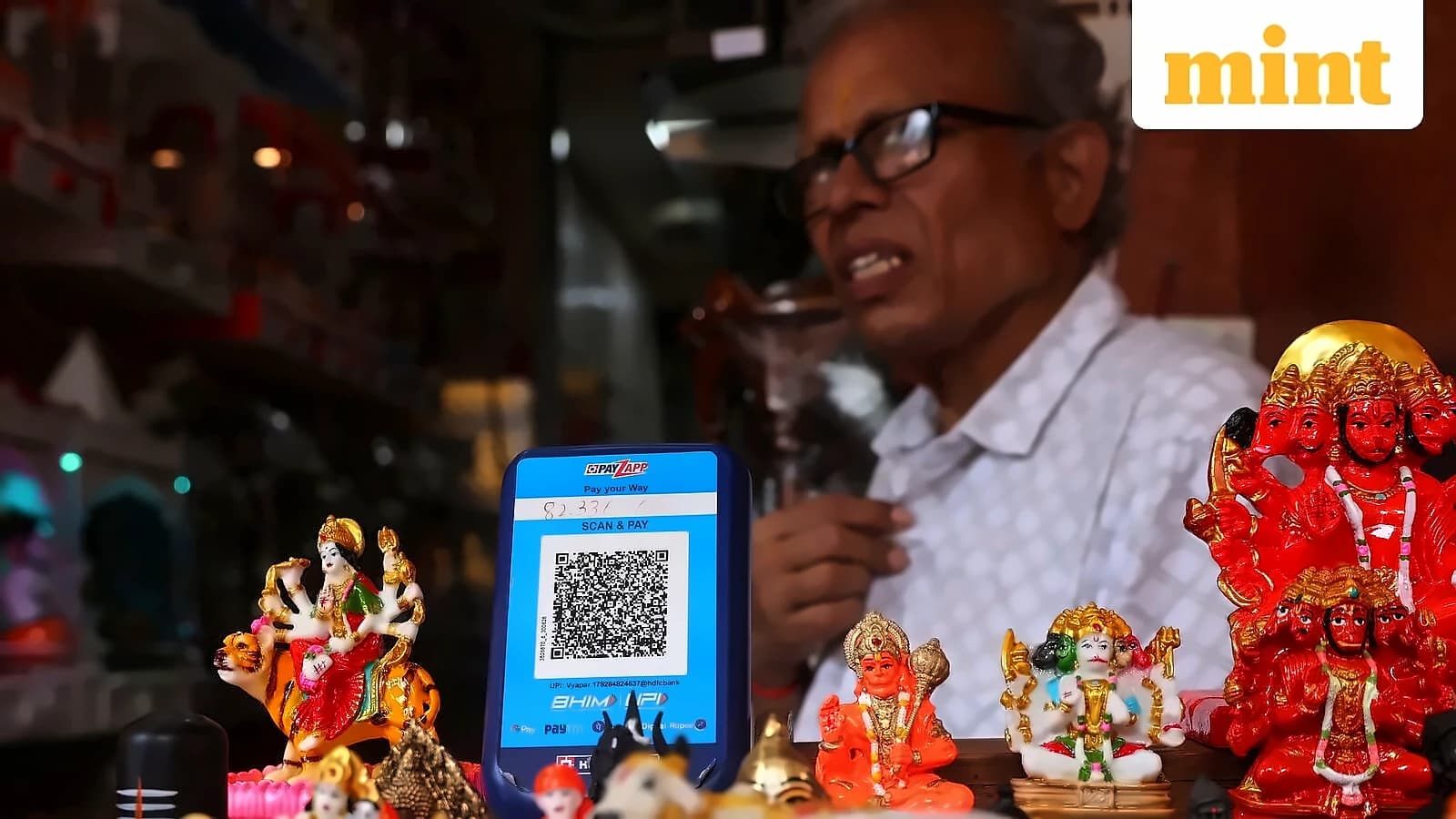
The Supreme Court on Monday refused to grant an interim stay on the Centre's decision to impose a 0.4% merchant discount rate (MDR) on specified Unified Payments Interface transactions exceeding ₹2,000. According to The Hindu BusinessLine, a three-judge Bench headed by Chief Justice of India Surya Kant issued formal notices to the Centre, RBI and NPCI, directing them to explain the legal basis for the new fee structure within four weeks. Justice Joymalya Bagchi questioned the executive authority under which the proposed recovery would be made, asking what the nature of the charge was if it was not a fee, and seeking clarity on the authority to impose it. CJI Surya Kant noted it was more of a technical issue, stating "It's more of a technical issue. Is it tax or a fee? If not a fee, what is the executive basis for making this expropriation? What is the service?" The petition was filed by advocate Anjan Datta against the Union Finance Ministry's September 14 and 15 notifications that paved the way for MDR charges on specified commercial UPI payments above ₹2,000. The new policy is set to take effect on October 15, 2026.
Following a high-level meeting with Finance Minister Nirmala Sitharaman, major retailer bodies have decided to call off the planned 'No UPI Day' protest scheduled for October 2, 2026. According to Mint, the All India Mobile Retailers Association (AIMRA) and the All India Consumer Products Distributors Federation (AICPDF) on Wednesday withdrew their proposed 'No UPI Day' protest planned for October 2, after a trade delegation met Union Finance Minister Nirmala Sitharaman. The delegation was led by BJP MP and CAIT secretary general Praveen Khandelwal and AIMRA founder chairman Kailash Lakhyani, who submitted a joint representation seeking deferment of the proposed MDR, phased implementation and changes in the threshold for its applicability. As reported by Mint, AIMRA had said the proposed MDR could put pressure on the "already thin" profit margins of micro, small and medium enterprises, shopkeepers and independent retailers that use digital payments for their daily transactions. "The trading community was encouraged by the dialogue and would continue to engage with the government on the issue," Khandelwal told reporters after the meeting, as reported by Zee News. The proposed October 2 protest has been called off, meaning customers should not assume that UPI payments will be unavailable at mobile retailers or other participating businesses.
Under the revised framework, general person-to-merchant UPI transactions above ₹2,000 will attract an MDR of 0.4%, subject to a cap of ₹300 for transactions of ₹75,000 and above. As reported by LiveLaw, UPI payments up to ₹2,000 and person-to-person transactions will remain free. According to an NPCI FAQ, this means a person will pay ₹12 for a ₹3,000 transaction. The framework also retains zero MDR for small merchants receiving up to ₹1 lakh a month through UPI QR codes into their bank accounts under the person-to-person merchant (P2PM) category. Certain essential and thin-margin sectors, including railways, telecommunications, insurance, fuel and agricultural inputs, will attract a flat MDR of ₹5 on transactions above ₹2,000, while capital market transactions will attract a lower MDR of 0.02%, capped at ₹300. The September 14 Finance Ministry notification protects specified electronic payments, including UPI transactions up to ₹2,000 and RuPay debit card payments, from direct or indirect charges. The Finance Ministry has said UPI will continue to remain completely free for all P2P transactions, irrespective of the amount, with the Ministry stating that about 70% of the total transaction value will remain completely outside the MDR framework and close to 96% of merchant transactions will remain free.

The trade delegation has submitted comprehensive recommendations to the Finance Minister for a more balanced approach to UPI MDR implementation. According to Mint, the delegation proposed that instead of an immediate 0.40% MDR, the charge be introduced at 0.20% in 2026-27 and increased by 0.05 percentage points annually until it reaches 0.40%. For example, if a merchant has a ₹20,000 UPI transaction, a 0.20% MDR would amount to ₹40, if the rate rises to 0.25% the following year, the charge would be ₹50, and at 0.30%, it would be ₹60. At the proposed 0.40% rate, the MDR on a ₹20,000 transaction would be ₹80. They have also proposed to re-evaluate the ₹1 lakh threshold limit and consider raising it to ₹5 lakh to align with real-world operational realities and transaction volumes of merchants. The delegation has requested that Merchant-to-Merchant (M2M) business transactions be exempted from MDR purview, highlighting their importance to the trading ecosystem and liquidity. They have also urged the government to constitute a dedicated special committee to examine industry concerns thoroughly and recommend a balanced way forward.
Additional Solicitor General N Venkataraman, appearing for the Centre, told the Supreme Court that 96% of transactions would remain exempt under the new framework, while MDR for essential services would be capped at ₹5. According to The Hindu BusinessLine, he emphasized that there was a value cap and stressed that the levy was neither a tax nor a government fee. The ASG explained that the charges would come into effect from October 15 and that the amount would be a settlement fee shared within the payment ecosystem between banks and payment aggregators. He maintained that the government would not receive any part of the charge and that it is not an expropriation. Mr. Venkataraman submitted that the charges would touch a "scarce, thin" population, stating "This [UPI MDR charges] is yet to come. It is likely to come on October 15. I have to say that 96 per cent of people using the gateway are exempted. Amongst the remaining 4 per cent, essential services are capped at ₹5. There is also a value cap - any threshold to the merchant beyond ₹75000 is capped at ₹300. Collection charges are less than half percent with all these limitations."** The Finance Ministry has advised banks to ensure that merchants do not pass the charge on to consumers, and UPI application providers have been prohibited from imposing platform fees or hidden charges on users under the framework. Despite the withdrawal of the protest, the proposed 0.4% fee on eligible merchant UPI transactions above ₹2,000 is scheduled to come into effect from October 15, as reported by Zee News. Traders' bodies said they remain hopeful that their concerns will be addressed before the new charge is implemented, as reported by Zee News.