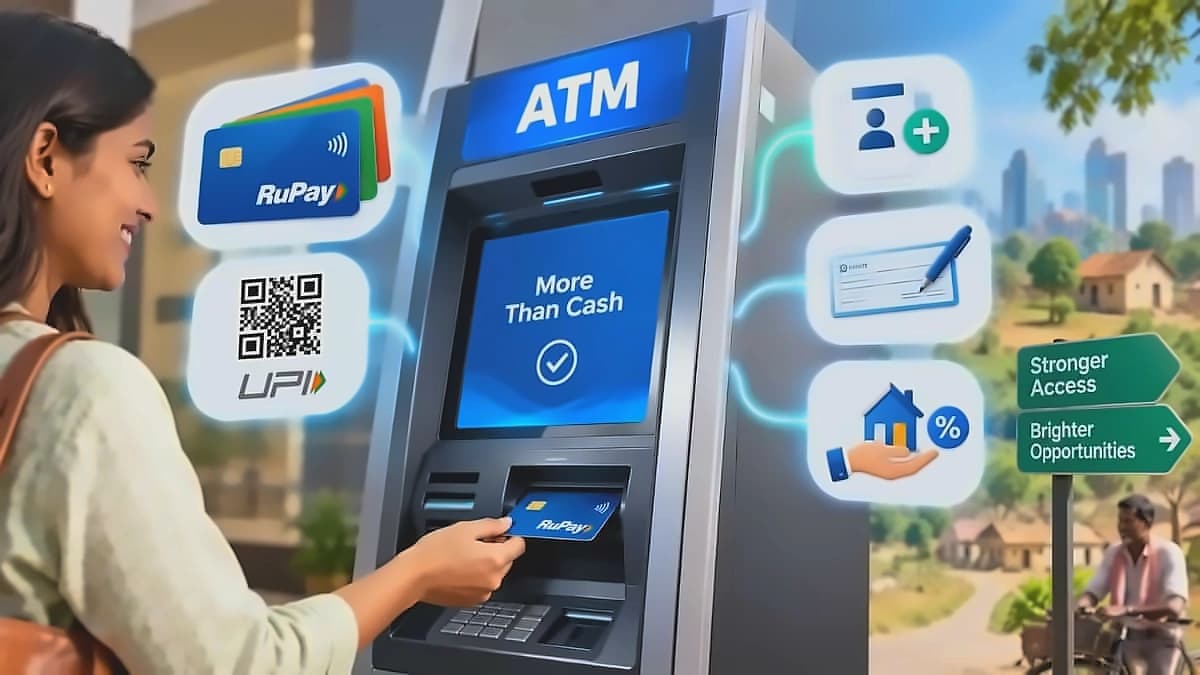
Automated Teller Machines are set to undergo a significant transformation, expanding beyond traditional cash dispensing to provide comprehensive banking services. According to reports from ZeeBiz, ATMs will soon dispense personalised RuPay debit cards within minutes and generate UPI QR codes instantly for merchants. This evolution represents a strategic shift by banks to offer banking services faster and more accessibly, particularly benefiting customers in semi-urban and rural areas where branch access is limited. The service is expected to make card issuance more convenient for customers and could be particularly useful in areas where access to branches is limited.
The proposed transformation extends beyond card issuance to include account opening, cheque deposits, and loan applications through ATMs. As reported by ZeeBiz, these services could make ATMs comprehensive points of access for customers, particularly outside major urban centres. The broader plan involves using ATMs as Digital Banking Units (DBUs), turning them into technology-enabled points where customers can access multiple banking services without depending entirely on physical branches. The shift reflects the changing role of banking infrastructure, with digital services increasingly being delivered through self-service channels.
Prime Minister Narendra Modi inaugurated the Global Fintech Fest (GFF) 2026 in Mumbai on Tuesday, September 8, highlighting India's economic growth and improved sovereign rating. According to reports from ZeeBiz, PM Modi noted that UPI completed 10 years on August 25, with India's UPI now operational in 11 countries. He emphasized that the next goal should be connecting with other countries' payment systems, citing the India-Singapore UPI network as an example of successful international integration. "Right about the time we sat in this venue, around 50,000 UPI transactions must've happened," he added, highlighting the platform's growing adoption.
At GFF 2026, the National Payments Corporation of India (NPCI) launched two AI platforms to streamline enterprise fintech operations. The AiNxt platform is an open-source, enterprise-grade agentic AI system designed to build, test, and deploy custom intelligent agents across integrated development environments. Additionally, AtOM (Agentic Orchestration & Messaging) is an AI-driven platform engineered to handle complex integration and change management across UPI systems. These initiatives aim to compress card and merchant QR onboarding times from weeks to minutes and automate workflows for enterprises through agentic AI technology.
A key objective of the ATM transformation is to improve banking access in semi-urban and rural areas. As reported by ZeeBiz, by adding more services to existing ATM infrastructure, banks can potentially provide customers with access to a wider range of products and services closer to where they live. The evolution of ATMs from simple cash dispensers to multi-service digital banking points could help bridge gaps in financial access while making routine banking transactions quicker and more convenient. This transformation is particularly significant for areas where banks often face difficulty in offering services to customers where branches are limited.
PM Modi emphasized that fintech and UPI have made financial services accessible in places where traditional banks could not reach. According to reports from ZeeBiz, he noted that PM SVANidhi has brought lakhs of street vendors into the formal financial system and helped them gain access to credit. The Prime Minister stressed the need for India to expand its UPI footprint to countries it does business with, calling UPI a civilisational story that requires further international integration. "In places where traditional banks or bank branches could not reach, fintech and UPI have made financial services accessible. Now, the scope needs to move beyond payments and expand further into credit, insurance and pensions," PM Modi said at GFF. He added that "several countries around the world are ready to work with India, and we need to bring them together and move ahead."