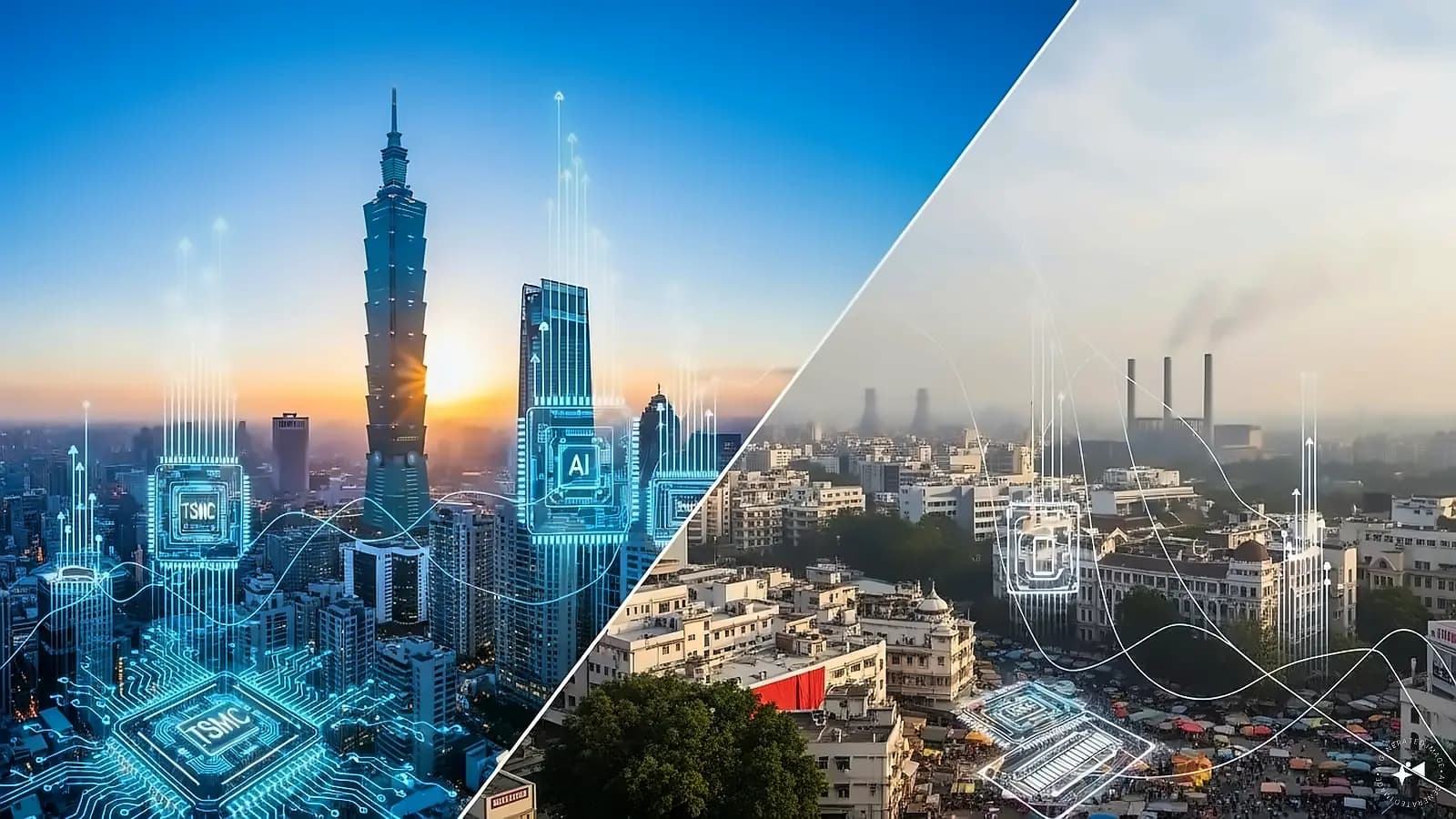
Taiwan has officially overtaken India in total market capitalisation after a dramatic rally in semiconductor and AI-linked technology stocks. According to Bloomberg data, Taiwan's equity market valuation climbed to $4.95 trillion, marginally ahead of India's $4.92 trillion market capitalisation. The surge has been driven largely by the global artificial intelligence trade, where Taiwan sits at the heart of the semiconductor supply chain through Taiwan Semiconductor Manufacturing Company (TSMC), the world's largest contract chipmaker. Taiwan's benchmark TAIEX index has surged 48% in 2026 so far, while TSMC itself has gained 43% year-to-date amid exploding demand for AI chips. The semiconductor industry forms the backbone of Taiwan's economy, accounting for nearly one-fifth of GDP, with TSMC producing over 90% of the globe's most advanced microchips. As reported by Investing.com India, this achievement is particularly striking given that Taiwan achieved this despite an economy roughly four times smaller than India's, highlighting the power of market structure and capital flows over relative economic size.
Despite India's higher ranking in market capitalisation, Taiwan has significantly outperformed Indian markets across multiple timeframes. According to Investing.com data as of May 29, 2026, the Nifty 50 has declined 6.48% over three months, 10.13% over six months, and 5.18% over one year, while Taiwan's TAIEX index has gained 23.22% over three months, 57.95% over six months, and 104.41% over one year. The performance gap is even more pronounced over longer periods, with ₹1 lakh invested in Taiwan's TAIEX growing to ₹2,04,410 over the past year, while the same investment in India's Nifty 50 would have fallen to ₹94,820. Over five years, ₹1 lakh in Taiwan's market would have risen to ₹2.59 lakh, compared to ₹1.53 lakh in India's Nifty 50. This stark performance differential raises questions about which market is better positioned for long-term sustainability.
Taiwan's ascent is overwhelmingly driven by TSMC, which now represents around 42% of the benchmark index and whose shares have rallied close to 46-49% year-to-date on the AI trade. According to Investing.com India, the market is estimated to be well over 80% exposed to AI-related revenue, making Taiwan the purest expression of the global AI hardware theme. TSMC sits at the chokepoint of the supply chain, with high-performance computing making up about 61% of wafer revenue and advanced nodes (7nm and below) around 74% in Q1 2026. The company reported Q1 2026 revenue of $35.9bn, up 35% year-on-year, with gross margin of 66.2%, beating guidance, and management raised full-year 2026 revenue guidance to above 30% growth. As Investing.com India notes, TSMC is a toll-booth that wins regardless of which chip designer prevails — Nvidia, Google, AMD or others all depend on it.
A significant shift in TSMC's valuation dynamics reveals the growing influence of local Taiwanese investors in driving the semiconductor giant's stock performance. According to Bloomberg data, TSMC's American depositary receipts traded at an average 13.7% premium to its Taipei-listed shares in May, down from 26% in December and marking the fifth straight month of decline. This reverses a trend that saw the chipmaker trade at significantly higher valuations among international investors during the early stages of the global AI rally. The shift has been driven by Taiwan-listed shares soaring more than 50% this year, outpacing the ADRs' less than 40% advance. Regulatory changes allowing local equity funds to increase exposure to domestic stocks have added fuel to the rally, while individual investors have poured into AI-related names, spurring a retail frenzy. As Vincent Fernando of Zero One Investment Research noted, "Taiwan local market sentiment has turned extremely positive about the AI cycle, much more so than the US over the last few months."
The Taiwan Stock Exchange is implementing significant reforms to enhance retail investor participation and market accessibility. As reported by The Hindu BusinessLine, exchange chairman Sherman Lin announced plans to optimize the odd-lot transactions mechanism, which caters to trades involving less than one standard unit of shares and is heavily used by individual investors. Key reforms under consideration include moving the start time of odd-lot trades ten minutes earlier to 9 a.m. to match regular trading hours, and shortening the current five-second order matching cycle. The exchange is also discussing with brokerages to extend regular trading hours from the current 9 a.m. to 1:30 p.m., though Lin acknowledged that implementation may take more time due to the complex nature of the process. Lin emphasized that "Our goal is to complete odd-lot trading reforms by year-end through actively working with securities firms," noting that retail investors play a crucial role in Taiwan's market.
While Taiwan's market capitalisation has surpassed India's, experts highlight significant structural differences that affect long-term risk profiles. SEBI Chairman Tuhin Kanta Pandey noted that "India is a very, very diversified market. In Taiwan, there are concentrated stocks, there are very few," as reported by Mint. Vaibhav Porwal of Dezerv explained that "Indices once designed as diversified gateways to developing-world consumption and GDP growth have, over time, drifted into concentrated thematic vehicles. The MSCI EM Index now reads largely as a technology proxy, and within it, Taiwan functions as a near-pure AI play." This means that if you invest ₹1 lakh in Taiwan's index, nearly 42% gets allocated to TSMC alone, representing around ₹42,000 in a single company. In contrast, if you invest ₹1 lakh in India's Nifty 50, only 10.73% goes to HDFC Bank, with the remaining distributed across multiple stocks. Porwal emphasized that "India offers the more forgiving structure for investors seeking to compound through multiple cycles without depending on any one industry," noting that "concentrated thematic plays, by design, are fragile."

Despite the current market cap ranking, India maintains significant structural advantages that position it better for long-term growth. As reported by Mint, India's real advantage lies in its connection to real economic growth rather than a single technological narrative. The residual 65% of the Nifty 50 is distributed across consumption, IT services, energy, capital goods, healthcare, autos, materials, telecom, and utilities, with no single stock dominating the index in the 40%+ range. India also benefits from a vibrant mid and small-cap universe of hundreds of companies between ₹3,000 crore and ₹30,000 crore in market capitalisation, which Taiwan lacks. According to Porwal, "The current cycle is structurally different: supported by domestic inflows that buffer foreign capital flight, by manufacturing diversification, and by the continued expansion of digital infrastructure." Despite foreign investor outflows of roughly $21bn over two months, experts believe India's growth story and market structure continue to be its biggest strengths for long-term investors seeking diversified exposure across multiple sectors and cycles.