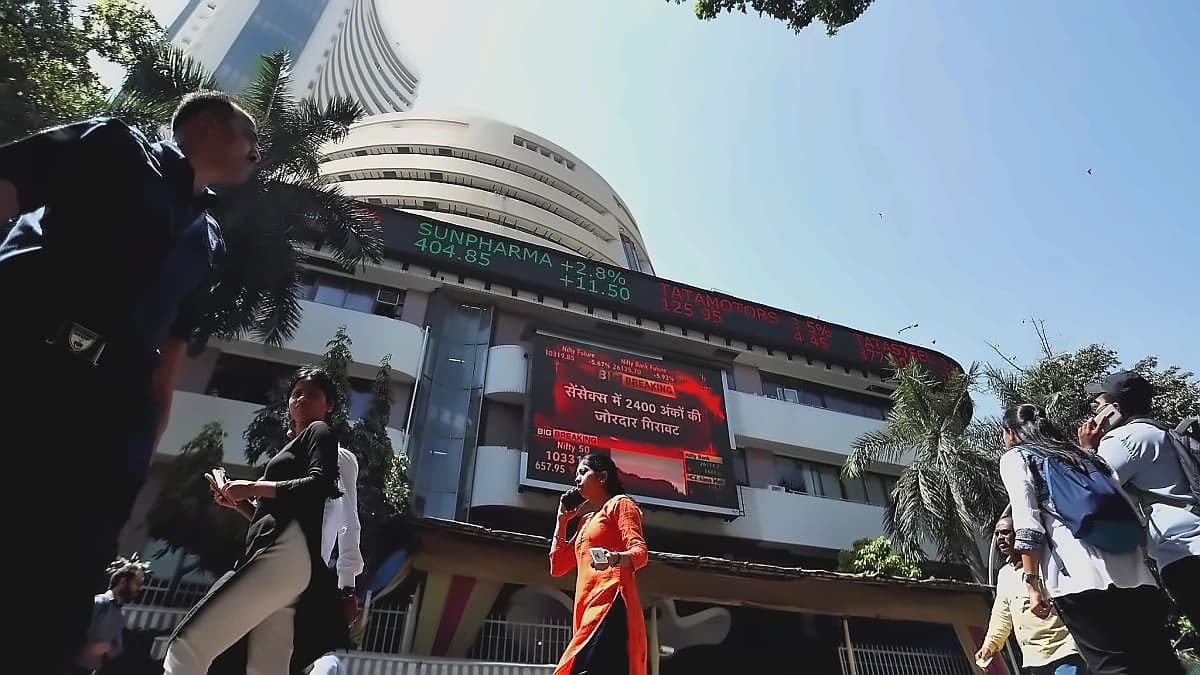
The recent stock market crash has resulted in investors losing a massive ₹16.77 lakh crore of wealth over four trading sessions. According to reports from The Times of India, the combined market valuation of companies listed on the BSE fell by this amount during the period, taking the total market capitalisation down to ₹4,56,02,981.70 crore ($4.77 trillion). The benchmark BSE Sensex plunged 1,456.04 points, or 1.92%, to close at 74,559.24 on Tuesday, while over the last four trading days, the index has dropped 3,399.28 points, translating into a decline of 4.36%. On Tuesday alone, investor wealth worth ₹10.95 trillion was wiped out in a single day as selling pressure hammered BSE-listed companies.

The sustained market decline has been attributed to multiple adverse factors weighing on investor confidence. As reported by The Times of India, uncertainty surrounding the stalled US-Iran talks, continued disruption around the Strait of Hormuz that pushed energy prices sharply higher, the rupee touching fresh record lows, ongoing foreign institutional investor selling, and weakness across sectors such as IT and real estate collectively triggered a broad-based market sell-off. Brent crude, the global benchmark for oil prices, was trading nearly 3% higher at $107.4 per barrel, adding to market pressures. The West Asia war, which began on 28 February, has lifted crude 44% to $104 a barrel as of 11 May, with Brent crude oil rising nearly 2% to $106.3 per barrel on Tuesday.
Market breadth remained weak on Tuesday, with 3,412 stocks declining on the BSE, while 869 advanced and 129 remained unchanged. According to The Times of India, among the Sensex constituents, major losers included Tech Mahindra, Adani Ports and Special Economic Zone, HCL Technologies, Tata Consultancy Services, Titan Company and Bharat Electronics. State Bank of India emerged as the only gainer among Sensex stocks. In the broader market, the BSE MidCap Select index tumbled 2.92%, while the SmallCap Select index declined 2.73%. The selloff intensified across the broader market as the Nifty Midcap 100 and Nifty Smallcap 250 fell 2.5% and 2% respectively. Among the biggest drags on the Nifty 50 were Adani Ports and Special Economic Zone and Shriram Finance, both of which slipped 4.3%, followed by IT stocks with Tech Mahindra falling 4.2% and HCL Technologies at 4%.
The pressure is visible in the currency markets, with the rupee depreciating 4.75% to 95.31 against the US dollar since 28 February, and on Tuesday, the rupee further depreciated 35 paise to close at an all-time low of 95.6. The rout also pushed up the India VIX—widely regarded as the market's 'fear gauge'—5% to 19.46, signalling a sharp rise in expectations of heightened volatility ahead. Levels between 15 and 20 typically signal elevated caution. Tuesday's decline was exacerbated by weekly Nifty derivatives expiry-related positioning and long unwinding in the options segment, with provisional FPI selling figures showing net outflows of ₹1,959.39 crore, while DIIs were net buyers with purchases worth ₹7,990.32 crore.
According to Hitesh Tailor, Technical Research Analyst at Choice Equity Broking Private Limited, the near-term outlook remains bearish to cautious, as sustained selling pressure and weak sentiment continue to dominate market direction. As reported by The Times of India, Hariprasad K, Research Analyst and founder of Livelong Wealth, noted that the current correction does not resemble a routine phase of profit booking, with investors increasingly viewing recent policy messaging and calls for austerity as signs that authorities may be preparing for a more challenging macroeconomic environment. Siddhartha Khemka from Motilal Oswal Financial Services Ltd emphasized that unless there is meaningful progress in negotiations or signs of de-escalation in the West Asia conflict, volatility and weakness in domestic equities are likely to persist. Ponmudi R., CEO of online trading firm Enrich Money, said the 23,300-23,150 region is now a crucial immediate support area for Nifty 50, with a decisive close below this band potentially extending weakness toward the 23,000 mark.