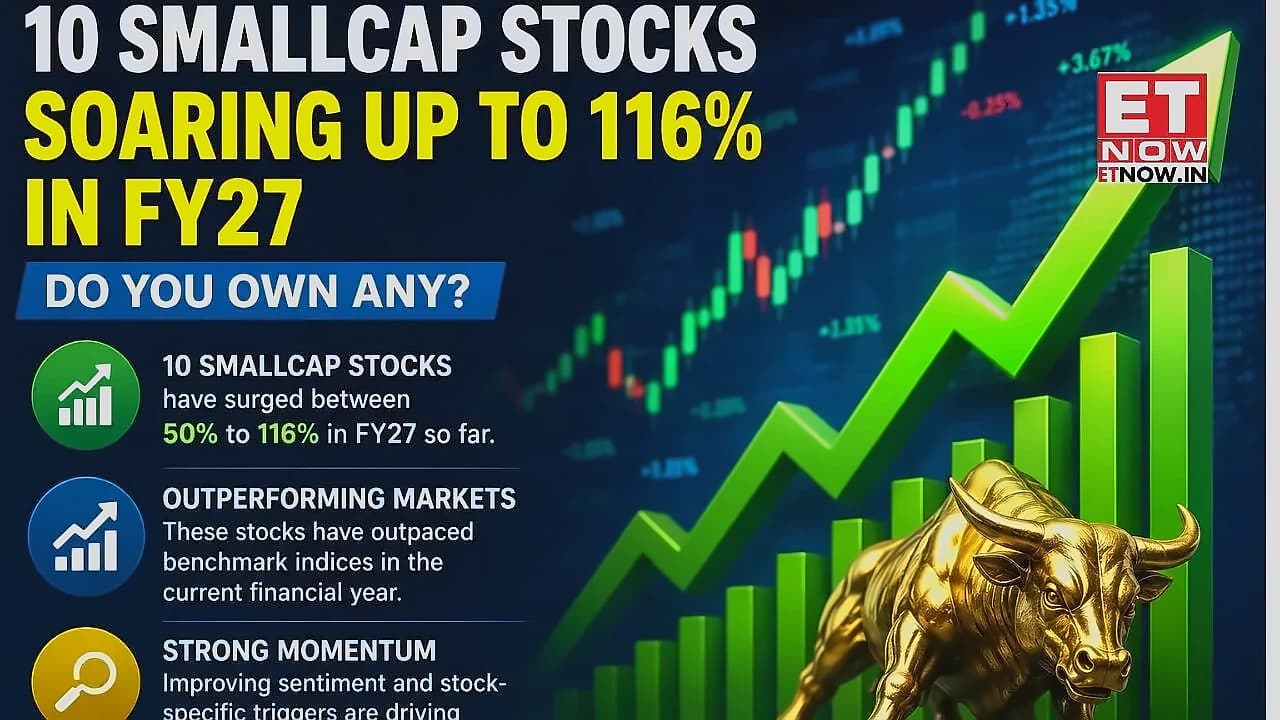
India's equity market has experienced a stark divergence as the Iran war crosses the two-month mark. According to The Economic Times, the Nifty50 has shed nearly 5%, losing around 1,200 points as crude prices surge above the $100-level and the Strait of Hormuz standoff rattles the macro outlook. In contrast, the Nifty Smallcap 250 has climbed 5.4% over the same period, representing a stunning decoupling that suggests domestic retail investors are betting the geopolitical storm will pass before it hits earnings. As ETMarkets.com reports, this divergence occurs despite the Middle East conflict remaining in limbo with an agreement to open the Strait of Hormuz remaining elusive, despite cessation in hostilities.
Leading the smallcap rally, HFCL has surged 56% since the war began, as reported by The Economic Times. Gallant Ispat is up over 51%, while Welspun Corp, Ola Electric, Cohance Lifesciences, Aditya Infotec, Angel One, Onesource Specialty Pharma and Emmvee Photovoltaic Power have each gained between 35% and 47% in the same window. In the midcap space, Lloyds Metals & Energy, Premier Energies, OFSS, Suzlon Energy, Thermax, NTPC Green Energy, BHEL, Groww and BSE are all up at least 30%. According to ETMarkets.com, the euphoria is being driven by domestic retail flows and easy liquidity, keeping the smallcap party alive despite institutional warnings.

Despite the smallcap euphoria, institutional desks are sounding cautionary notes. According to The Economic Times, Emkay Global's head of research Seshadri Sen warned that the market has "lost its valuation support, trading near long-term average at 19x." JP Morgan has downgraded Indian equities to Neutral, citing elevated valuations, earnings risk, dilution pressures and limited exposure to next-generation technology. The bank's year-end targets for the Nifty 50 now stand at 30,000 for the bull case, 27,000 for the base case and 20,500 for the bear case. As ETMarkets.com reports, Nuvama's strategists warn that mid and smallcap valuations remain more than one standard deviation above historical averages across metrics, with the sharp earnings rebound the market is pricing — a 22% profit CAGR for FY26–28, against just 12% in the prior two years — unlikely to materialise.
Brokerages are expressing concerns about the sustainability of the current rally. As reported by The Economic Times, Nuvama warns that mid and smallcap valuations remain more than one standard deviation above historical averages across metrics. The brokerage notes that the sharp earnings rebound the market is pricing — a 22% profit CAGR for FY26–28, against just 12% in the prior two years — is unlikely to materialise. HSBC strategists expect consensus forecasts, currently pricing in 16% year-on-year earnings growth for 2026, to be revised down in the coming months. According to ETMarkets.com, JP Morgan's sector analysts have already cut FY27 earnings estimates by 2–10% across key sectors, with the bank noting that India's premium to the MSCI Emerging Markets index has compressed to 65% from a peak of 109%.
The geopolitical tensions are creating immediate economic pressures. According to The Economic Times, Brent crude hovering near $100 per barrel means a 10% hike in retail petrol and diesel prices is now likely absent a breakthrough on the Hormuz impasse. As ETMarkets.com reports, Emkay's head of research Seshadri Sen notes that the first quarter of FY27 is already off to a weak start, with roughly 7% of Emkay's coverage universe missing forecasts so far. The brokerage warns that household, corporate and government incomes are all under pressure, capex is being pruned, and credit recovery is being led by gold and MSPE loans — substitutes for weak income and not increasing activity. With crude above $100 and potential fuel price hikes on the horizon, the divergence between smallcap exuberance and large-cap reality is unlikely to hold indefinitely.