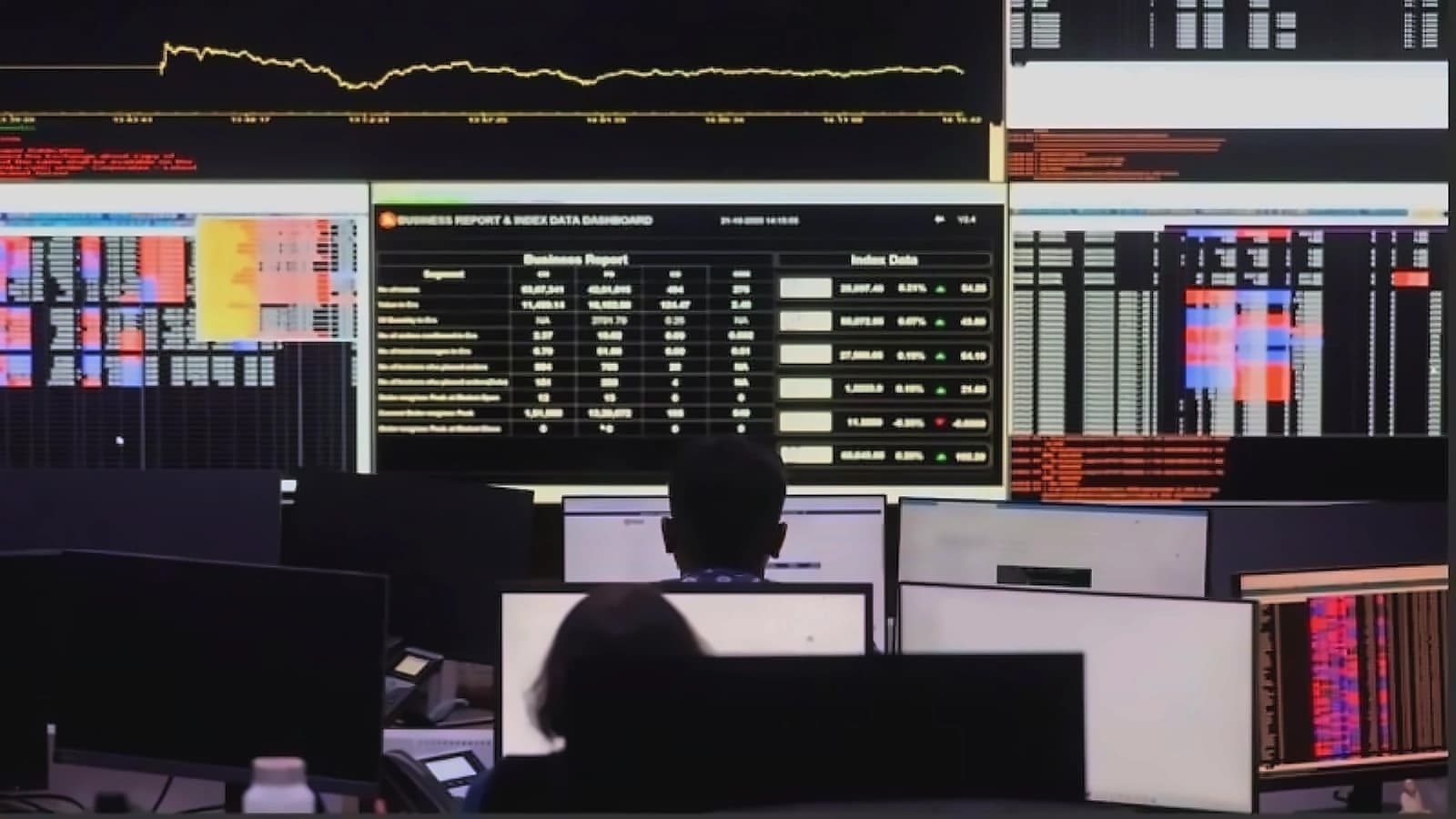
Benchmark indices Sensex and Nifty 50 rebounded on Thursday after Wednesday's decline, supported by gains in information technology, auto and private banking stocks. According to latest market updates, the Sensex surged 1,534 points (over 2%) to close at 74,315.61, while the Nifty 50 soared 374.65 points to settle at 22,997.35, reclaiming the psychologically important 23,000 mark. The Nifty opened at 22,671.30 against a previous close of 22,622.70 and the Sensex opened at 72,965.80 against Wednesday's close of 72,781.89. As of the close, both benchmarks were trading close to their intraday highs, with the Sensex up 1,533.72 points, or 2.11%, at 74,315.61, and the Nifty 50 gaining 374.65 points, or 1.66%, to trade at 22,997.35. The rally gathered momentum during the session, with the Sensex rising more than 1,200 points and the Nifty50 crossing the 22,900 mark in afternoon trade. The latest data shows the Sensex has now zoomed 1,400 points intraday, significantly exceeding earlier projections. Vinod Nair, Head of Research at Geojit Investments Limited, attributed the domestic market's strength to better technology earnings, currency stability and easing bond yields, noting that "Indian equities advanced as stronger-than-expected technology earnings boosted confidence in corporate profit growth and lifted benchmark-heavy large-cap stocks."
Sectorally, the Nifty IT index led the gains, rising 2.26% to 30,851.45, extending its winning streak to the third straight session. As reported by The Hindu BusinessLine, Nifty IT was the best-performing sectoral index, while Nifty PSU Bank was the worst. The Nifty's advance-decline ratio stood at 45:5, with 1,739 stocks advancing and 2,412 declining, of the 4,386 stocks traded on the BSE. Among Sensex constituents, Tech Mahindra led the Nifty 50 gainers, surging 4.75% to ₹1,650, followed by ICICI Bank climbing 3.17% to ₹1,381.00, Reliance Industries gaining 3.07% to ₹1,210.70, Bharti Airtel adding 3.98% to ₹1,866.00, and HCL Technologies rising 3.10% to ₹1,368.10. Tech Mahindra shares gained as much as 4% to touch an intraday high of ₹1,637.50 ahead of the firm's September quarter earnings, with experts expecting net profit to rise 28-32% YoY to between ₹1,530-1,580 crore. Trent, Bharat Electronics, Power Grid Corporation of India and Titan were the only stocks trading in the red, with Trent dropping 1.63% to ₹2,922.50 being the steepest decline on the Nifty 50. Information technology shares outperformed the broader market, with Tech Mahindra, Tata Consultancy Services (TCS) and Tata Consumer Products among the leading Nifty50 gainers during the session. The Nifty MidCap index gained 0.27% in afternoon trade, whereas the Nifty SmallCap index fell 0.66%, suggesting that the rally was concentrated in select stocks and sectors. On the sectoral front, auto, IT, Infra, Oil & Gas, Private Bank and Realty up more than 1-1.8%, while Media and PSU Bank indices down over 1% each. Top gainers included Tech Mahindra, TCS, Reliance Industries, Bharti Airtel, and HCL Technologies, while FMCG and retail names like Nestle and Trent saw sharp selling.

The banking sector showed mixed performance with Bank Nifty rising 494.50 points or 0.89% to 55,810.50, while individual banking stocks faced significant pressure. Yes Bank plunged 14.53% after the Supreme Court upheld the Bombay High Court's decision to cancel the ₹8,415 crore write-off of its AT1 bonds, creating a potential financial liability for the lender. As reported by The Hindu BusinessLine, Goel warned the ruling "weakens the entire framework that allows distressed banks to be rescued without taxpayer money...every future bank restructuring just got more complicated." Separately, IDBI Bank fell over 7% after the government approved the sale of its 60.72% stake to Fairfax Financial Holdings for ₹52,878 crore at ₹81 per share, a price well below the stock's previous close. Canara Bank shed 6.12% as PSU banks broadly declined 1.55% on AT1 bond risk concerns. Sarvam Goel, Founder of Pocketful, noted that "Thursday's Nifty number is misleading. The real story is in what it hides...advances came in at 1,343, declines at 2,218...this was not a rally. It was a rotation."
Gains in heavyweight stocks Reliance Industries and Bharti Airtel contributed significantly to the rally, amid renewed attention on India's telecom and digital services sector following Jio Platforms' filing of its Red Herring Prospectus (RHP) for its proposed initial public offering (IPO). The Jio Platforms IPO will open for subscription on Wednesday, October 21, and close on Friday, October 23, 2026, with shares scheduled to list on October 28. Jio Platforms has set a price band of ₹1,065– ₹1,119 per equity share and expects to raise ₹28,755 crore to ₹30,213 crore. The fresh issue could raise up to ₹30,213 crore, with a reservation of up to ₹2,500 crore for eligible Reliance Industries shareholders. The IPO comprises a fresh issue of up to 27 crore equity shares, with no offer-for-sale component, and existing shareholders will not sell their holdings through the offering. Even at its revised size, the issue is positioned to surpass Hyundai Motor India's ₹27,870 crore IPO in 2024, potentially making it India's largest-ever public issue in rupee terms. Sentiment turned positive after Jio Platforms announced dates for the country's biggest share sale via initial public offering (IPO), drop in crude prices and contra AI trade, that is a decline in tech shares in South Korea and buying in Indian IT companies also added to the positive sentiment on the street, analysts noted.
The Indian rupee extended its winning streak to five sessions, appreciating 9 paise to close at 95.06 against the dollar, aided by RBI intervention and unwinding of dollar longs. As reported by The Hindu BusinessLine, the rupee has now gained 2% so far this week, with the domestic currency having risen 2% so far this week. The dollar index, which measures the strength of the dollar against a basket of six major currencies, was at 102.10, down 0.4% driven by a decline in U.S. treasury yields alongside worries over a further rate hike by the U.S. Federal Reserve this month. Global crude prices also traded lower on Thursday (October 15, 2026). The benchmark Brent crude eased roughly 2.3% to around $103.6 a barrel, offering some relief. Anil Kumar Bhansali, head of treasury, Finrex Treasury Advisors LLP, noted that "for the rupee, the key near-term influences remain RBI intervention, importer dollar demand, foreign portfolio flows and crude oil prices. We expect flows from the Jio IPO to hit the market from tomorrow or Monday, while the Fairfax deal will also bring in about $6-7 billion of flows, taking the rupee to the upward territory of 94-94.50."
Vinod Nair, Head of Research at Geojit Investments, explained that "Indian equities rallied sharply as concerns over stretched AI valuations and higher US inflation triggered a sell-off across tech-heavy global markets, improving India's relative appeal and encouraging rotation toward domestic large-cap technology, private financials and defensive heavyweights." According to him, "Correcting bond yields, rupee stability and softening crude prices further supported sentiment, while hope of possible reconsideration of equity taxation added to risk appetite." However, he pointed out that "weakness in small and midcaps and selling in PSU banks indicate that the rally lacks broad participation, suggesting benchmark gains may overstate underlying market strength. Near-term sustainability will therefore depend on Q2 earnings delivering on revenue and margins, broader market participation and evidence of returning foreign flows, while durable stability in oil and the currency remains crucial amid geopolitical and global inflation risks." Shrikant Chouhan, Head Equity Research at Kotak Neo, is "of the view that the intraday market outlook is positive. However, buying on intraday dips and selling on rallies would be the ideal strategy for day traders. On the downside, 22,875/74,000 and 22,800/73,700 are key support zones, while on the upside, 23,100–23,175/74,500–74,800 are key resistance areas for the bulls." He believes that "sentiment could change if the market falls below 22,800/73,700. Below this level, traders may consider exiting their long positions."