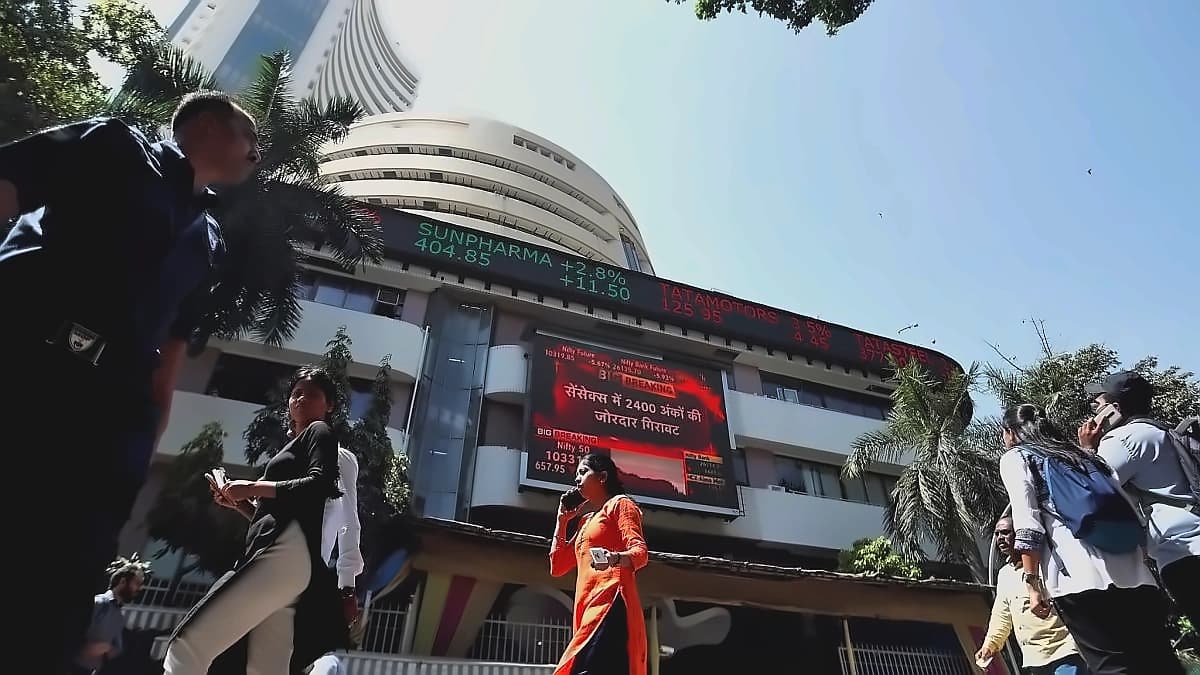
The Indian equity benchmarks ended Tuesday's session with significant losses, with Sensex declining 388.19 points, or 0.49% to settle at 78,154.25 and Nifty falling 112.10 points, or 0.46% to close at 24,471.70. According to Zee News, the decline was primarily driven by losses in realty, FMCG and cement stocks amid investor caution over signs of an impasse in negotiations between the United States and Iran. Market participants remained cautious amid geopolitical uncertainties after indications emerged that progress in negotiations between the United States and Iran had stalled, raising concerns about energy markets and global risk sentiment. The India VIX rose over 2% to 12.4175 points, indicating increased fear in the equity market, while market breadth remained negative with 1,958 shares rising and 2,221 shares falling on the BSE, showing mixed performance across segments.
Technical experts have identified the 24,400 zone as the immediate support area for Nifty, with a decisive break below this level potentially paving the way for further decline toward the 24,300 mark. As per Zee News, on the upside, 24,500 is likely to act as the immediate resistance, having shifted from a key support level. The broader 24,600–24,700 zone remains the stronger hurdle, and a sustained breakout above 24,700 would be required to revive bullish momentum. This technical analysis comes as the index continues to face pressure from ongoing geopolitical uncertainties and sector-specific challenges.
Among the Nifty constituents, Tata Consumer Products, Max Healthcare Institute and UltraTech Cement figured among the top losers of the session, contributing significantly to the broader weakness in benchmark indices. According to Zee News, the Nifty Cement index led the losses, followed by the Nifty FMCG, Nifty Realty and Nifty Metal indices. In contrast, pharmaceutical stocks bucked the broader trend, with the Nifty Pharma index emerging as the top-performing sector of the day as investors rotated into defensive counters. The BSE 150 MidCap Index edged down just 0.02% while the Nifty SmallCap index outperformed, gaining 0.22% during the session, showing resilience in smaller market segments despite benchmark declines.
Media, FMCG and metal shares declined while consumer durables, IT and PSU Bank shares advanced during the trading session. According to Business Standard, Dr Reddy Laboratories gained 3.09%, Titan Company rose 1.06%, TCS advanced 0.60%, HCL Technologies increased 0.53%, and Infosys gained 0.51% among the top gainers. On the losing side, Max Healthcare fell 2.69%, Tata Consumer Products dropped 2.21%, SBI Life Insurance Company declined 2.01%, Apollo Hospitals Enterprise fell 2%, and Nestle India dropped 1.83%. Triveni Turbine declined 5.77% after reporting a 20.78% decline in consolidated net profit to ₹51.1 crore despite a 19.23% increase in revenue from operations to ₹442.7 crore in Q1 FY27. Vodafone Idea rose 2.09% after reporting strong operational performance with adjusted net loss narrowing to ₹5,361.99 crore from ₹6,608.1 crore in Q1 FY26.
Oil prices jumped significantly as negotiations between the U.S. and Iran over a peace deal and the reopening of the Strait of Hormuz hit an impasse. According to Business Standard, Brent crude futures rose nearly $88 per barrel and U.S. crude futures ticked up to $82.42, both the highest levels since July 31, after the contracts rallied roughly 5% on Monday. U.S. President Donald Trump on Monday responded to Iran's conditions for a peace deal with his own demands that Iran pay compensation for people killed in wars, attacks and protests, in a rhetorical escalation likely to complicate efforts to reopen the crucial waterway. Iran had called for Washington to meet conditions, including recompensing Tehran for the damage caused since the U.S. and Israel launched strikes on its territory more than five months ago. Market attention now shifts to the US Consumer Price Index (CPI) data due on Wednesday, which is expected to provide fresh direction for global interest-rate expectations and broader market sentiment.