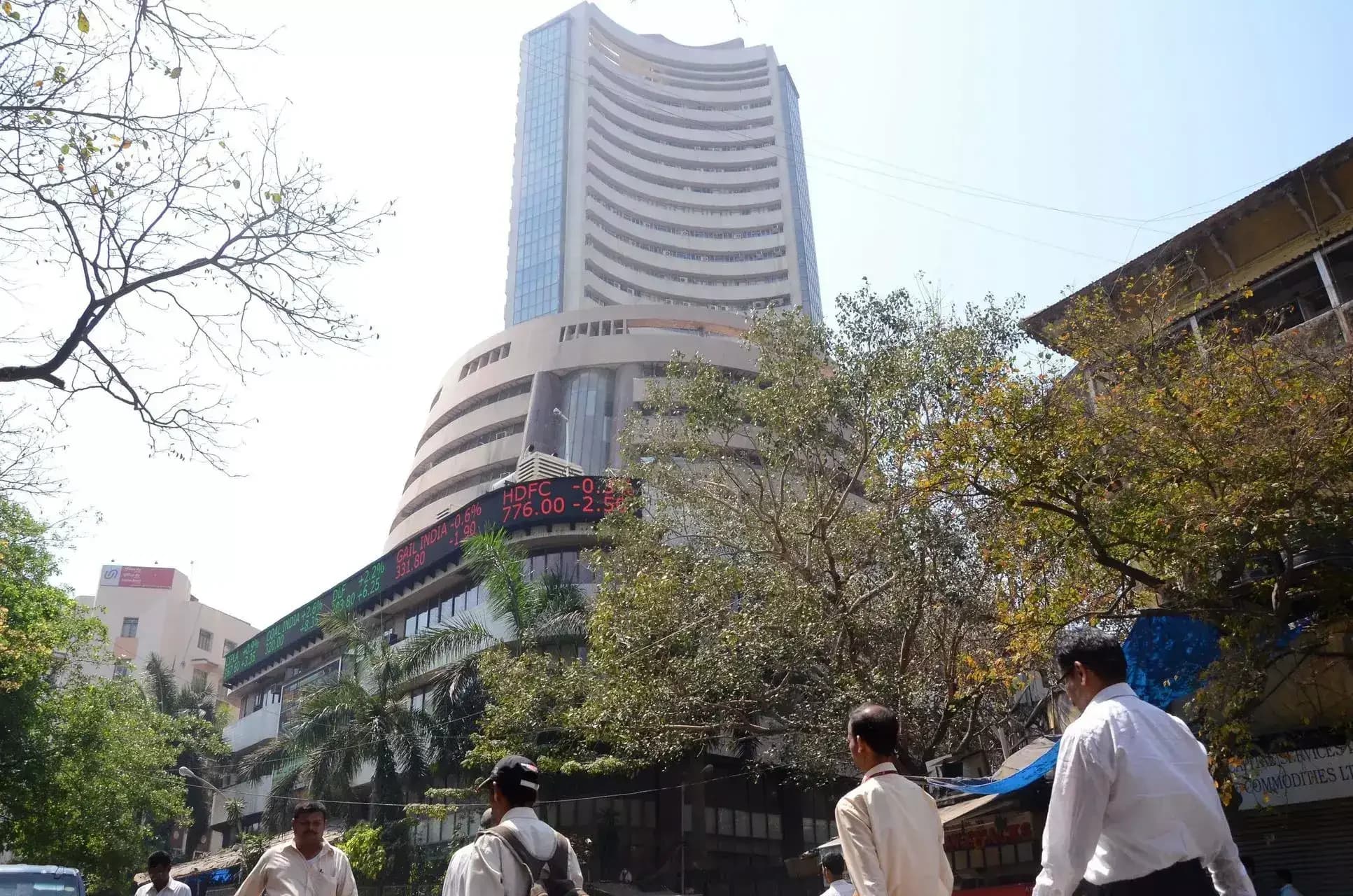
Indian equity markets staged a strong rebound in opening trade on Thursday, with benchmark indices continuing their positive momentum from the previous session. According to latest reports, the BSE Sensex advanced 75.71 points to 77,726.62 in early trade, while the NSE Nifty went up by 26.90 points to 24,275.85. This follows Wednesday's strong performance where the Sensex jumped 888.68 points, or 1.16%, to settle at 77,654.60, and the Nifty climbed 264.85 points, or 1.10%, to end at 24,250.20. The positive momentum was supported by broad-based buying across large-cap counters, with Foreign Institutional Investors (FIIs) buying equities worth ₹2,981.87 crore on Wednesday, as reported by The Hindu. The rally pushed the total market capitalisation of all BSE-listed companies to around ₹482 lakh crore, with the gains being broad-based across heavyweight stocks and the broader market.
Sector-wise performance showed broad-based gains with technology stocks leading the rally. Nifty IT emerged as the top performer, climbing more than 2%, while FMCG, Pharma, Healthcare, Metal, and Auto indices also traded higher. On the downside, Realty was the only major sectoral index in the red, declining 0.46%. Among individual stocks, Infosys, Tech Mahindra, HCL Tech, Tata Consultancy Services, Mahindra & Mahindra and Sun Pharma were among the major winners in Thursday's early trade. Other notable gainers included Tech Mahindra, Bharti Airtel, HCLTech, ITC, and Reliance Industries. On the downside, Adani Ports, Asian Paints, Eternal and Bharat Electronics were among the laggards. The Nifty IT index was up 3% intraday, with Coforge leading the rally with gains over 4%, followed by Infosys and Larsen & Toubro (L&T).
Oil prices rebounded sharply on Wednesday, reversing part of the previous session's steep decline, as renewed tensions in the Middle East reignited concerns over global crude supplies. Brent crude climbed 4.41% to $87.80 a barrel, gaining $3.71, while US West Texas Intermediate (WTI) crude rose 4.23%, or $3.35, to $82.61 a barrel. However, Brent crude, the global oil benchmark, traded 1.26% lower at $89.60 per barrel in Thursday's early trade. Lower US crude inventories and expectations around OPEC+ production policy also lent support to the market. This oil price recovery provided additional positive momentum for Indian markets, with the rupee appreciating 12 paise to 95.70 against the US dollar in opening trade, extending its gains after ending the previous session higher on the back of lower crude oil prices and easing geopolitical tensions in West Asia.
Investors are feeling optimistic and tracking upcoming commentary and policy announcements from the Federal Reserve, which is set to announce its latest monetary policy decision this week. The Federal Reserve kept interest rates unchanged, but an unusually hawkish outcome with three policymakers dissenting in favour of a rate hike pushed long-dated Treasury yields close to two-decade highs, as noted by Rajesh Palviya, Head of Research at Axis Direct. With the Fed set to announce its latest monetary policy decision this week, institutional investors are paying a sharply higher price to insure themselves against the possibility of a major upside shock in US interest rates. Activity in the interest-rate derivatives market suggests traders are no longer treating aggressive policy tightening as a remote possibility, even as opinions remain deeply divided over what the central bank will do. This uncertainty has provided a positive backdrop for Indian markets, with shares of leading Indian IT majors such as Tata Consultancy Services Ltd., Infosys, and Coforge gaining nearly 2-3% in early trade for the second straight session.
Global markets provided mixed cues after Wall Street posted strong gains overnight, with U.S. markets ending significantly lower on Wednesday (July 29, 2026) as the Dow Jones declined 2.19%, while the S&P 500 and Nasdaq lost 1.52% and 1.74%, respectively, amid renewed selling in technology stocks. In Asian markets, South Korea's KOSPI, Shanghai's SSE Composite index and Hong Kong's Hang Seng index traded lower, while Japan's Nikkei 225 index quoted in positive territory. The sell-off was driven by a sharp decline in SK Hynix, whose shares slumped about 20% after the chipmaker's quarterly profit missed analysts' expectations despite posting strong growth. Samsung Electronics also came under pressure, falling as much as 14% in early trade, while other major Asian markets also traded mostly lower as investors reacted to the weakness in South Korea's technology sector. Unlike India, Japan's Nikkei 225 fell more than 4% and Taiwan's benchmark index declined by over 4%, as the global selloff in AI-linked technology stocks continued. India has relatively fewer large listed companies directly exposed to the global AI infrastructure investment cycle, which has insulated domestic equities from the sharp correction triggered by rising doubts over whether hyperscalers' massive AI spending will ultimately deliver adequate returns.
Market sentiment improved significantly on Wednesday, with India VIX, the volatility gauge, declining more than 3% to 12.18, despite renewed geopolitical uncertainty. This improvement in market sentiment came at a time when investors across the region continued to exit technology and semiconductor stocks amid growing concerns that the global artificial intelligence investment boom may not generate the expected returns. The broader market participated in the rally as well, with the Nifty Midcap 100 and Nifty Smallcap 100 indices gaining up to 1% each. Market experts remain cautiously optimistic about the current rally, with analysts noting that the market's prolonged range-bound phase could eventually break on the upside. VK Vijayakumar, Chief Investment Strategist at Geojit Investments, said the market's prolonged range-bound phase could eventually break on the upside, supported by reasonable valuations in large-cap stocks. He added that big-conviction buying by FIIs will depend on clarity regarding crude oil prices and the progress of the monsoon. Investors will now watch the Fed's policy statement and commentary for clues on the future interest-rate trajectory, along with movements in crude oil prices and foreign institutional investor flows.