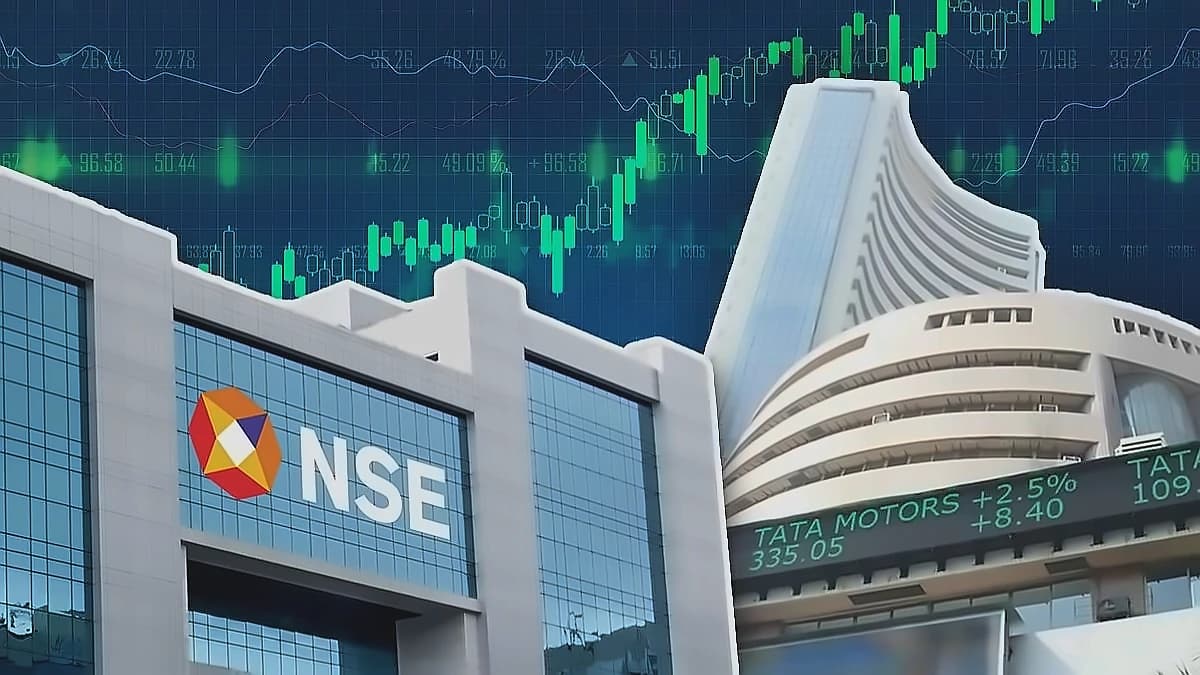
Indian stock markets extended their rally for a second consecutive session on Monday, with Sensex surging 1,233 points, or around 1.65%, to close at 75,693 and Nifty gaining 388 points, or around 1.68%, to settle at 23,441, reclaiming the 23,400 mark. Foreign institutional investors (FPIs) remained net buyers for the second consecutive session, purchasing shares worth ₹3,114.68 crore on Monday, according to exchange data. Domestic institutional investors (DIIs) turned net sellers, offloading equities worth ₹392.20 crore, as reported by CNBC TV18. Market breadth remained positive with NSE seeing 2:1 advance-decline ratio, indicating that advancing stocks outnumbered declining shares by two to one. Out of 3,693 stocks traded on NSE, 54 hit fresh 52-week highs while 117 stocks were at new 52-week lows, indicating broad-based participation in the rally.
Reliance Industries emerged as the biggest contributor to the benchmark rally, surging over 9% and marking its biggest single-day gain in six years after reporting strong Q2 results. The rally added more than ₹1.8 lakh crore to the company's market capitalisation, its highest-ever single-day increase. Nifty Bank advanced 315 points to 55,002, while the Nifty Midcap index climbed 682 points to 57,983, as reported by CNBC TV18. JSW Steel and Tata Steel also supported the indices, while ICICI Bank, Kotak Mahindra Bank and Axis Bank ended lower. A nearly 4% decline in crude oil prices supported buying in paint stocks and oil marketing companies, with Indian Oil Corporation emerging as the top Nifty gainer.
The recent FPI buying may be attributed to concerns over the outlook for the artificial intelligence trade influencing investor decisions, as reported by The Economic Times. Ritesh Jain, founder of Pinetree Macro, noted that "Indian large-cap stocks, particularly banks and IT companies, are being viewed as an anti-AI trade, attracting model-driven flows rather than a broad-based return of long-only foreign investors." Between October 16 and October 30, FPIs made net purchases of nearly $1.2 billion in the secondary market, with ₹3,600 crore invested on October 30 alone, according to NSDL data. In the primary market, they were buyers worth $600 million, with Jio Telecom's ₹30,188 crore IPO expected to have cornered a large chunk of these flows. Gautam Chhaochharia from UBS noted that "a small portion of the inflows reflected selective foreign investors returning to India on a bottom-up basis, attracted by improving growth prospects and opportunities in certain technology sectors." The recent purchases may be positional flows looking for avenues that are less impacted by the AI sell-off rather than a fresh bullish call on India by global investors.
Dixon Technologies surged 12% after reporting healthy Q2 growth, with its commentary on the artificial intelligence opportunity also supporting sentiment, as reported by CNBC TV18. Delhivery gained 6% following a strong quarterly performance, while Muthoot Finance advanced 5% after reporting healthy Q2 results and raising its FY27 assets under management (AUM) growth guidance. IndiGo closed in positive territory, although off its session highs, following positive management commentary on the third quarter. Auto stocks ended mixed after monthly sales updates, with passenger vehicle stocks gaining while two-wheeler stocks declined. Among individual stocks, Navin Fluorine gained over 5% following its Q2 results, Laurus Labs rose over 7% and Borosil surged 20% after their quarterly results, and Jio Platforms recovered during the session and ended with a gain of nearly 1%.
Technical indicators suggest the Nifty could move towards 23,000 levels if buying momentum continues, with the 22,500-22,700 range expected to provide near-term support and the 22,200-22,400 band remaining an important downside level. Apurva Sheth from Samco Securities noted this was a "very good rebound" and said "The week should end on a positive note. From here, the chances of a pullback are high for the near future, and we can reach at least 23,500 levels." However, sustained buying across sectors will be essential to establish a more durable recovery. Vinod Nair from Geojit Investments said "Recent foreign buying alongside sustained domestic institutional support have improved liquidity backdrop. The broader thesis remains supported by selective earnings resilience and domestic demand stability, although elevated input costs could test margin durability." From a technical perspective, Nifty has managed to move above its 21-day exponential moving average, currently placed around 22,850, which is a positive development and suggests that immediate selling pressure has eased. For the immediate trading sessions, 22,850–22,800 will act as an important support zone, followed by 22,650–22,700, while on the upside, 23,150–23,200 is the first major resistance area, followed by 23,500. The ability of Nifty to sustain above 23,000 will therefore be important in determining whether the market can extend its recovery, with a decisive move above 23,200 essential to improve the medium-term technical outlook.