
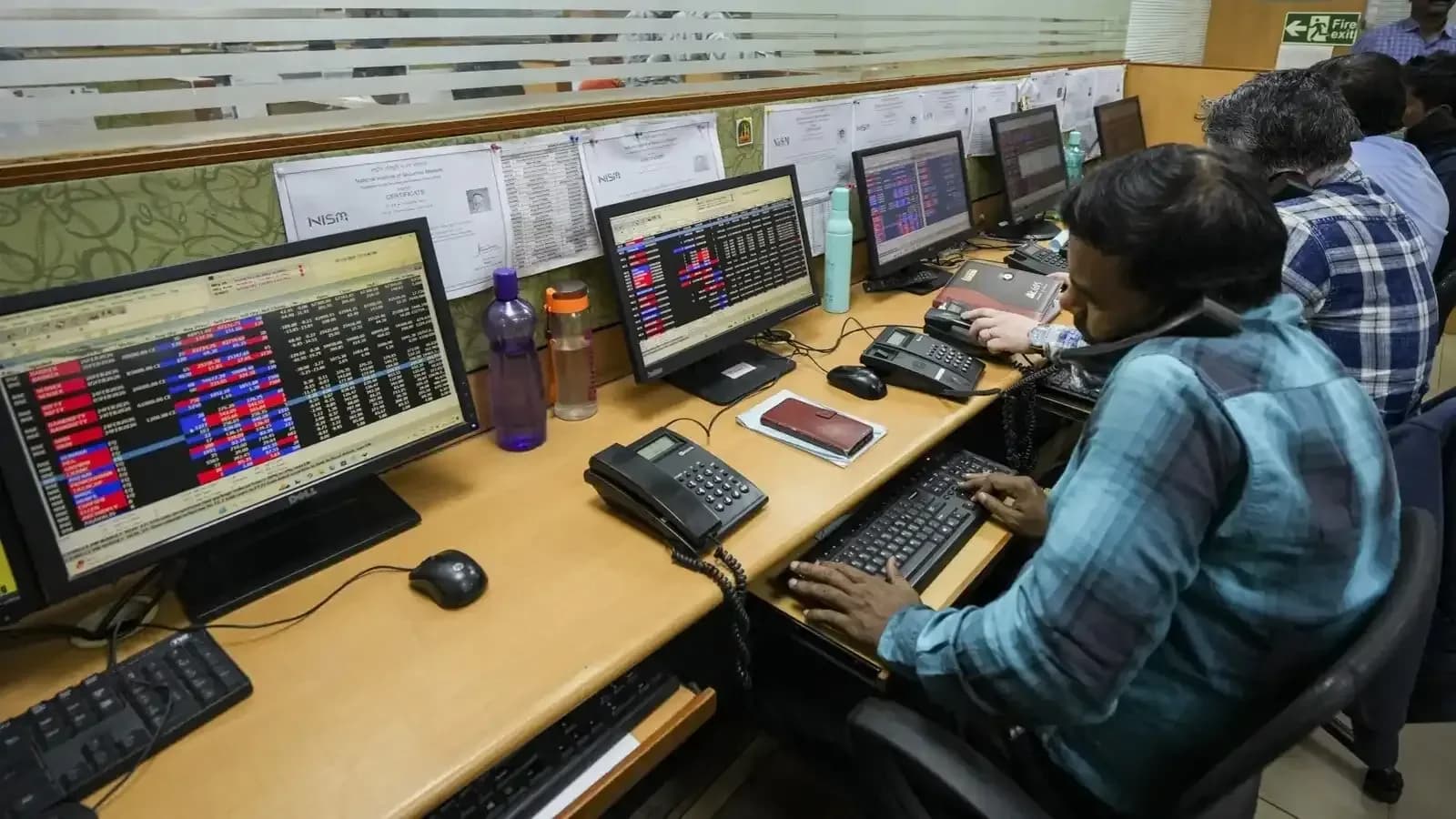
Indian equity benchmarks declined on Thursday, February 5, with the BSE Sensex closing at 83,313.93, down 503.76 points or 0.60%, and the NSE Nifty ending at 25,642.80, 133.20 points or 0.52% lower, slipping below the 25,700 mark. According to The Hindu BusinessLine, the decline ended a three-session winning streak as weak global market cues weighed on sentiment. During intraday trade, the Sensex dropped as much as 666.07 points or 0.79% to 83,151.62. The NIFTY50 traded in a range of 25,579.50 to 25,757.65 during the session, with 19 stocks advancing against 31 declining on the index. On the 30-stock Sensex, 4 stocks advanced against 26 declining, with Hindustan Aeronautics, Hindalco, Bharat Electronics, SBI Life, ITC, and Bajaj Finserv emerging as the biggest laggards. As per The Hindu, the Sensex further dropped 278.72 points to 83,538.97 in early trade after starting on a bearish note. From the Sensex firms, Eternal, Bharti Airtel, Bharat Electronics, ITC, Infosys, Reliance Industries, ICICI Bank and Asian Paints were among the major laggards, while Trent, Tata Steel, State Bank of India and Bajaj Finance were the gainers. Market breadth remained negative with 2,447 stocks declining against 1,737 advances on the BSE, where 4,342 stocks traded. The volatility gauge India VIX ended at 12.17, down 0.7% from the last closing, indicating reduced market uncertainty.
The market decline was primarily driven by anxiety about the potential disruptive impact of artificial intelligence on traditional business models and profit margins. After strong rallies in tech and semiconductor stocks fueled by optimism around AI adoption, recent trading suggested investors were locking in gains ahead of potential changes in growth expectations. Growing concern about valuation risk also weighed on markets, as rapid advances in AI technology and the high stock prices of related companies raised questions about whether valuations had outpaced fundamentals. This led to profit-taking in key AI stocks, especially in semiconductor names that had driven a large portion of gains across Asia. Investors doing stock research pointed out that while AI represents a long-term growth theme, short-term volatility can arise when valuation expectations shift faster than earnings growth. Market experts noted that the recent sell-off in IT is more of panic selling than anything else, as reported by ET Now, suggesting the current decline may be overdone relative to fundamental concerns. Vinod Nair, Head of Research at Geojit Investments Limited, noted that Indian equities saw consolidation as weakness was followed by a sharp rally in recent sessions driven by optimism around the US-India trade deal, suggesting profit booking was at play. Rupak De, Senior Technical Analyst at LKP Securities, noted that the Nifty closed in the red for the third straight session and remained below its 50-day moving average, pointing to near-term pressure, while the index has held above its 20-day exponential moving average over the past three sessions, indicating that the immediate trading range could stay narrow.
Except Nifty PSU Bank, all sectoral indices closed in red during the session, with significant declines across multiple sectors. The BSE Metal index declined 1.02% amid a sell-off in both precious and base metal prices, following a short-lived rebound and being further impacted by supply concerns, profit booking, and a strengthening US Dollar. According to The Times of India, Trent emerged as the top gainer on Nifty50, rising 2.98% to ₹4,132.00 from its previous close of ₹4,012.60 after reporting its Q3 results. Max Healthcare Institute gained 1.22% to close at ₹1,038.00 from ₹1,025.45, and Tata Steel advanced 1.13% to ₹197.60 from ₹195.40. JSW Steel rose 1.04% to ₹1,241.00 from ₹1,228.20, and Grasim Industries climbed 0.92% to ₹2,871.10 from ₹2,844.90. The Nifty IT extended its losing streak, with the NIFTY IT index falling 0.5% on Thursday, dragged by Infosys (-1.03%), TCS (-0.2%), and HCL Tech (-0.7%). Nifty Auto snapped its 3-session gaining streak with majority of constituents closing in red. However, Nifty PSU Bank managed to buck the trend with a 0.34% surge, led by BOI and Union Bank, with the sector being the only bright spot in an otherwise weak market. The Nifty Small-cap 100 index emerged as the worst performer, plunging 1.29% to close at 16,983.90, down 221.20 points, significantly underperforming frontline indices. The Nifty Midcap 100 declined 0.28% to 59,517.10, losing 166.50 points. Sudeep Shah, Head - Technical and Derivatives Research at SBI Securities, noted that the Smallcap index was notably the worst performer, declining 1.29% and severely underperforming frontline indices.
The metal sector decline was significantly impacted by falling precious metals prices, with gold futures with April expiry falling around 3% to ₹1,48,455 per 10 grams and silver futures with March expiry dropping 6% to ₹2,52,719 per kilogram. As reported by Moneycontrol, the contracts with June expiry also fell around 3% for both metals. This decline directly affected metal companies like Hindustan Zinc and others who are producers of these commodities, contributing to the sector-wide selloff. The stronger US dollar, which was up 0.2% at 96.671 on the U.S. dollar index, also pressured metal prices as it makes commodities more expensive for international buyers. According to The Hindu BusinessLine, spot gold and silver slipped below $4,800 per ounce and $75 per ounce respectively after two days of recovery. Currently, spot gold and silver are attempting a recovery above $4,900/oz and $78/oz, though prices look likely to remain choppy, said Kaynat Chainwala, AVP Commodity Research at Kotak Securities. Brent crude, the global oil benchmark, dropped 1.32% to $68.54 per barrel, adding to the commodity-related pressure on markets. WTI crude oil prices reversed sharply, falling more than 2% to below $64 per barrel as the US and Iran agreed to resume talks in Oman.
Despite the overall market weakness, select stocks posted strong gains with Trent emerging as the top gainer on the NIFTY50 index, rising 2.98% to ₹4,132.00 from its previous close of ₹4,012.60 after reporting its Q3 results. As per Upstox, Max Healthcare Institute climbed 1.22% to ₹1,038.00, Tata Steel gained 1.13% to ₹197.60, JSW Steel rose 1.04% to ₹1,241.00, and Grasim Industries climbed 0.92% to ₹2,871.10. Top losers on the NIFTY50 index were Hindalco Industries (-3.00%), Eternal (-2.41%), Bharti Airtel (-1.66%), Bharat Electronics (-1.53%), and ITC (-1.19%). In the midcap space, PB Fintech was the top gainer, surging 7.22% after the company cancelled its board meeting that was scheduled to consider a qualified institutional placement. However, Tube Investments of India Limited declined 9.86%, Suzlon Energy fell 4.04%, Muthoot Finance dropped 3.49%, Aurobindo Pharma declined 2.95%, and Godfrey Phillips India fell 2.94%. In the smallcap segment, Devyani International gained 7.78%, Aditya Birla Real Estate rose 6.25%, Inventurus Knowledge Solutions climbed 5.35%, Whirlpool of India advanced 4.36%, and BLS International Services gained 3.16%. Redington Limited declined 5.74%, Kaynes Technology India fell 4.77%, Multi Commodity Exchange of India dropped 4.65%, Cyient declined 4.22%, and Trident fell 3.52%.
The Indian rupee strengthened against the US dollar, trading near 90.30 and gaining approximately 0.20 paise or 0.22%, according to The Hindu BusinessLine. Rupee traded stronger near 90.30, gaining around 0.20 paise or 0.22%, supported by dollar weakness and softer commodity prices, said Jateen Trivedi, VP Research Analyst at LKP Securities. The Nifty Bank fell 0.29% to 60,063.65, down 174.50 points, while Nifty Financial Services slipped 0.41% to 27,689.35, losing 113.20 points. The Nifty Next 50 declined 0.47% to 68,970.40, down 328.15 points. All eyes are now on the RBI policy due tomorrow, as participants will closely watch liquidity measures and the policy stance, said Trivedi. Ajit Mishra of Religare Broking recommended maintaining a positive stance on the Nifty and continuing a buy-on-dips approach as long as the index holds above the 25,400 level, with upside potential toward 26,000 initially. The Nifty index traded in a noticeably tight band on Thursday, moving within a 178 point range, the narrowest in the last four trading sessions, as noted by Sudeep Shah, Head - Technical and Derivatives Research at SBI Securities.
Foreign institutional investors remained net buyers, purchasing equities worth ₹29.79 crore, according to exchange data, while Domestic Institutional Investors also added to their holdings, buying stocks worth ₹249.54 crore in the previous trading session. According to The Hindu, Vinod Nair, Head of Research at Geojit Investments Limited, noted that Indian equities saw consolidation as weakness was followed by a sharp rally in recent sessions driven by optimism around the US-India trade deal. He highlighted that possibly profit booking was at play today, with global cues adding further pressure from concerns over a broad-based tech sell-off in international markets and heightened US-Iran tensions leading to risk-off sentiment. Ponmudi R, CEO of Enrich Money, said Indian equity markets traded in a tight range, signalling a wait-and-watch phase as investors remained cautious in the absence of fresh domestic triggers. Rajesh Bhosale, Technical Analyst at Angel One, said Nifty has entered a consolidation phase with prices moving within a defined range after a sharp two-sessions jump, adding that the index continues to trade above all key moving averages, while the RSI remains in positive territory above the 50 mark, indicating that the broader trend remains positive. The current phase appears to be a healthy cooldown after the sharp gap-up of Tuesday (1200 points), and the next momentum trigger is likely post the RBI policy announcement. Until then, the primary trend remains intact and any dip should be viewed as a buying opportunity, provided key supports hold, he said. Bhosale noted that Nifty is holding above the crucial support zone of 25,500 and below this level a strong support is placed around the 25,250 mark, which coincides with the 200DEMA, the bullish gap left and the 61.8% retracement of the entire upward move from the Budget day low. On the upside, 25,750–25,850 remains an immediate resistance zone, followed by the psychological 26,000 mark.