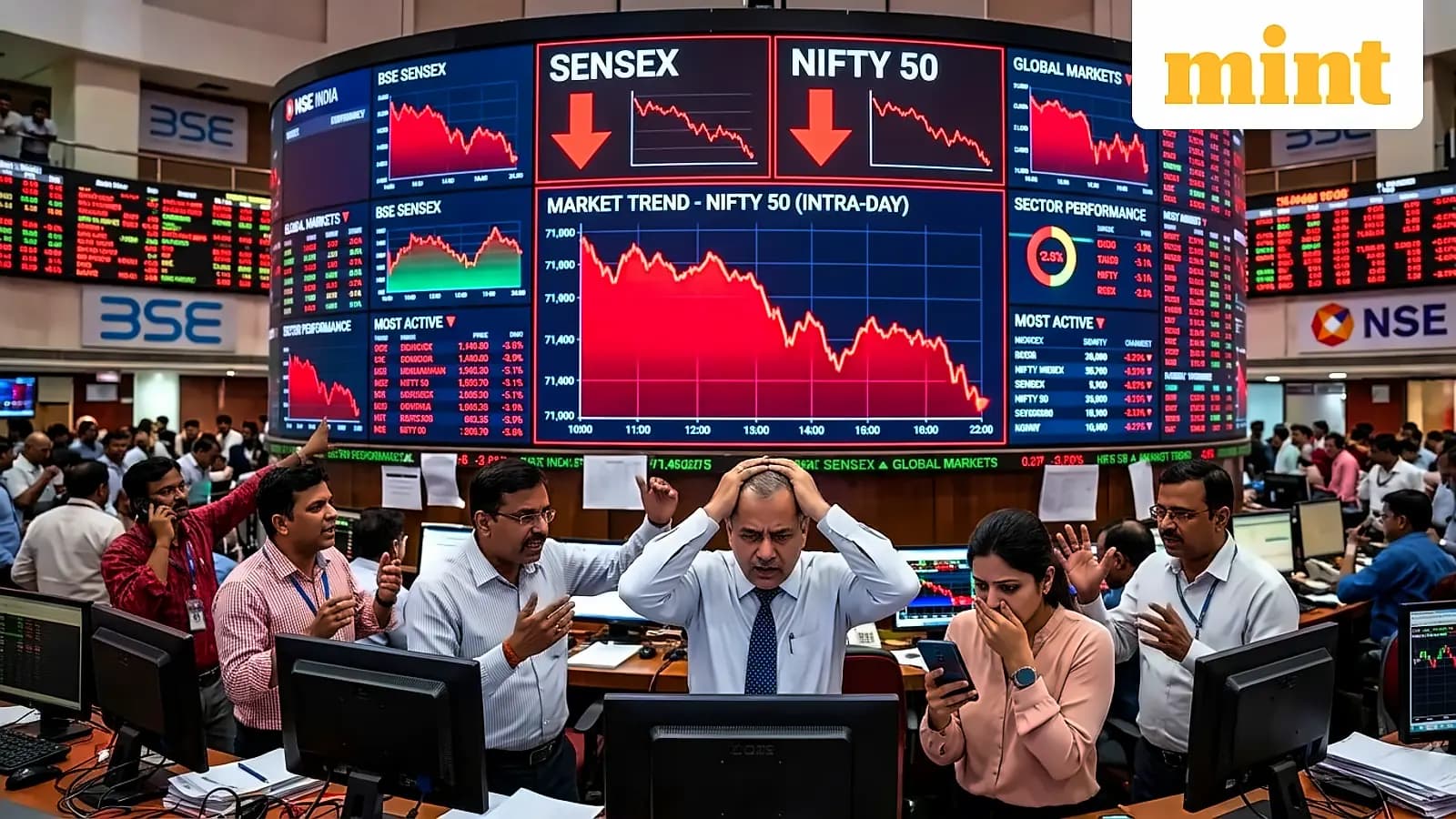
The SENSEX declined 120.83 points, or 0.16%, to settle at 74,781.76 on Friday, recovering from early session lows amid cooling oil prices and selective buying in IT and banking stocks. According to The Hindu BusinessLine, the benchmark had fallen as much as 742.43 points, or 0.99%, to 74,160.16 during the day before staging a recovery. The NIFTY50 dipped 79.70 points, or 0.34%, to end at 23,398.10, after touching an intraday low of 23,231.40, reflecting a 246.4-point drop. The recovery was aided by late buying in HDFC Bank and IT stocks, providing some support after the initial sell-off. Brent crude, the global oil benchmark, declined 3.19% to $104.2 per barrel, providing relief from earlier concerns about elevated energy costs.
The NIFTY IT index plummeted 2.73% to 29,067.20, extending its decline to 8.2% over six consecutive trading sessions. As per Business Standard, major IT stocks witnessed significant selling pressure with Coforge tumbling 6.91% after the company announced that its non-executive independent director and chairman, O.P. Bhatt, resigned from the Board with immediate effect on September 9, 2026. Other major IT stocks also declined sharply, with Infosys down 3.6%, Tech Mahindra falling 3.26%, HCL Technologies dropping 2.84%, Mphasis declining 2.42%, Persistent Systems falling 2.41%, Tata Consultancy Services down 2.33%, Wipro declining 1.99%, Oracle Financial Services Software dropping 1.13%, and LTM falling 0.23%. The IT sector's weakness contributed significantly to the overall market decline, offsetting gains in other sectors.
Defence equipment manufacturers such as Hindustan Aeronautics (HAL), Bharat Electronics (BEL), and BEML traded with impressive gains on Tuesday, September 8, as reported by The Economic Times. This surge was driven by the defence ministry's approval of military hardware acquisition for the three services, including radars, advanced light helicopters and mechanical mine layers at an estimated cost of ₹1.10 lakh crore to boost the military's overall combat prowess. The procurement proposals were cleared by the Defence Acquisition Council (DAC) headed by Defence Minister Rajnath Singh, with the ministry stating that the DAC accorded Acceptance of Necessity (AoN) for various acquisition proposals. Approximately 98% of these acquisitions will be sourced from Indian industries, supporting the government's indigenisation push. The approvals cover requirements of the Army, Navy and Air Force, with new high-mobility vehicles, advanced light helicopters, and existing fighter jet upgrades among the approved procurements.
Among the 30 Sensex firms, Tata Steel, Reliance Industries, Sun Pharma, Bajaj Finance, NTPC, Power Grid, Larsen & Toubro and Axis Bank were the major laggards, while HDFC Bank, Tech Mahindra, HCL Tech, Eternal, and Infosys were among the gainers. According to The Hindu BusinessLine, BSE sectoral indices showed divergent performance with Realty tumbling 2.69%, Metal declining 2.40%, Commodities falling 1.61%, Energy down 1.06%, Utilities dropping 1%, and Auto declining 0.88%. However, Financial Services, Private Banks, IT, Telecommunication, Bankex and Focused IT were the gainers. The BSE SmallCap Select index declined 0.67% while MidCap Select index ended marginally higher by 0.07%. Market breadth remained negative with 1,474 shares rising and 2,651 shares falling on the BSE.

The NIFTY FMCG index declined 1.05% to 45,271 on Tuesday, September 9, marking a reversal from its previous session's 0.35% gain. According to Business Standard, major FMCG stocks witnessed significant selling pressure with United Spirits down 2.16%, Hindustan Unilever declining 1.39%, Dabur India falling 1.35%, Marico down 1.3%, Varun Beverages dropping 1.21%, Colgate-Palmolive (India) declining 1.16%, Radico Khaitan down 1%, Tata Consumer Products falling 0.81%, ITC declining 0.78%, and Godrej Consumer Products dropping 0.69%. The sector's weakness contributed to the overall market decline, with FMCG stocks underperforming despite their recent positive momentum.
Oil prices remained a major market concern with Brent crude climbing close to $100 a barrel after attacks on Saudi energy infrastructure by Iran-backed Houthi militants and further US-Iran military escalation. According to The Hindu BusinessLine, Brent crude declined 3.19% to $104.2 per barrel on Friday, providing some relief from earlier elevated levels. The geopolitical situation intensified after the US said its forces destroyed five Iranian oil tankers following an attempted attack on a US Navy vessel, with the US Treasury announcing fresh sanctions targeting Iran's aviation sector. India is particularly vulnerable to rising crude prices as the country meets more than 80% of its crude oil requirements through imports, making it susceptible to sustained increases in oil prices. A prolonged elevation in crude prices could add to inflationary pressures and weigh on the rupee, potentially hurting companies' profit margins through higher input costs.
On the weekly front, the BSE benchmark tumbled 1,733.67 points, or 2.26%, and the Nifty declined 499.6 points, or 2%. According to The Hindu BusinessLine, Foreign Institutional Investors (FIIs) offloaded equities worth ₹438.24 crore on Thursday, adding to the selling pressure. Market analysts noted that the retreat in crude oil prices provided some relief, but Brent around $104 a barrel remains elevated enough to sustain concerns over inflation, the rupee and India's import bill. Vinod Nair from Geojit Investments stated that while elevated crude prices, foreign outflows, and geopolitical uncertainty may keep volatility high, resilient domestic fundamentals and strong institutional support continue to attract buying at lower levels, limiting downside risks and supporting the medium-term outlook.