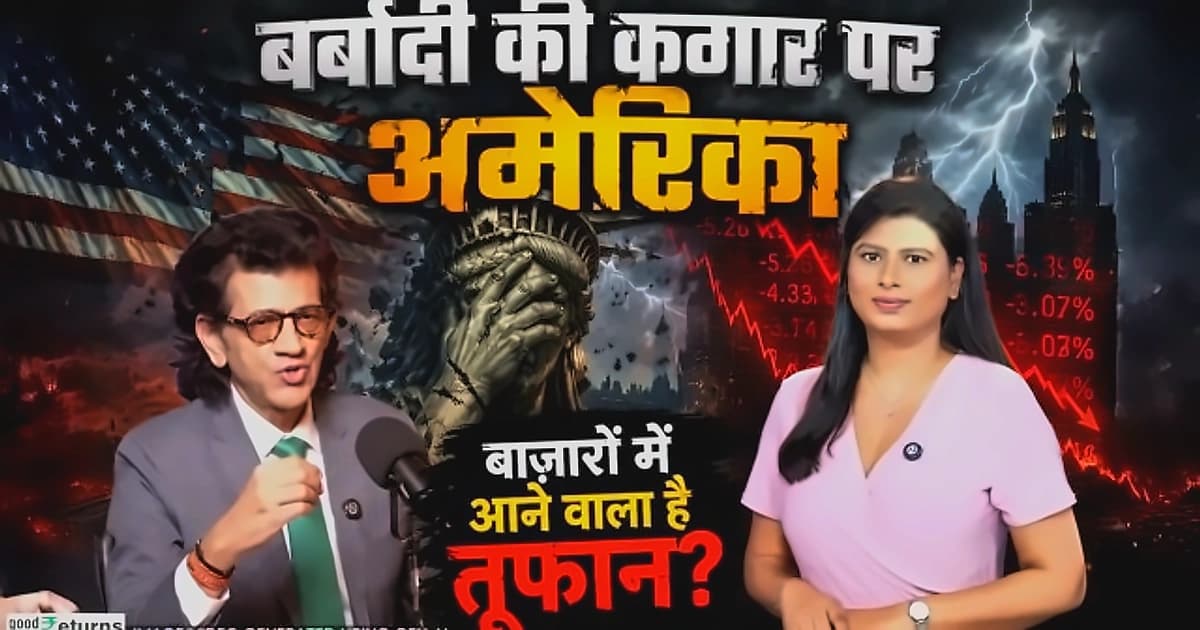
The Indian stock market witnessed a sharp selloff on Friday, with benchmark indices closing at day's lows amid broad-based selling pressure across sectors. According to The Hindu BusinessLine, Sensex fell 1,092 points to close at 74,775, while the Nifty declined 359 points to settle at 23,547. The latest data confirms that benchmark indices fell nearly 2% each during the session, with the Nifty Bank slipping 615 points to 54,239 and the Midcap Index dropping 835 points to 61,724. The Nifty Bank and Midcap indices declined more than 1% each, while market breadth remained weak with 2,673 stocks declining against 1,611 advancing. As per CNBC TV18, only five Nifty stocks closed in the green, with HCLTech, Wipro and Power Grid among the gainers from the IT pack, while thirteen Nifty stocks fell more than 3% during the session. The Nifty's Advance Decline Ratio stood at a weak 14:36, reflecting continued pressure on the index.
The MSCI index rebalancing emerged as a key factor behind the market decline, with the global leading index services provider implementing significant changes to its constituents. According to The Hindu BusinessLine, market participants estimated that the MSCI rejig, which took effect at the close of trading, resulted in nearly $1 billion (over ₹9,000 crore) of passive fund-related selling by global investors tracking the index. As per The Hindu BusinessLine, MSCI added stocks like Federal Bank, MCX, National Aluminium Company, and Indian Bank from its MSCI Standard Index, while removing others like RVNL, Kalyan Jewellers, Jubilant FoodWorks, and Hyundai Motors. On the smallcap front, 29 stocks were removed while 14 stocks were added to the MSCI Small Cap index. The MSCI also added a free-float factor framework to its constituents, which means that even if a stock is removed from the index, the new methodology will hold a buffer time period where the stock price will still swing due to weightage adjustments. The MSCI rebalancing triggered an estimated $800 million to $1 billion in passive foreign outflows from Indian equities, as reported by The Hindu BusinessLine. The pressure intensified during the final hours of trade after the MSCI Global Standard Index rebalancing came into effect, triggering heightened volatility in select stocks amid expected passive fund flow adjustments, said Siddhartha Khemka of Motilal Oswal Financial Services.
Several sectors emerged as top performers during the session, with technology stocks remaining the standout performers despite broader market weakness. According to The Hindu BusinessLine, barring information technology (IT), all major sectoral indices ended in the red as flow-driven selling intensified during the closing hour. The IT sector remained the lone bright spot, gaining over 2% on the back of overnight gains in US technology stocks and a weaker rupee. TCS stayed in focus after the company denied reports of losing a major client mandate in Canada, providing additional support to the sector. However, barring the Nifty IT index, all sectoral indices closed in the red, with Oil & Gas, Metals, and Auto leading losses. Heavy selling in Reliance Industries, down over 1.6%, and ITC, down over 3%, along with weakness in banking majors HDFC Bank and ICICI Bank, deepened the decline. Bajaj Auto, Max Healthcare, IndiGo, Eicher Motors, ONGC and Asian Paints were among the top losers on the Nifty, while Ola Electric rose 3% on healthy Q4 earnings and a strong outlook. Tejas Networks gained 6% tracking retail data for May, while Hikal advanced more than 5% on expectations of a healthy outlook. Bharat Dynamics dropped more than 7% after a brokerage downgrade, while PB Fintech fell over 4% following weak Q4 results.
Market breadth remained weak throughout the session, with the advance-decline ratio at 1:2 indicating broad-based selling pressure. According to The Hindu BusinessLine, the India VIX, a gauge of market volatility, rose 8 per cent to 16.2, reflecting heightened investor nervousness. The Midcap 100 fell 1.33 per cent and the Smallcap 100 declined 0.85 per cent, showing widespread selling across market segments. The Nifty ended 0.72% lower on a weekly basis, with more than 30 stocks ending the week with losses. On the gaining side, Tata Motors PV, Adani Enterprises, Tech Mahindra, Larsen & Toubro and Eternal led advances among benchmark constituents. Among sectoral indices, the PSU index recorded the steepest weekly decline, followed by the capital market and healthcare stocks. Industrials and PSU Bank indices emerged as the top gainers, rising nearly 2% each during the week. The Nifty's Advance Decline Ratio stood at a weak 14:36, reflecting continued pressure on the index.
Market activity surged in several stocks due to passive fund adjustments linked to the MSCI rebalance, with NSE cash market turnover more than doubling compared to the previous session, largely driven by rebalancing-related trades. According to The Hindu BusinessLine, amid the MSCI rebalancing, the NSE's cash market segment recorded an all-time high turnover of ₹2.87 trillion, surpassing the previous record of ₹2.71 trillion logged on June 4, 2024. The surge underscored the scale of passive fund activity during the closing session. Index heavyweights HDFC Bank, down 1.8 per cent, Reliance Industries, which fell 1.6 per cent, and ICICI Bank, down 1.3 per cent, accounted for a large part of the Sensex's losses. Market experts expect some stabilisation in the coming session now that the MSCI-related flows are behind the market. Sudeep Shah of SBI Securities noted that immediate support for the Nifty is placed in the 23,400–23,350 zone, with resistance in the 23,750–23,800 zone, while U R Bhat of Alphaniti Fintech expects a slight rebound on Monday because the forced rebalancing activity is now behind us. As long as Nifty trades below the 50-day SMA of 23,700, the weak sentiment is likely to continue, cautioned Amol Athawale of Kotak Securities, flagging 23,300–23,000 as the next support band on the downside.