The Reserve Bank of India's 25-basis-point repo-rate hike from 5.25% to 5.50% is unlikely to derail festive auto growth, but protecting buyers from higher borrowing costs could cost automakers and lenders nearly ₹1,000 crore over four years, according to estimates by auto and BFSI industry experts. The calculation assumes manufacturers and financiers absorb around half the incremental financing cost across roughly one crore two-wheeler loans, 20 lakh passenger-vehicle loans and 10 lakh three-wheeler loans. The actual cost will depend on financing penetration, lender pass-through and the extent to which manufacturers subsidise interest rates.
For individual buyers, the impact is modest with an illustrative ₹1-lakh two-wheeler loan at 12% for four years costing about ₹12 more a month, or roughly ₹590 over the tenure. A ₹3-lakh three-wheeler loan at 15% would cost about ₹38 more monthly, or around ₹1,830 over four years. For a ₹10-lakh car loan at 9%, the increase works out to about ₹120 a month, or ₹5,700 over four years. As per The Hindu BusinessLine, the relatively small individual impact is one reason industry executives do not expect the hike by itself to derail festive demand. According to Upstox analysis, a 25 bps hike adds about ₹105 to the average car EMI, which is manageable for most buyers given the average auto loan of ₹8.6 lakh.
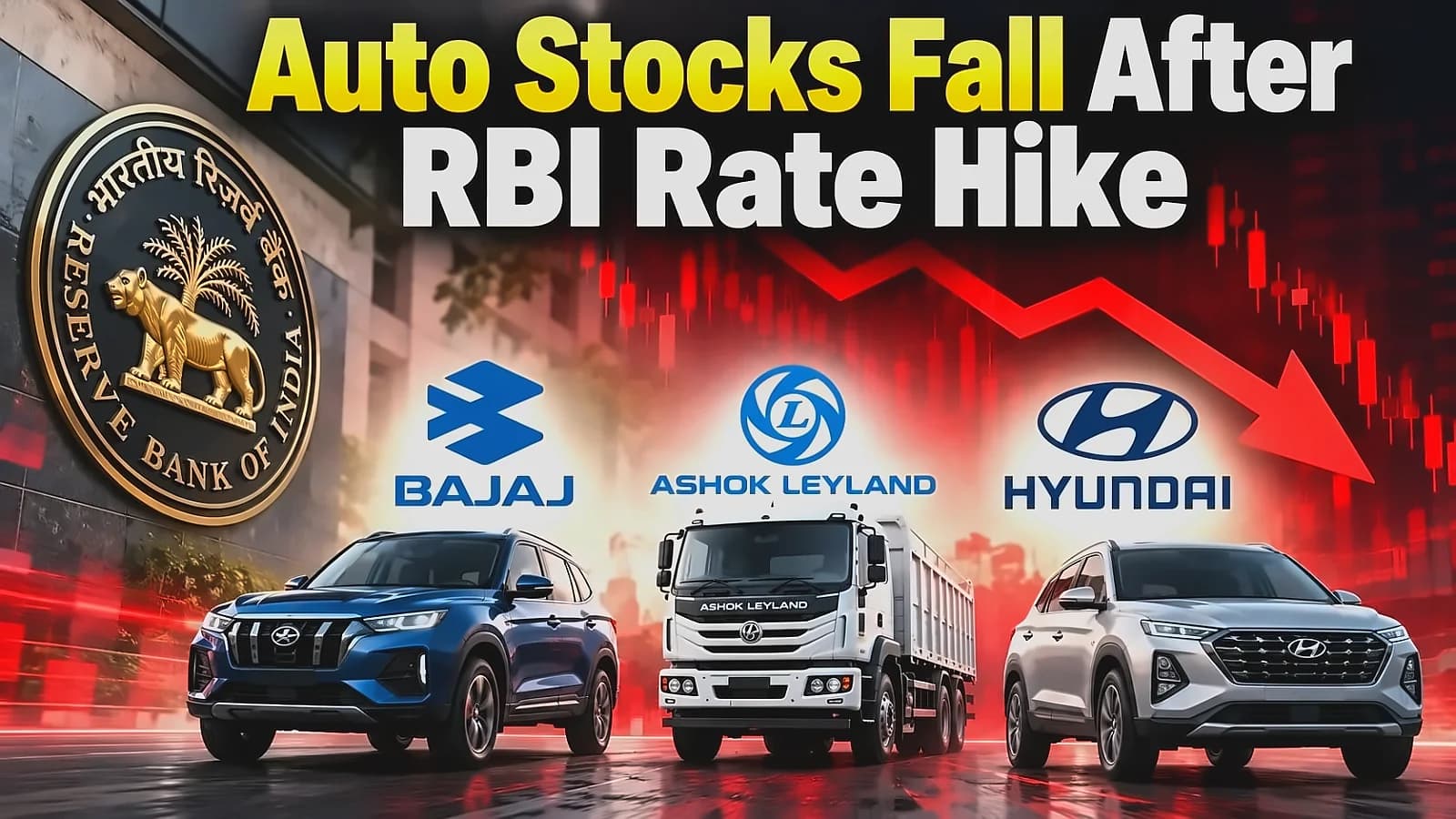
Shares of Indian automobile companies declined sharply on Wednesday, with the Nifty Auto Index falling over 1.6% as the RBI raised the repo rate by 25 basis points to 5.50% and shifted its policy stance to 'calibrated tightening'. Unlike past rate hikes, consumption-focused sectors bore the brunt of the monetary tightening, with Nifty Auto, Nifty Consumer Durables and Nifty Realty shedding around 1-2% on the day of the rate hike. According to Mint's analysis of 11 RBI rate-hike episodes over the past 13 years, this breaks a typical pattern where auto, consumer durables and realty stocks typically rose on policy day in most cases. Avik Chattopadhyay, an auto-industry expert and co-founder at Expereal, expects the response to show up at dealerships, stating that prospective customers will surely expect better deals and festive discounts may get deeper.
Nine years of data analysis reveals that interest rate changes have limited impact on auto sales growth. In FY20, RBI cut rates by 185 bps, yet sales of both cars and two-wheelers fell almost 18%, with the COVID-19 lockdown occurring only in the last week of the fiscal year. FY23 showed another stark example where the RBI raised rates six times (250 bps in total) yet sales of cars and two-wheelers jumped significantly. FY26 offered an unusually clean test where between February and June 2025, the RBI cut the repo rate by 100 bps, yet PV sales fell 1.4% in April–June and 1.5% in July–September. As per Upstox analysis, vehicles remain an aspirational purchase for most Indian families, with steady replacement cycles of 12-15 years providing consistent demand support.
Despite the weakest monsoon in over a decade with rainfall 12.6% below normal, rural automobile demand continues to show remarkable resilience. According to Business Standard, rural vehicle sales rose 32.69% year-on-year in September, significantly outpacing urban markets at 30.93% growth. The strength was particularly visible in commercial vehicles and three-wheelers, with rural CV sales rising 40.44% compared to 35.15% in urban markets, while three-wheeler sales grew 40.09% against just 4.71% in urban areas. As per FADA president Sai Giridhar, the emergence of smaller transport businesses in rural areas is helping support automobile demand, with such activity earlier concentrated more in cities. Uday Narang, Founder and Chairman of Omega Seiki Mobility, noted that the pressure is potentially greater in 2-wheelers and 3-wheelers, where financing and monthly cash flows play a larger role in purchase decisions.