
The KSE-30 index plunged as much as 9.6% at the open on Monday, March 2, marking the worst fall on record for Pakistan's stock market. According to a Reuters report, the index lost almost 5000 points to hit the day's low of 46,351.64 in intraday deals. Despite the dramatic decline, the Pakistan stock market remained 32% higher for the year prior to Monday's crash. The steep losses forced a 45-minute trading halt as tensions in the Middle East spiked following US and Israel's strikes on Iran. The conflict intensified over the weekend after coordinated strikes by the US and Israel targeted multiple locations in Iran, with Tehran responding with missile attacks aimed at Israel as well as US military installations and strategic sites in Qatar, the United Arab Emirates, Kuwait and Bahrain.
The decline coincided with broader global market weakness, though Pakistan's losses were among the sharpest in the region. Asian markets traded sharply lower as the war between Iran and the US-Israel escalated, with Japan's Nikkei 225 plunging almost 2% and Hong Kong's Hang Seng index futures indicating a lower opening. In Europe, Germany's DAX fell 2.2% to 24,737.47, France's CAC 40 dropped 1.9% to 8,413.91, and the UK's FTSE 100 declined 1% to 10,800.63. Back home, Indian stock markets were down around 1.5% in the afternoon session, as reported by Mint. The total market capitalisation of BSE-listed companies fell by ₹6.5 lakh crore, slipping to ₹456.97 lakh crore from ₹463.50 lakh crore in the previous session.
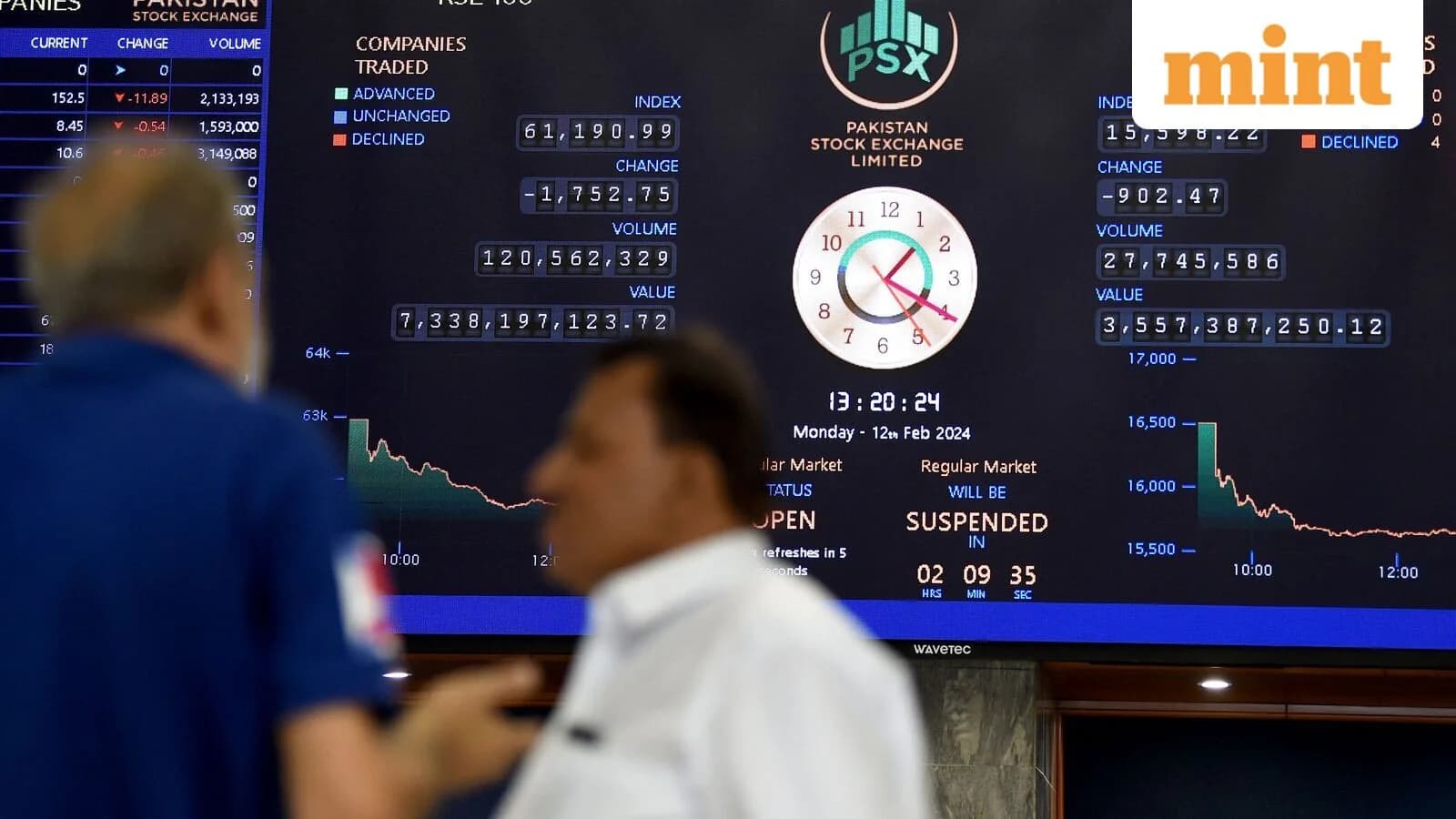
The steep decline was attributed to escalating Middle East tensions and domestic border conflicts. According to Reuters, at least 10 people have been killed in clashes with police after protesters tried to storm the gates of the US Consulate in Karachi on Sunday. Bilal Khan, head of international equity sales at Karachi-based brokerage Arif Habib, told Reuters that "the overall tensions in the Middle East have tanked the market along with the pro-Iran protests around the country." Pakistan is also facing threats from Afghanistan, with both sides carrying out cross-border strikes reaching as far as the Afghan capital. The conflict intensified after the United States and Israel carried out extensive military strikes on Iran, with the US and Israeli strikes killing Iran's Supreme Leader Ayatollah Ali Khamenei, triggering fresh uncertainty across global financial markets and driving volatility in commodities.
Pakistan launched operation 'Ghazab Lil Haq' on Thursday night in response to Afghan Taliban operatives attacking 53 locations along the more than 2,600 km-long border, targeting military installations deep in the country through air strikes. As reported by Mint, the KSE-30 index had also declined on Friday amid conflict with Afghanistan, shedding nearly 0.8%. In February, the index had declined as much as 9.10%, snapping its three-month winning streak. The ongoing conflict has created additional pressure on Pakistan's stock market, with both sides carrying out cross-border strikes reaching as far as the Afghan capital.
According to Anshul Jain, Head of Research at Lakshmishree, KSE30 is showing extreme technical weakness after the panic-driven 9.5% single-day decline. The index has tested the 50-week moving average near 46,440, with the velocity of the fall signaling distribution rather than routine correction. The next critical downside magnet sits near the 20-month moving average around 41,000, which may offer interim stabilization, while failure to hold this level could lead to the 50-month moving average near 33,000. Market analysts suggest that experience tells us that panic selling during a crisis is wrong strategy, with data from crises during the last many decades indicating that events like the present crisis will not have any impact on the market six months later.