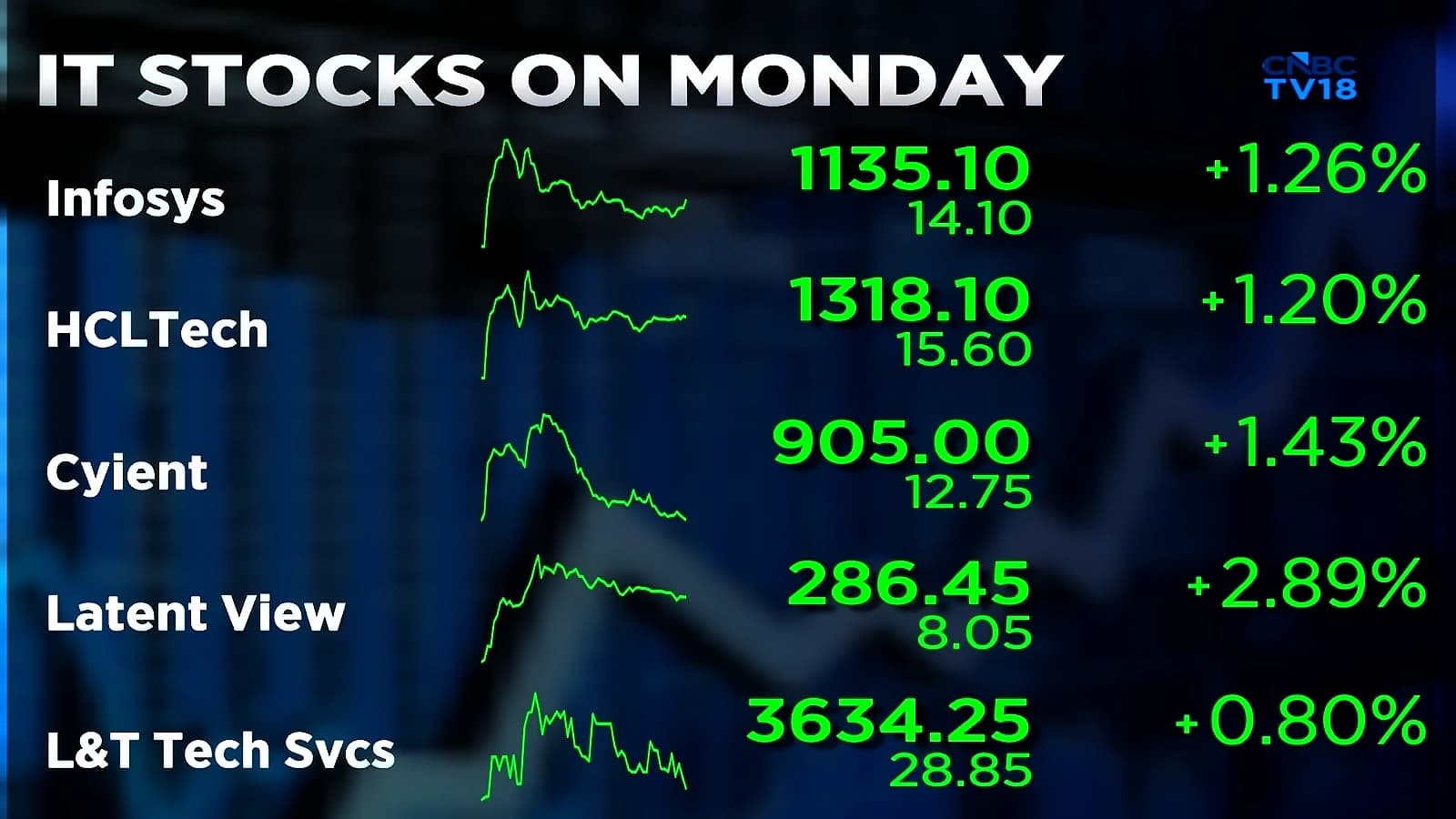
Indian IT stocks started the week on a strong note, with the Nifty IT Index rising over 1% on Monday as reports of Nvidia's potential price hikes surfaced, which may have spooked investors about a possible AI bubble going bust. According to The Economic Times, this rally came alongside a sharp 3% fall in the KOSPI, the benchmark index of South Korea's tech-heavy exchange. The contrasting performance reflects different market reactions to AI-related developments, with Indian IT stocks benefiting from relief rallies while global AI-linked stocks faced pressure. As per The Economic Times, the Nifty IT index has surged around 7% over the past 30 days, with Infosys and HCL Technologies shares gaining more than 1% each on Monday. The tech-heavy markets of Japan, South Korea, and Taiwan are also awaiting Nvidia's results, which will be released on Wednesday. Although blockbuster profits seem to be all but assured, options suggest a range of 5% to 6.5% after the results.
The sell-off in AI-linked stocks was triggered by semiconductor giant Nvidia announcing a 15% price hike by year-end for AI chips. As reported by CNBC TV18, this announcement is the latest in a series of developments that threaten the sustainability of AI companies running high on capital investments and low on revenue and profitability. The rising pressure on US interest rates may also squeeze the viability of massive investments planned by hyperscalers like Amazon, Meta, Google, and Microsoft. According to Bloomberg, the price hikes will take effect on systems shipped in early 2027 and will affect systems powered by Nvidia's flagship Vera Rubin and Grace Blackwell chips, with the increases depending on Nvidia's chip generation and memory configurations. Latest reports from Bloomberg indicate that some of Nvidia's largest customers have been informed that prices of servers containing its AI chips will rise by more than 15% in many cases on the back of soaring memory chip costs. Companies building servers under contract for large data centre operators such as Microsoft, Alphabet Inc.'s Google and Oracle have recently informed their customers of the upcoming increases.
According to CNBC TV18, most marquee Indian IT stocks are still down significantly for the year, with Wipro leading declines at -31.08%, followed by Infosys at -29.73% and TCS at -28.26%. However, Hexaware emerged as the biggest gainer among IT stocks on Monday after the company revealed that more than half of its revenue is already 'AI-infused'. This development led CLSA, a multinational broking firm, to project a 37% rise in the stock in the next 12 months. As per The Economic Times, the Hangzhou-based firm has been ploughing tens of billions of dollars into AI, with its shareholders eager to see how it will monetise the huge investments. The strong performance of Hexaware reflects investor interest in companies with established AI revenue streams, particularly those that have successfully integrated AI solutions into their existing business models.
As reported by CNBC TV18, Hexaware's gains were backed by strong volumes with more than 1.7 million shares exchanged in the first hour of trade, representing nearly 10 times the last 10-day average. This significant trading activity demonstrates investor interest in companies with tangible AI-related revenue and growth prospects. The strong trading volumes reflect the market's focus on companies with tangible AI-related revenue and growth prospects, with the substantial volume increase indicating heightened investor engagement with AI-focused stocks.
According to HSBC, India can serve as an 'anti-AI' diversifier as sharp swings in technology-exposed markets encourage foreign investors to broaden their portfolios. HSBC strategists Prerna Garg, Herald van der Linde and Yogesh Aggarwal said in a report that AI-rotation outflows from India have 'largely played out'. However, analysts continue to debate whether India's IT sector offers an 'anti-AI' advantage. As per The Economic Times, CLSA downgraded its rating on the shares of Tata Consultancy Services (TCS), Infosys and Tech Mahindra to 'Hold', and that on Wipro and Mphasis to 'Underperform' due to structural concerns. Given the long gestation time and limited potential upsides, CLSA noted that AI could initially compress revenues as productivity gains are passed on to clients, but 'AI volumes could supersede deflation by FY30'. The study found that the gap in AI readiness was the widest difference between the two groups, with 56% of Indian respondents saying AI and automation were making it slightly or much harder to get their desired job, close to the 59% of global graduates who saw AI as a barrier of some kind.