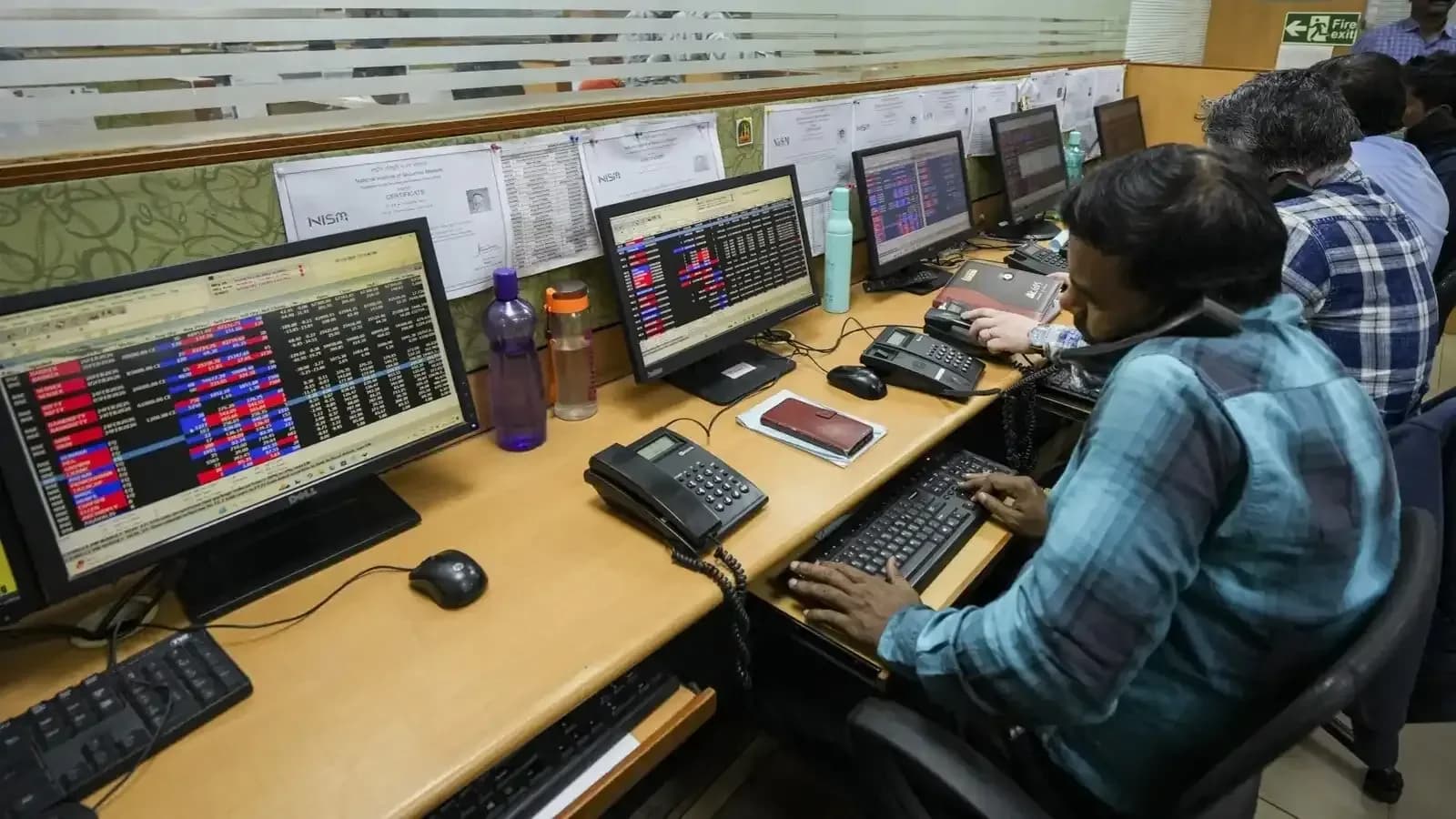
Indian benchmark indices ended largely unchanged on Monday, August 10, as rising crude oil prices and continued uncertainty over developments in the Middle East offset optimism from weaker-than-expected US jobs data, which strengthened expectations of a less restrictive Federal Reserve policy stance. According to reports from The Economic Times, The Times of India, and Investing.com, the Nifty50 ended the session up 13.15 points, or 0.05%, at 24,583.80, while the BSE Sensex settled at 78,542.44, gaining 43.27 points, or 0.06%. The market showed volatility throughout the session, with both benchmarks moving in a narrow range and swinging between gains and losses of around 0.3%. Broader markets showed mixed performance, with the Nifty Midcap50 rising 0.70%, the Nifty Midcap100 gaining 0.62%, the Nifty 200 advancing 0.17%, and the Nifty 500 rising 0.13%, while the Nifty Smallcap100 fell 0.27%, indicating that buying was not evenly spread across the broader market.
The mixed sentiment was reflected across sectoral indices, with Nifty Realty leading gains, rising 1.35%, followed by Nifty IT, Media, Private Bank and Financial Services indices ending higher. In contrast, Bank Nifty, Pharma, Auto, FMCG and PSU Bank indices closed in the red. According to The Times of India and Investing.com, Titan Company emerged as the biggest gainer on the Nifty 50, rising 3.14% to ₹5,098.20, extending its gains after the company's strong Q1 results and positive brokerage views. Bajaj Finance gained 1.93%, while Bajaj Finserv rose 1.15%. Other notable gainers included Tata Steel which advanced 1.09%, Asian Paints which gained 1.07%, and Infosys which rose 0.81%. On the losing side, State Bank of India fell 2.19%, making it the biggest loser among major stocks, while NTPC declined 1.52% and Eternal fell 1.57%. Nifty Private Bank gained 0.52%, Nifty Financial Services 25/50 rose 0.11%, Nifty IT gained 0.27% and Nifty Media rose 0.29%. Nifty PSU Bank fell 1.67%, Nifty Healthcare declined 0.35%, Nifty FMCG slipped 0.14%, and Nifty Oil & Gas also fell 0.37%.
From a technical perspective, the 24,500 support level remained intact, limiting the downside and keeping the broader recovery structure stable, as reported by The Economic Times. According to Ponmudi R, CEO of Enrich Money, the 24,600–24,700 zone continues to act as the immediate resistance area, with a sustained breakout above 24,700 potentially strengthening buying momentum and opening the way towards the 24,800 level. On the downside, 24,500 remains the immediate and crucial support level, with a decisive break below this level potentially increasing selling pressure and exposing the index to the 24,400–24,300 region. The 2107 stocks fell and 2051 advanced on the Bombay Stock Exchange, while 188 ended unchanged on the India National Stock Exchange, indicating broader market participation in the session's movements. From The Times of India, the Nifty 50 was trading at 24,606, up 35.35 points or 0.14% at 1:42 pm, showing some recovery from earlier lows.
The current session's modest gains come against the backdrop of several key market variables that continue to influence investor sentiment. Crude oil prices climbed to $87 as uncertainty over the reopening of the Strait of Hormuz persisted, with Brent crude rising 1.32% to $84.65 a barrel and US WTI gaining 1.04% to $78.99 a barrel. Foreign portfolio investors maintained their positive stance, investing ₹12,921 crore during the first week of August, providing important support to Indian equities. Upcoming inflation data, including July CPI and WPI readings, are expected to provide fresh insights into domestic price pressures, while the Q1 FY27 earnings season continues to gather momentum with companies like HAL, Bharat Forge, Grasim Industries, and Tata Motors scheduled to announce quarterly results. Market participants are closely monitoring these developments alongside global cues and domestic economic indicators to assess the broader market trajectory. As per The Times of India, Vinod Nair, Head of Research at Geojit Investments Limited, noted that markets remained "on a tight leash" as uncertainty surrounding the Strait of Hormuz continued to weigh on risk appetite, while encouraging corporate earnings were supporting broader sentiment.