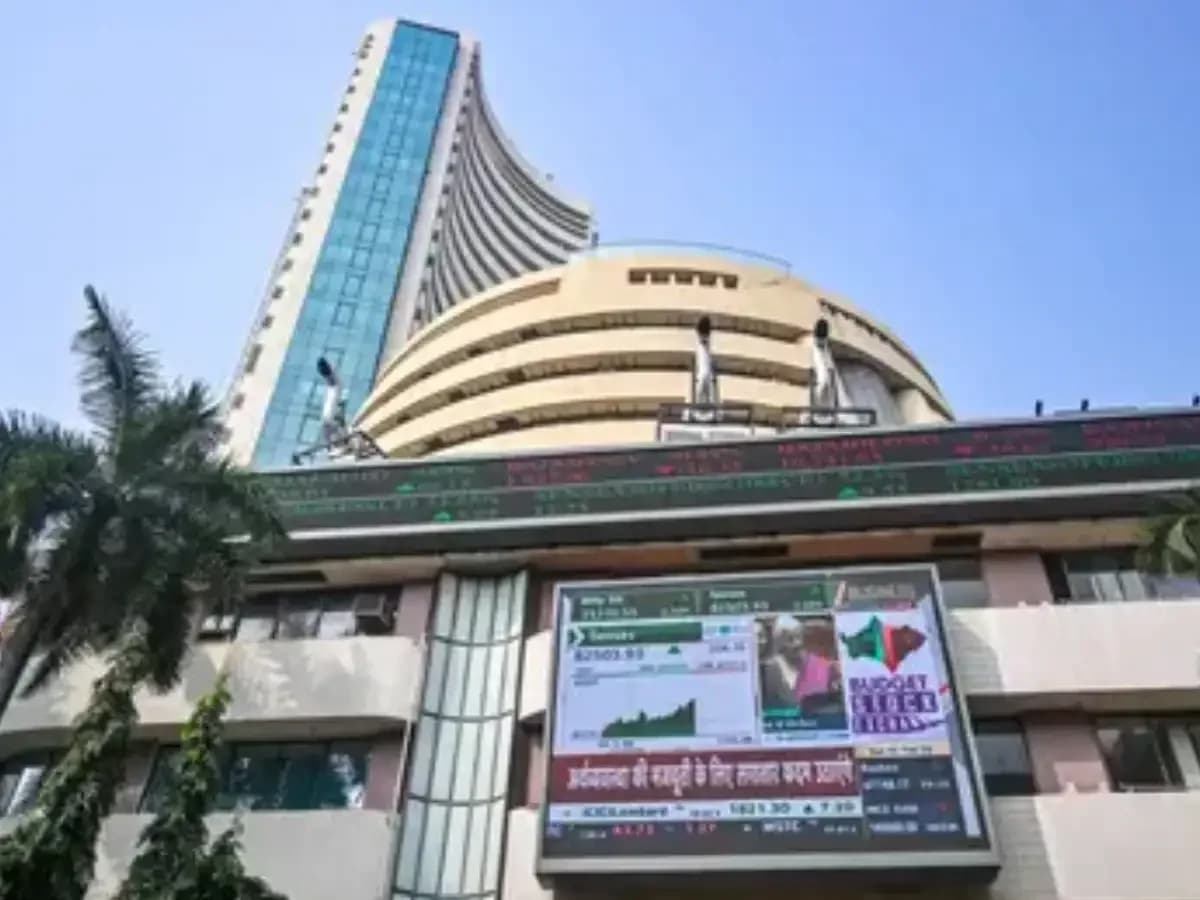
Indian equity benchmark indices are likely to trade with a positive bias as trading resumes on Thursday (August 20), according to latest market predictions. This follows a strong recovery in the previous session, where Nifty 50 rose 0.58% to 24,218.40, ending a seven-session losing streak, and Sensex gained 0.69% to 77,437.21. However, the latest session saw a seven-day falling streak with Nifty 50 closing below 24,100 level at 24,078.30 and Sensex dropping 325.78 points (0.42%) to close at 76,909.68. The recovery was led by private-sector banks providing support to the benchmark indices, with HDFC Bank being the top contributor to the Nifty's gains, helping the index maintain its positive bias despite limited directional momentum. Market activity remained subdued, with traders waiting for fresh triggers that could provide a decisive breakout from the current intraday consolidation. The recovery came as global markets turned firmer, with S&P 500 futures up 0.1%, Nasdaq-100 futures gaining 0.4%, and Asian markets largely higher - the Hang Seng Index rose 1.34%, Nikkei 225 gained 1.36%, and Shanghai Composite advanced 0.24%. However, Brent crude rose for a fourth straight session to near $92 as talks with Iran remained stalled and traffic through the Strait of Hormuz stayed well below pre-war levels, adding pressure to markets.
According to Choice Broking's Hitesh Tailor, Nifty has formed a Doji-like candlestick on the daily chart, indicating indecision after recent weakness and suggesting the index is yet to establish a clear directional trend. The immediate support levels are placed at 24,000–24,050, while resistance is seen at 24,270–24,350. The 50% Fibonacci retracement level at 24,190 has emerged as an important reference point, with sustaining above this level supporting the recovery attempt. Bajaj Broking Research noted that Nifty formed a high wave candle with a bullish gap below its base (24,172-24,184), highlighting pullback from oversold territory and breaking the sequence of lower highs. For traders, 24,300–24,400 on Nifty is the key near-term resistance zone, while 24,000 remains an important downside level, with confirmation still required for sustained recovery. As per LKP Securities's Vatsal Bhuva, the Nifty 50 found support near the lower band of its rising channel and filled a gap on the daily timeframe, with the 61.80% Fibonacci retracement level coinciding with the key support zone. Angel One's Hitesh Rathi identified the 24,040-24,000 zone as an immediate and crucial support band, followed by stronger support at 23,900, while immediate resistance is seen in the 24,200-24,300 range. Sudeep Shah, Head of Technical and Derivatives Research at SBI Securities, noted that Nifty has remained confined to an extremely tight 42-point range since the opening, reflecting a cautious approach among market participants at higher levels.

As reported by Choice Equity Broking's Sachin Gupta, Sensex formed a bullish green candle after three consecutive red candles, indicating meaningful recovery in sentiment. The latest session saw Sensex rising over 200 points, trading above 24,300, indicating a significant improvement from the previous session's decline. The index opened sharply higher with a gap-up of 558.77 points to 77,468.45 and maintained positive momentum through most of the session. Immediate support is placed at 77,000–77,365, while 77,720–78,000 remains the key resistance zone. The RSI stands at 41.78, well below its RSI moving average of around 55.34, signalling increasing bearish momentum, while the PCR at 0.88 reflects cautious market positioning and reinforces the near-term negative bias. Gupta added that the Sensex needs to reclaim the 77,270-77,400 resistance zone to regain stability and improve the near-term technical setup, with maintaining the 76,500-76,750 support band being crucial to prevent further weakness.
Foreign portfolio investors net sold shares worth ₹583 crore, while domestic institutional investors were net buyers at ₹3,538 crore, according to latest market data. This institutional flow pattern reflects the ongoing market recovery dynamics, with domestic investors providing support to offset foreign selling pressure. The divergence shows that domestic institutions continue to provide support even as foreign investors remain cautious, as reported by PTi News. Analysts expect Indian equities to remain sideways with a marginal recovery bias, supported by value buying after seven consecutive sessions of decline and firm global cues. Broader market action and sector-specific opportunities are likely to remain in focus as the market navigates through the current consolidation phase.
HDFC Bank, Infosys, ICICI Bank, Reliance Industries, Tata Steel, HCL Technologies and Kotak Mahindra Bank were the top movers in the SENSEX, driving the index's recovery above 24,300. Saatvik Green Energy remains in focus after its subsidiary secured a ₹190 crore order for solar PV modules, expected to be executed by March 2027, reinforcing the company's exposure to India's expanding renewable-energy and solar manufacturing ecosystem. Kfin Technologies could remain active after General Atlantic sold an 8.75% stake for approximately ₹1,400 crore, with large institutional stake transactions influencing short-term sentiment and trading volumes. HDFC Bank has raised approximately $1.75 billion, making it one of the largest overseas fundraises by the lender since the global financial crisis period. Samsung is reportedly planning a massive $79 billion shareholder-return initiative, which could influence global technology-sector sentiment. Realty stocks were among the strongest performers, with Oberoi Realty remaining in focus after receiving relief related to its 360 North project, while Lenskart shares rose around 4.5% after establishing a new subsidiary in China. Healthcare and pharma stocks could remain active in Friday's trading session, with several pharmaceutical companies having important developments. The rupee weakened 7 paise to close at 95.75 per dollar, its lowest level in August, though with the US Dollar Index softening and crude prices stable, the rupee is positioned to open with an upward bias.