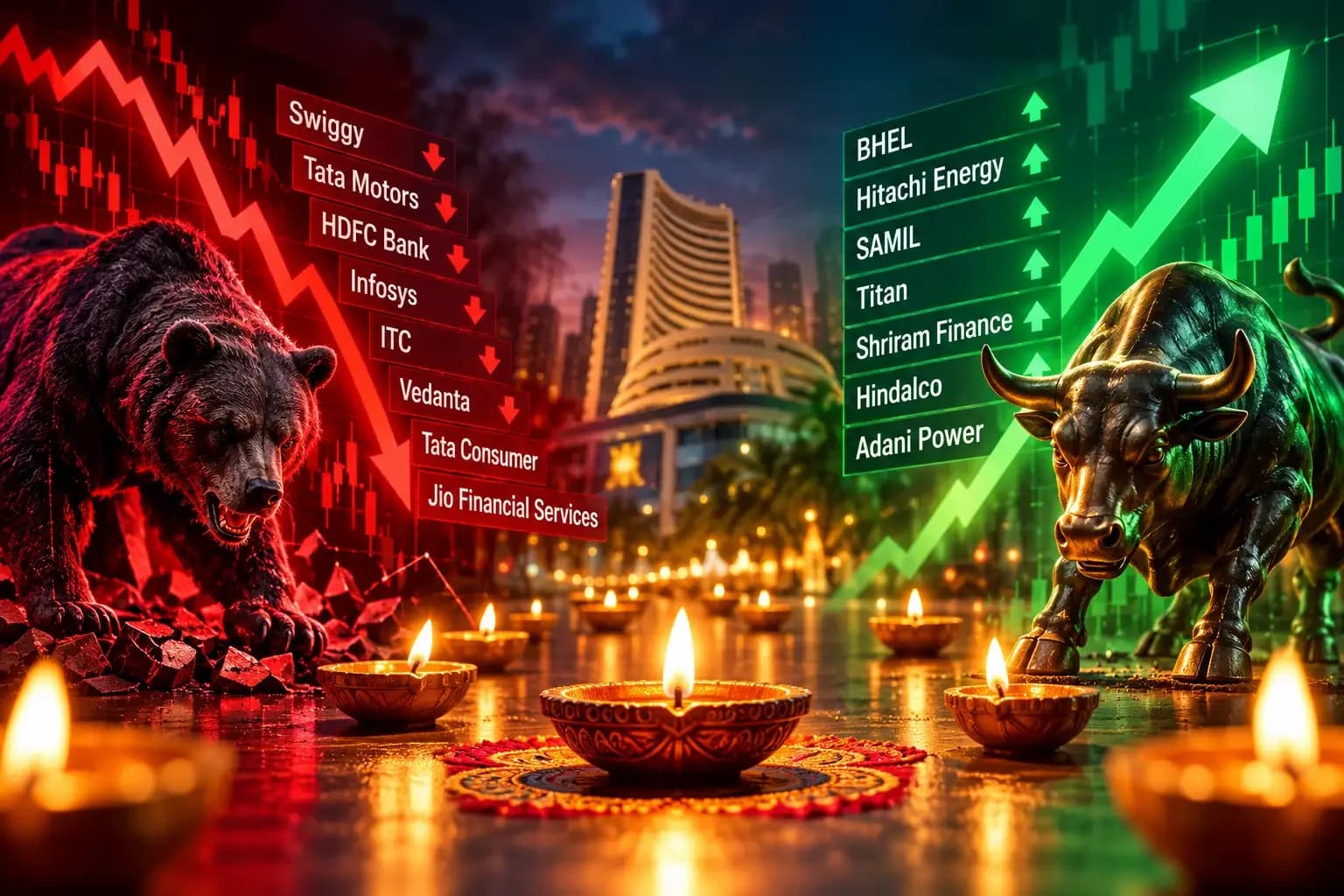
The recent rally in the Nifty 50 has created a stark divergence between large-cap and broader market performance, with the benchmark surging 10.75% over 10 trading sessions from its October 23 closing level of 22,600 to 25,030 on November 6. As reported by SAMCO Securities, the Nifty Top 10 Equal Weight Index surged 10.64% over the past month, significantly outperforming broader market indices. In contrast, the Nifty Midcap 150 declined 2.74% during the same period, while the Nifty Smallcap 250 also fell 2.74%, and the Nifty Microcap 250 dropped 5.32%. According to SAMCO Securities Head of Market Perspectives and Research Apurva Sheth, this divergence explains why many investors are struggling to see similar gains in their portfolios as the rally remains heavily concentrated in large-cap stocks. "Lot of investors are scratching their head thinking why their portfolio isn't moving up with Nifty. The simple answer is you don't own what is moving up," Sheth noted.
The performance of the Nifty Top 10 Equal Weight Index constituents highlights the recovery in large-cap stocks. ICICI Bank and Infosys gained 16% each over the past month, followed by Bharti Airtel, which advanced 14.61%. Kotak Mahindra Bank rose 10.08%, while HDFC Bank gained 10%. Larsen & Toubro advanced 9.02%, Reliance Industries climbed 8.44%, State Bank of India gained 6.24%, ITC rose 5.91%, and Axis Bank advanced 5.58%. The average one-month return of these 10 stocks stood at 10.19%, though their average year-to-date performance remained negative at 6.73%, indicating that the recent rally has not fully reversed earlier losses. Several of these stocks had experienced sharp corrections earlier in the year, with HDFC Bank down 21.55% in 2026, Infosys losing 27.76%, ITC declining 30.12%, and Reliance Industries down 16.48%.

According to SAMCO Securities, the divergence stems from valuation catch-up among heavyweight stocks and return of foreign portfolio investors (FPIs). Large-cap stocks were among the worst performers during the preceding market correction that began in January 2026, pushing several heavyweight companies to relatively attractive valuations. The average price-to-earnings ratio of these 10 stocks stood at 21.18, while the average price-to-book ratio was 3.43. FPIs have invested approximately ₹40,000 crore over the last eight sessions, with their initial preference being large, liquid and well-established companies that offer the liquidity and scale required for substantial capital deployment. On November 5 alone, foreign investors bought ₹15,000 crore worth of Indian shares on a net basis, their largest single-day purchase in nearly six years, according to Reuters.
As reported by SAMCO Securities, this represents a heavyweight-led rebound, driven by valuation comfort and the return of institutional flows rather than a broad-based market recovery. The recent market recovery has been supported by falling crude oil prices, renewed foreign institutional buying, improving corporate earnings and easing geopolitical concerns. However, the gains have been uneven, with large companies attracting most of the fresh investment. The next crucial test for the market will be whether the rally eventually broadens to midcaps and smallcaps or remains concentrated in large companies. According to Sheth, the market is still in the early stages of a heavyweight-led rebound, with the wider market yet to demonstrate convincing strength. A broader recovery would require participation from mid-cap and small-cap stocks, where many retail investors have substantial exposure.