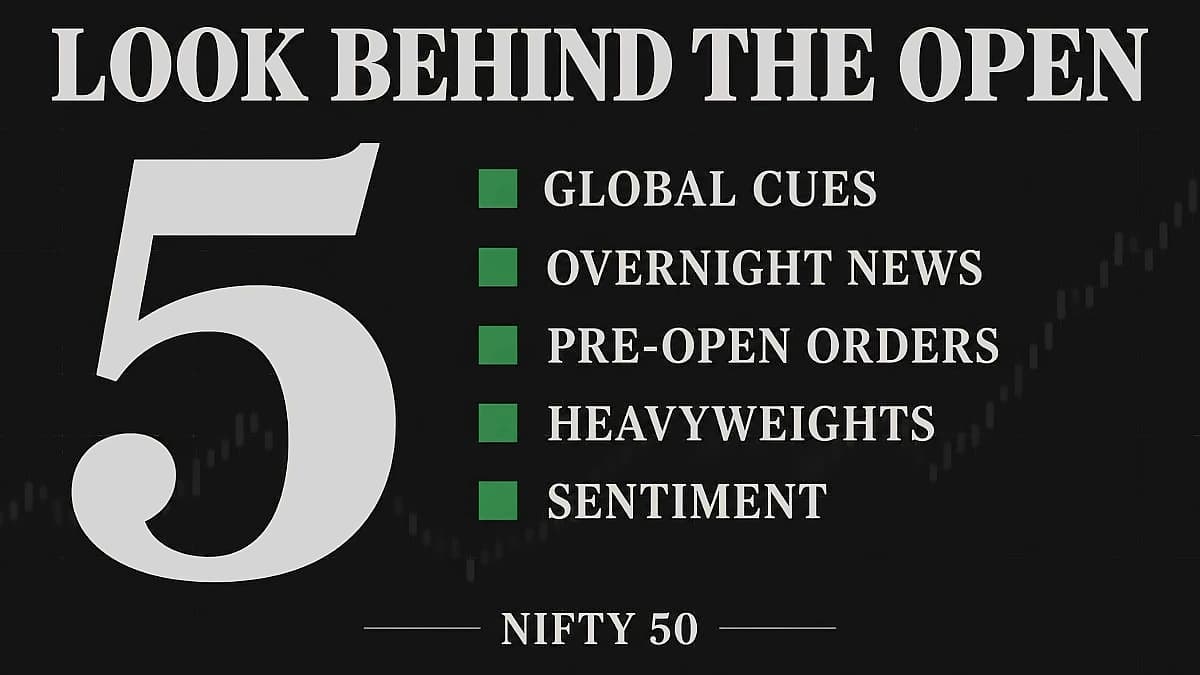
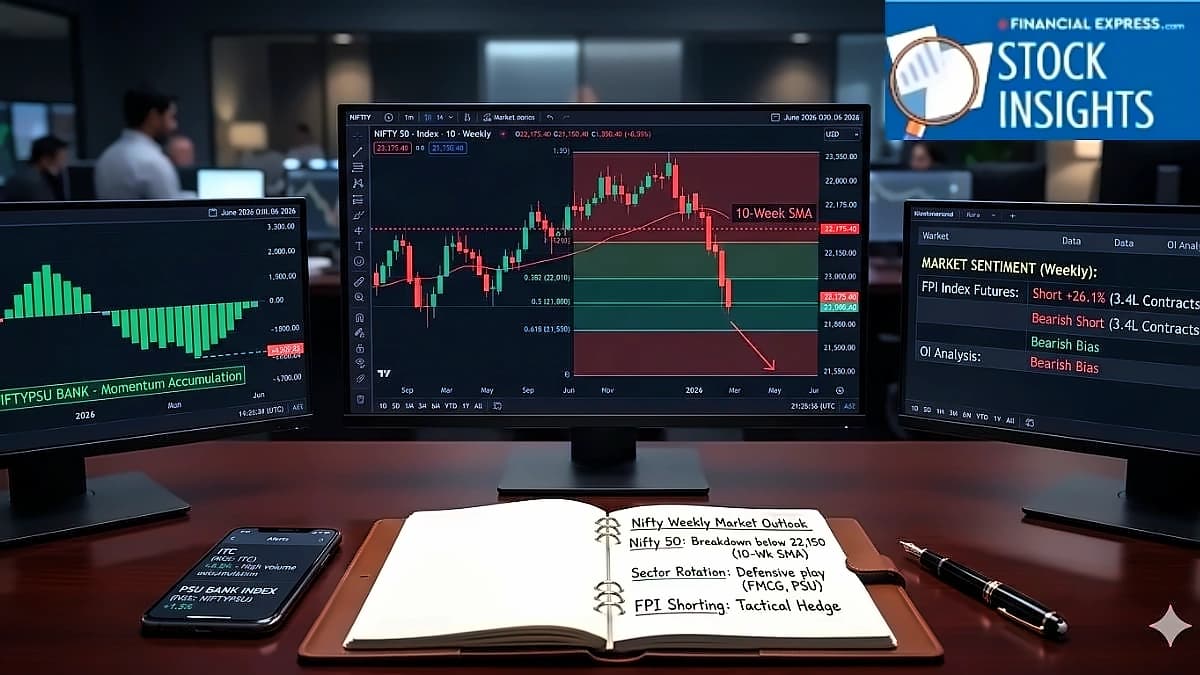
The Nifty ended Wednesday's session at 23,161.60, closing 0.23% lower after a highly volatile trading day that saw the index move above its 8-DEMA to touch an intraday high of 23,300 before erasing all gains. According to reports from The Financial Express, the downside close candle thereof, marking the second consecutive weekly red candle, is the first such instance since March. This also marks the first close in six weeks below the 10-week SMA, hinting at the potential for the start of a downtrend that is not evident on the face of it. The index is still held within the recent trading range of 23,152-23,500, with a break expected in the coming week, though no runaway move is anticipated with 22,800-23,650 likely to keep a lid on swings. GIFT NIFTY futures traded more than 140 points lower at 7:50 am on Thursday, indicating a weak start for NIFTY50 amid elevated global tensions and weak global market cues.
Indian benchmark indices ended lower in a highly volatile session, with the Nifty 50 closing below the 23,200 mark amid broad-based selling across sectors. However, pharma, private banks and media stocks managed to outperform and ended in the green despite the overall market weakness. According to market reports, ICICI Bank, Kotak Mahindra Bank, Grasim, M&M, JSW Steel were among top gainers on the Nifty, while losers were Infosys, HCL Tech, Adani Ports, Trent, Eternal. The market opened on a subdued note amid weak global cues, as a sharp rise in US inflation and renewed escalation in the Middle East conflict weighed on investor sentiment, dragging the Nifty below 23,100 in early trade. The benchmark staged a strong intraday recovery and briefly climbed above 23,300, supported by buying in select heavyweight stocks, but the momentum failed to sustain in the second half.
The Nifty IT index declined 1.62% to 27,821.00, with the index tanking 11.64% in the seven consecutive trading sessions. Major IT stocks including Infosys (down 2.51%), Oracle Financial Services Software (down 2.03%), HCL Technologies (down 1.83%), Tech Mahindra (down 0.78%), Persistent Systems (down 0.77%), Wipro (down 0.72%), Tata Consultancy Services (down 0.71%), Mphasis (down 0.64%) and Coforge (down 0.37%) fell during the session. The sustained decline in IT stocks reflects broader market concerns about technology sector valuations amid global uncertainties and geopolitical tensions.
Market experts are warning of continued weakness unless key resistance levels are reclaimed. According to Shrikant Chouhan, Head of Equity Research at Kotak Securities, the market is currently exhibiting a lower-top formation, which supports the possibility of further downside. "On daily and intraday charts, the market is holding a lower top formation, which supports further weakness from the current levels. As long as the market is trading below 23,250 and 73,800, weak sentiment is likely to continue," Chouhan said. He identified 22,950 on the Nifty and 73,000 on the Sensex as immediate support zones, with a breach potentially triggering additional selling pressure toward 22,800 and 72,500 respectively. On the upside, Monday's high of 23,267 remains the immediate hurdle, with a move above this level potentially opening recovery toward the 23,500–23,550 zone. The Nifty50 opened more than 200 points lower but later recovered partially during the mid-market session, however, closing-hour selling again pulled back the index near its crucial support levels.
The Indian rupee ended sharply lower, depreciating 48 paise to close at 95.75 per dollar on Thursday, compared with its previous close of 95.27. Global market cues remain mixed with escalating Middle East tensions after the US carried out multiple strikes on Iran for the second consecutive day. According to Upstox, Brent crude oil prices steadied near $94 per barrel on Thursday morning following the US military action. President Trump accused Iran of taking too long to make a deal and said that it will have to pay the price for it. The US markets closed deep in the red as tensions escalated, with the Dow Jones, NASDAQ and S&P 500 plunging over 1.5% on Wednesday. Investors also turned cautious after US CPI inflation soared to 4.2%, the highest in three years, driven mainly by a sharp increase in energy prices amid the Iran conflict. Energy costs surged 23.5% year-on-year, while core inflation edged up to 2.9%. Asian markets opened in the red across the board, with the Japanese Nikkei falling 0.9%, Korea's Kospi dropping 0.7% and Hong Kong's Hang Seng slipping 0.2% on Thursday morning.