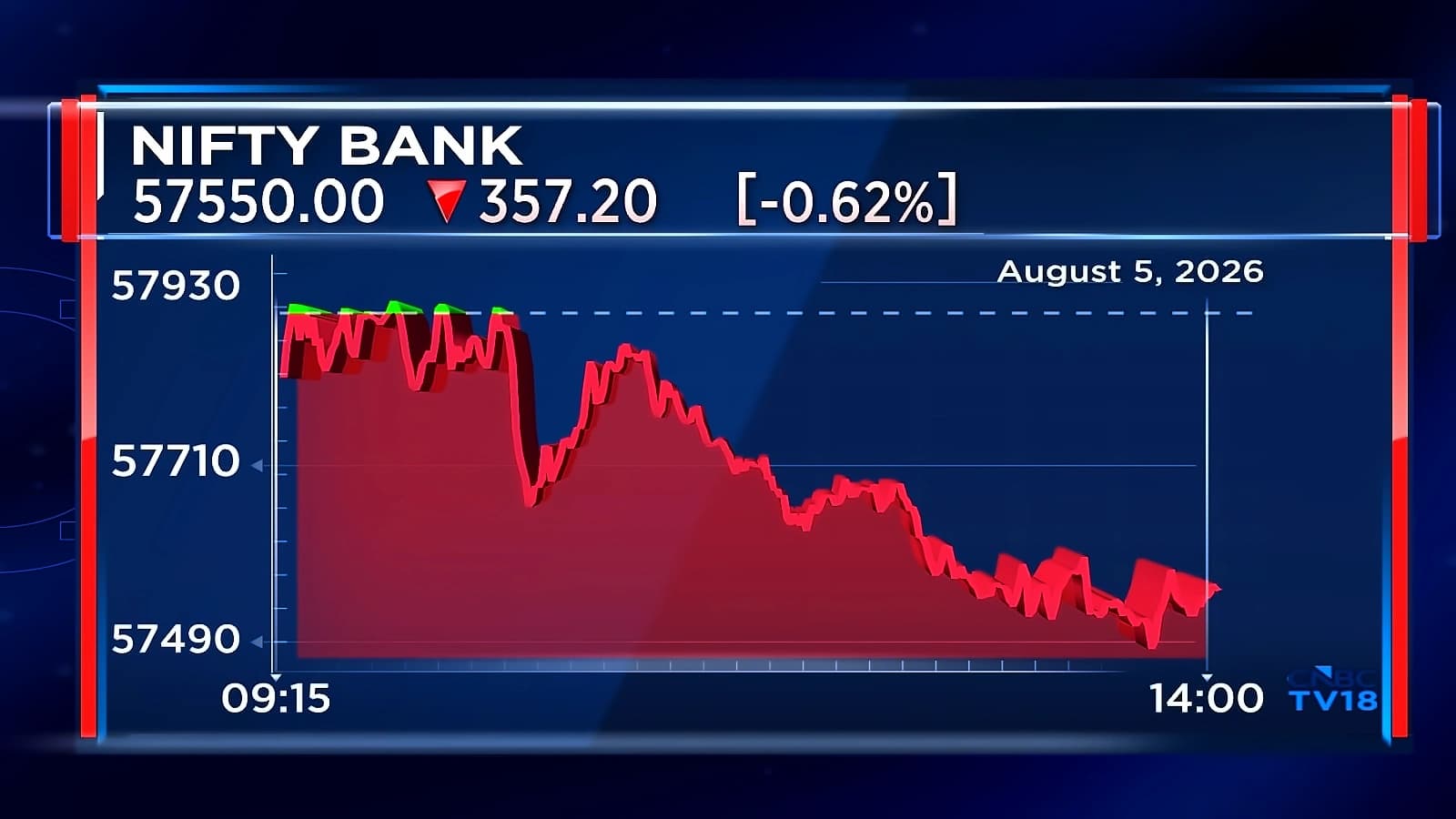
The Nifty Bank index experienced significant selling pressure, falling to the day's low following the Reserve Bank of India's decision to keep the repo rate unchanged at 5.25% and maintain the policy stance as 'Neutral'. According to reports from CNBC TV18, the banking sector faced renewed pressure as investors assessed the implications of the central bank's monetary policy stance. The decline reflects broader concerns about the sector's near-term profitability outlook amid margin squeeze pressures.
The primary driver behind the banking sector's weakness stems from margin squeeze concerns affecting Indian banks. As reported by CNBC TV18, the gap between the cost of money raised by banks using short-term certificates of deposits and the yield on government treasury bills narrowed in July across most maturities. This compression in net interest margins has created additional pressure on bank profitability, contributing to the sector's underperformance. The RBI's latest policy stance provides some relief as it maintains the current rate environment, though the central bank continues to monitor inflation pressures that could impact future policy decisions.
The RBI's decision to maintain the status quo reflects a 'wait and watch' approach with the central bank willing to adopt a more reactive stance on policy rates. According to market analysts, the policy outcome was marginally more dovish than expected, particularly on the inflation outlook and liquidity management approach. The absence of any indication that the RBI intends to use permanent liquidity absorption tools to manage excess liquidity arising from capital inflows is supportive for bond market yields. With crude oil below USD 80 per barrel and expected FCNR(B) inflows supporting rupee liquidity, the macro environment has become more favourable for India despite global uncertainties.
The RBI has upwardly revised its FY27 GDP growth forecast to 6.7% from the earlier estimate of 6.6%, as Governor Sanjay Malhotra pointed to steady consumption, manufacturing strength and healthy credit expansion. However, the central bank has slightly lowered CPI inflation projection to 5.0% from 5.1% earlier, with inflation moving unevenly through the year: 5.3% in Q1, 4.7% in Q2, 5.9% in Q3, easing to 5.5% in Q4. The RBI's assessment of a resilient domestic economy, supported by healthy banking and NBFC fundamentals, provides a positive backdrop for capital markets despite global volatility.
For Small Finance Banks, the RBI's policy continuity provides greater certainty as their business model serves households, farmers, traders, and small enterprises across semi-urban and rural India. The policy outcome largely reinforces a range-bound but constructively selective outlook for equities, with steady economic growth and intact corporate demand drivers continuing to support the broader earnings outlook. However, elevated inflation expectations for Q3 and persistent global volatility may limit sharp valuation re-ratings in the near term, keeping investor focus on sectors with strong margin visibility and lower input-cost sensitivity, including banking, domestic consumption, and infrastructure.