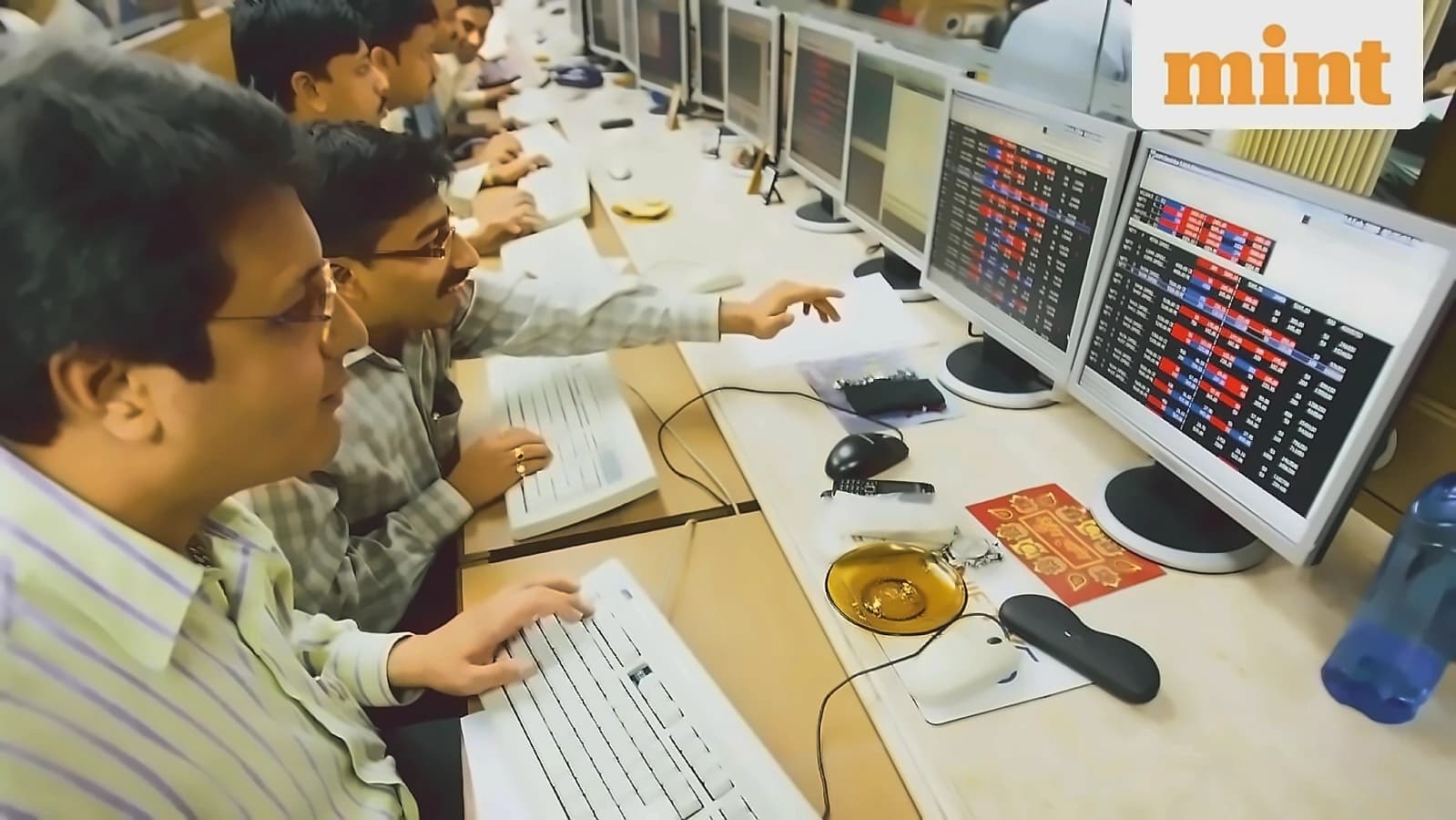
Indian equity benchmarks opened Thursday's session on a weak note, with BSE Sensex declining 229.69 points to 74,139.32 and NSE Nifty dropping 66.30 points to 23,339 as of 9:15 AM. GIFT Nifty futures traded 0.11% lower at 23,306.50 points before the opening bell, suggesting continued weakness as global sentiment remains fragile. The subdued start comes despite expectations of a busy trading session, with investors turning cautious amid renewed geopolitical tensions in West Asia and ahead of the Reserve Bank of India's monetary policy decision. In the pre-open session at around 9:05 AM, the Sensex had slipped 313.29 points to 74,032.88, while the Nifty fell 121.40 points to 23,284.20. The exchange data showed 19 out of the 50 stocks listed on the benchmark NIFTY50 index were trading in the green, while the remaining 31 stocks declined during early market hours.
IT stocks witnessed heavy selling, dragging the Nifty IT index down over 5% during the session, making it the biggest laggard among all sectoral indices. The index had soared 7.64% in the past three consecutive trading sessions before today's sharp decline. Among the 30-Sensex firms, TCS emerged as the top loser, falling around 7%, while Tech Mahindra, HCL Technologies, Infosys and Wipro were among the top losers in the Nifty 50 constituents. IT stocks fell sharply amid profit-taking after rallying in the past few days, with the sectoral weakness contributing significantly to the overall market decline as investors showed selective selling in technology stocks amid mixed global cues. Except for healthcare, all sectoral indices traded in the negative territory, highlighting the sector-specific nature of the current market weakness.
Eternal, Titan, Adani Ports and Tech Mahindra were among the gainers in early trade, while Trent, Infosys, HDFC Bank, Bajaj Finserv, Kotak Mahindra Bank and Tata Steel were among the biggest laggards from the 30-Sensex firms. This mixed performance reflects selective buying in certain stocks while broader market sentiment remains cautious. Foreign Institutional Investors (FIIs) offloaded equities worth ₹5,616.56 crore on Wednesday (June 3, 2026), according to exchange data, contributing significantly to the market weakness amid continued foreign fund outflows.
Geopolitical concerns resurfaced after tensions between the United States and Iran intensified once again. According to reports, Iran launched strikes targeting Kuwait International Airport early on Wednesday, the day after US Central Command said it had intercepted multiple Iranian ballistic missiles and carried out defensive operations against targets on Qeshm Island in the Persian Gulf. Despite these diplomatic signals, the latest military developments have reignited concerns over regional stability and global energy supplies. US President Donald Trump said Iran had agreed not to acquire nuclear weapons, while Washington also indicated that Israel had agreed to a ceasefire arrangement with Lebanon provided Hezbollah halts its attacks. Any escalation in the region could have implications for global trade routes, energy prices and overall market sentiment, with investors worrying that a prolonged conflict could disrupt global energy supplies and create further uncertainty in international financial markets. The absence of tangible progress towards a diplomatic resolution continues to leave markets highly sensitive to geopolitical headlines, particularly given the implications for energy prices and global trade flows.
While geopolitical developments dominate headlines, the focus at home is increasingly shifting towards the RBI's Monetary Policy Committee (MPC) meeting. The central bank's policy announcement on Friday is expected to be the most significant domestic event of the week. Investors will closely analyse the RBI's outlook on inflation, growth, liquidity conditions and interest rates amid evolving global uncertainties. Any commentary on the impact of higher crude oil prices and external risks could influence market direction in the near term. In Asian markets, South Korea's Kospi, Japan's Nikkei 225 index, Shanghai's SSE Composite index and Hong Kong's Hang Seng index traded lower, while U.S. markets ended lower on Wednesday (June 3, 2026). Brent crude, the global oil benchmark, traded 0.97% lower at $96.86 per barrel. V.K. Vijayakumar, Chief Investment Strategist at Geojit Investments Limited, noted that "In the near-term, headwinds are stronger for the market than tailwinds. The continuing uncertainty in West Asia and the big and sustained FPI selling are the strong headwinds which are weighing on the market."