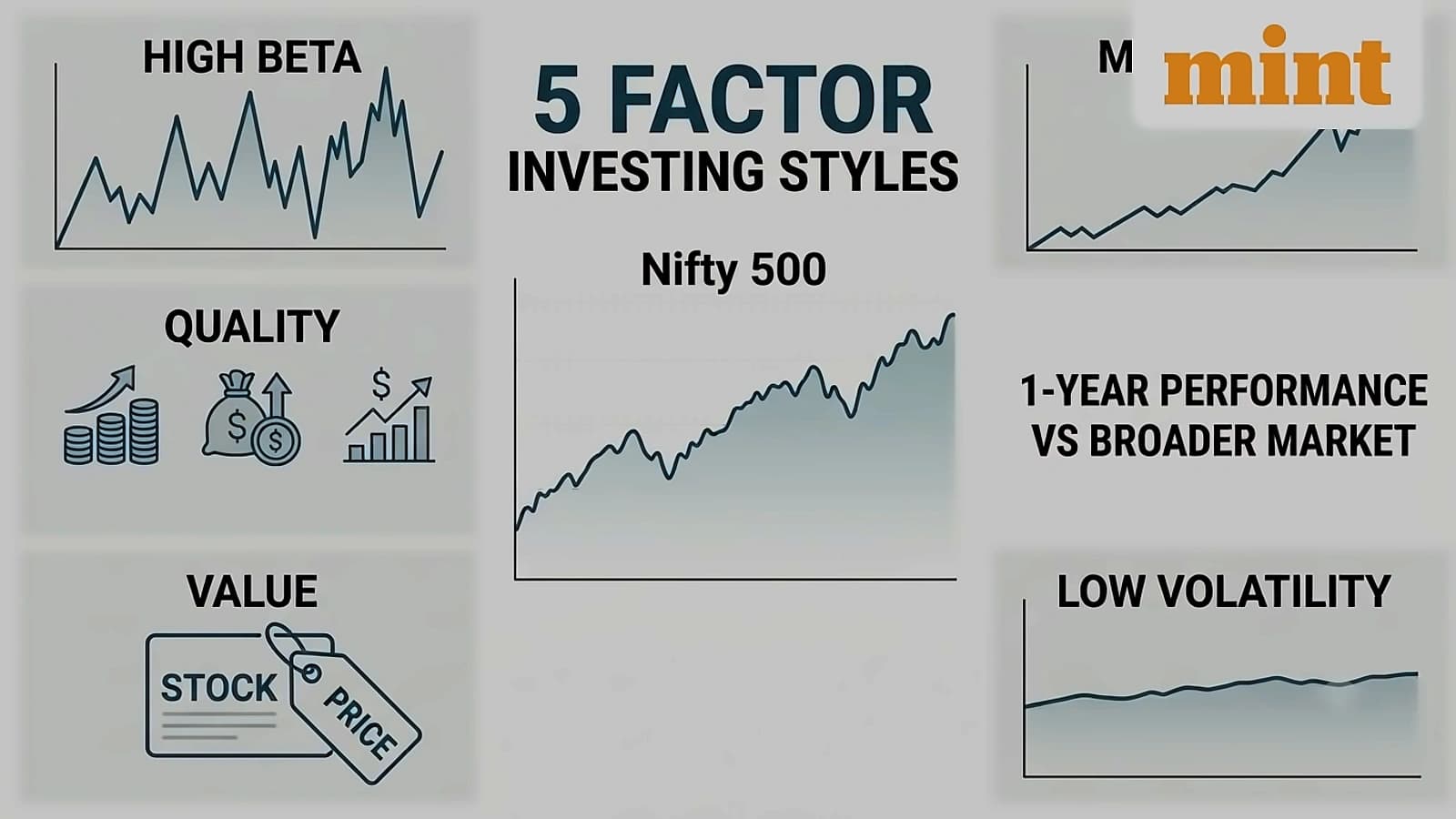
Momentum investing has staged a dramatic comeback on the Indian stock market, delivering 17.29% returns in the three months to 30 June after nearly 15 months of tepid performance. According to National Stock Exchange (NSE) data, the Nifty 500 Momentum 50 index outpaced all other factor investment styles during this period. The momentum factor, which focuses on stocks showing strong upward price trends, surpassed the Quality index by 1.22 percentage points, Value by 9.36 percentage points, and Low Volatility by 1.77 percentage points. The recent resurgence indicates that despite a broader market slowdown, certain sectors continue to outperform, with momentum capital actively chasing these pockets of growth outside major large caps.
The recent resurgence follows a challenging period for momentum investing, which delivered stellar returns of 47.7% in 2023 and 27.2% in 2024, according to NSE data. However, performance weakened in 2025 with the index declining 7.5%. As reported by Siddharth Srivastava, head of ETF products at Mirae Asset Investment Managers (India), momentum typically performs well during bull markets or when markets exhibit strong trends. "Apart from large caps and certain segments like IT and FMCG, others have done relatively better and that is what momentum has been able to capture," Srivastava noted. The strategy's recent rebound suggests that certain segments or stocks are showing sustained outperformance in the current market environment.
Rohit Tandon, senior fund manager at Kotak Mahindra Mutual Fund, explained that momentum performs well when market volatility increases gradually from a low base. "During 2025, momentum underperformed as markets were affected by tariffs and geopolitical conflicts. This led to sudden and sharp volatility jumps rather than a gradual increase," Tandon said. Viraj Gandhi, chief executive at Samco Mutual Fund, highlighted that momentum's recent rebound is not entirely surprising given the strategy's historical performance of around 20% CAGR. "Momentum is a factor that typically performs well during bull markets or when markets exhibit a strong and persistent trend. If momentum is doing well in the current scenario, it means certain segments or stocks are showing sustained outperformance," Gandhi noted.
According to Gandhi's daily rolling-return analysis, momentum has demonstrated superior long-term performance over three and five-year periods. Over a three-year rolling horizon, momentum outpaced the benchmark by 7.8%, significantly higher than value at 5.96%, quality at 3.65%, and low volatility at 3.09%. Over a five-year rolling period, momentum led the pack by beating the benchmark by 7.72%, compared to value at 4.06%, quality at 3.73%, and low volatility at 2.91%. The strategy's outperformance persists across multiple timeframes, demonstrating its ability to capture sustained market trends and momentum-driven growth.

Despite the strong recent performance, momentum investing carries significant risks, as highlighted by Abhishek Kumar, founder of SahajMoney and a Sebi-registered investment adviser. "Momentum funds can see sharp drawdowns when trends reverse or markets turn sideways, so investors need to be prepared for periods of underperformance," Kumar warned. He emphasized that these products are best suited for experienced investors with high risk tolerance and a long-term horizon, and should ideally be part of a satellite portfolio rather than the core portfolio. The strategy involves holding stocks that are already rising in an attempt to benefit from further potential gains, but can face sharp drawdowns when market trends reverse or during broad corrections, as demonstrated by the 10.82% decline on 4 June 2024 when the Nifty 500 Momentum 50 index fell alongside the broader market.