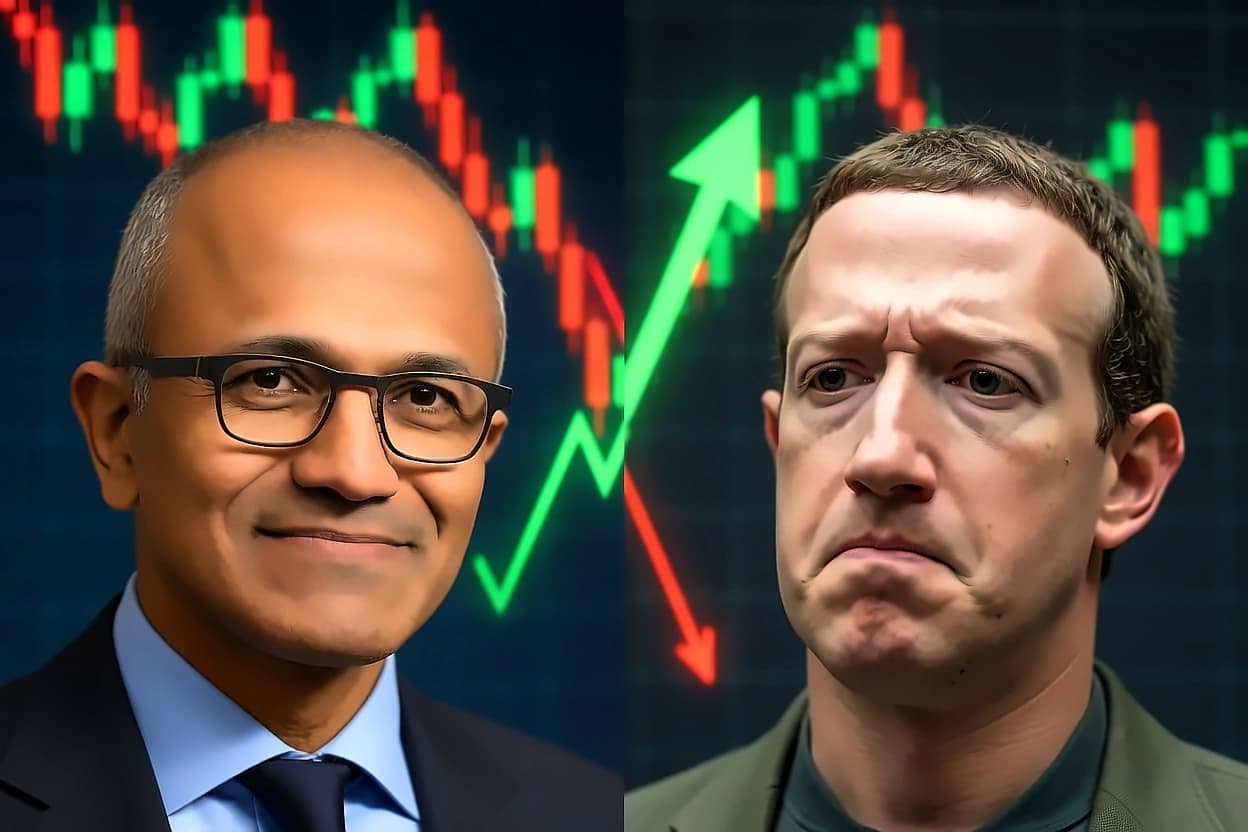
The megacap technology companies faced a critical test this week as investors scrutinized their artificial intelligence spending strategies. According to reports from Investing.com India and The Economic Times, Microsoft rose approximately 16% while Meta fell nearly 8% following their earnings announcements. The market's reaction centered not on whether to invest in AI infrastructure, but rather on the timeline for achieving returns on these massive capital expenditures. Meta's capex hit $31 billion in the quarter, with free cash flow collapsing to $784 million from $8.5 billion a year ago, while the company issued approximately $25 billion of debt to maintain spending levels. Meta's 2026 capex guide moved to $130-145 billion, significantly higher than previous estimates, as the company remains in build mode. The divergence between Microsoft and Meta is unlikely to be a one-quarter anomaly, instead signaling that the AI trade is entering a more mature phase where execution matters more than ambition.
Microsoft distinguished itself by providing concrete financial metrics for its AI investments. As reported by Investing.com India, the company achieved approximately 30% return on invested capital (ROIC) on its AI initiatives and demonstrated that AI has become a standalone business unit. Microsoft's AI run-rate reached $37 billion, representing a 123% increase, while Azure passed $100 billion in annual revenue and is still accelerating with guidance of 45% growth in constant currency for the next quarter. Microsoft reported fiscal fourth-quarter revenue of $90.01 billion, beating the $87.62 billion consensus estimate, with earnings per share reaching $4.74, well ahead of expectations. The biggest surprise came from Azure, where revenue grew 43% in constant currency, outperforming forecasts and pushing annual revenue above $100 billion for the first time. Microsoft 365 Copilot passed 30 million paid seats, providing concrete evidence of AI monetization. Equally important was management's outlook - rather than announcing another sharp increase in spending, Microsoft reaffirmed its capital expenditure plans and said future investments would remain tied to customer demand, proving that Microsoft's AI infrastructure is expanding because demand already exists.
The most significant development came from the cloud computing sector, where all three major providers - AWS, Azure, and Google Cloud - accelerated simultaneously for the first time in recent quarters. According to Investing.com India, AWS achieved a $169 billion run-rate, growing 37% year-over-year, marking the fastest growth in 18 quarters with record $18.6 billion of net-new annual recurring revenue (ARR) added during the quarter. Azure reached a $124 billion run-rate, growing 43% year-over-year, accelerating from 39% last quarter with $15.9 billion of net-new ARR. Google Cloud recorded $99 billion run-rate, growing 82% year-over-year, adding record $19.0 billion of net-new ARR and maintaining capacity constraints against a growing backlog. The semiconductor supply chain has also benefited from AI demand, with Lam Research Corp., Schneider Electric SE and Prysmian SpA among the outperformers on robust demand for technology that enables AI.
Meta faced significant challenges as the company missed investor expectations on earnings and revenue guidance for the current quarter. According to CNBC and The Economic Times, Meta expects revenue this quarter of between $61 billion and $64 billion, or $62.5 billion at the middle of the range, while analysts were expecting guidance of $63.15 billion. At the same time, Meta's free cash flow plunged 91% year-on-year to $784 million as it continues to spend on AI investments. However, Meta CEO Mark Zuckerberg said the company is "getting a lot of offers for compute at a significant premium" over what the company paid for it, suggesting a potential shift toward monetizing excess computing capacity. As reported by CNBC, this would represent a change of direction for Meta if it begins leasing out its excess computing capacity to third parties, though Zuckerberg acknowledged the company will need to keep compute resources for developing new products.
The AI investment divergence extends beyond Big Tech, with European stocks outperforming US markets as gains broaden beyond technology into financials, energy and healthcare sectors. According to The Economic Times, S&P 500 firms are on track to post a 29% surge in second-quarter earnings per share, among the highest on record outside of post-crises recovery years, yet the S&P 500 has gone nowhere since the season began in mid-July. The Stoxx 600 has advanced 1.3%, and briefly hit a record, as its members posted a 19% surge in profits after earnings barely rose in the past two years. US earnings revisions have seen net upgrades for 15 weeks in a row, the longest streak since 2022, while European companies have boosted guidance at one of the strongest rates in recent years. A UBS Group AG basket of AI winners rallied 11% after reassuring earnings reports, including companies like Sandisk Corp., ASML Holding NV and Taiwan Semiconductor Manufacturing Co. The analysis suggests that while buyers continue debating returns on AI investments, companies in the hardware value chain are already collecting substantial cash flows, with investors becoming more selective about which AI trades are worth backing.