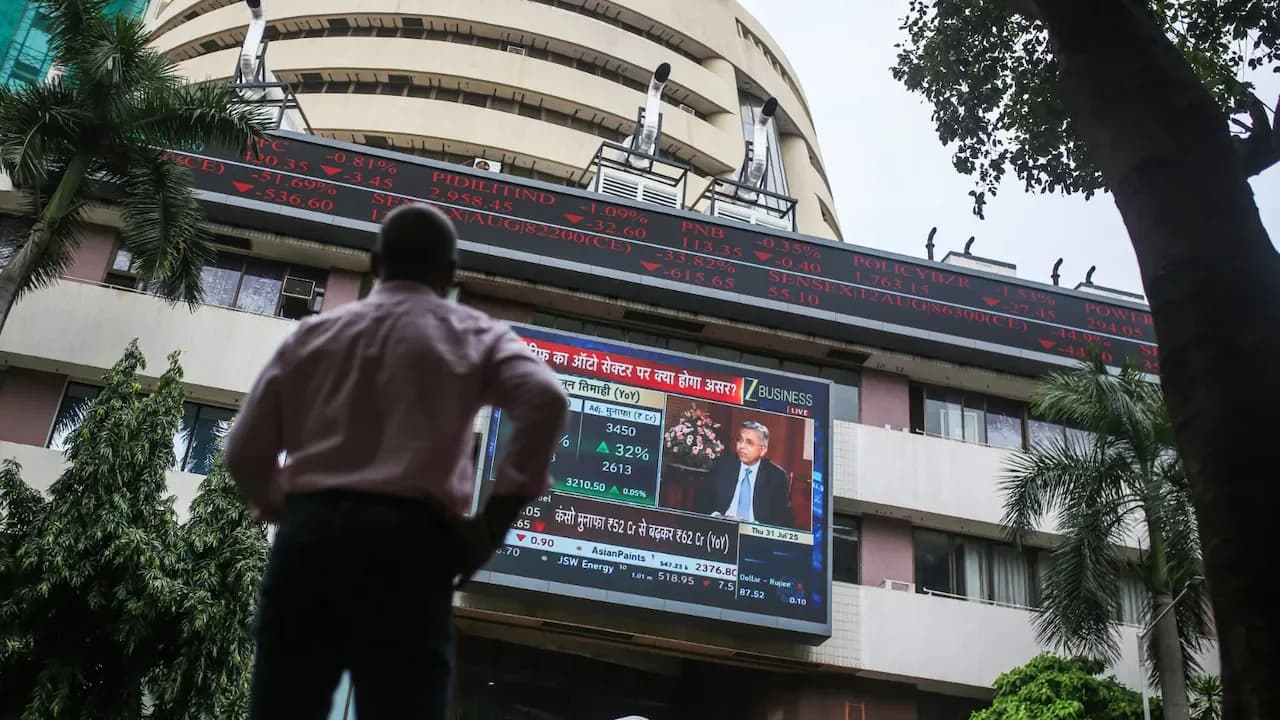
According to HSBC Mutual Fund's latest report, Indian stock markets remained resilient despite global macroeconomic challenges, recording modest gains of 2% in July after a volatile month. The mutual fund house noted that Nifty valuations are now in-line with 10-year average, with the index trading at 18.3x 1-year forward PE - a 6% discount to its 5-year average and a 2% discount to its 10-year average. IT, real estate and automobiles were named the best performing sectors in July, while healthcare also outperformed Nifty, though metals, FMCG, infrastructure, banks and telecom underperformed. Utilities, energy and industrials were the worst performing sectors.

According to CNBC TV18, Richard Harris, Chief Executive of Port Shelter Investment Management, expects foreign institutional investors (FIIs) to return to Indian and other emerging markets if the current AI-driven liquidity boom in Western markets continues into the second half of the year. Harris noted that the surge in liquidity and enthusiasm around AI has shifted investor focus towards Western markets, leaving India relatively overlooked. As reported by CNBC TV18, the CEO highlighted an enormous increase in liquidity with new players entering the market, including corporates that are the size of countries raising substantial sums of money themselves, often cheaper than sovereigns.
As reported by HSBC Mutual Fund, the mutual fund house remains constructive on Indian equities on a longer-term basis, with the near-term outlook now improving assuming no re-escalation of geopolitical conflicts. HSBC expects India's investment cycle to be on a medium-term uptrend supported by government investment in infrastructure, support to manufacturing and pickup in private investments. The mutual fund house noted that corporate earnings recovery continues with strong Q1 FY27 results growth till date and more earnings beat than misses over consensus estimates. HSBC also expects potential trade deals with the European Union and US to support exports and encourage private sector investments.
According to HSBC Mutual Fund, four key headwinds face Dalal Street's trajectory in the future: 1) Global commodity prices - Benign global prices of crude oil and fertilisers have reversed due to geopolitical conflict, likely to be a headwind for India in 2026; 2) Weak global growth driven by risk of tariffs and policy uncertainty; 3) Below-normal monsoon with negative consequences for food production and higher food inflation; and 4) Sharp slowdown in government capex. The mutual fund house noted that a below-normal monsoon can lead to higher food inflation, which can have negative impact on consumption and government budget. Despite these challenges, HSBC sees three key tailwinds: RBI's regulatory easing, government measures on taxation (GST/income tax) and lower tariffs by US should support consumption in FY27.