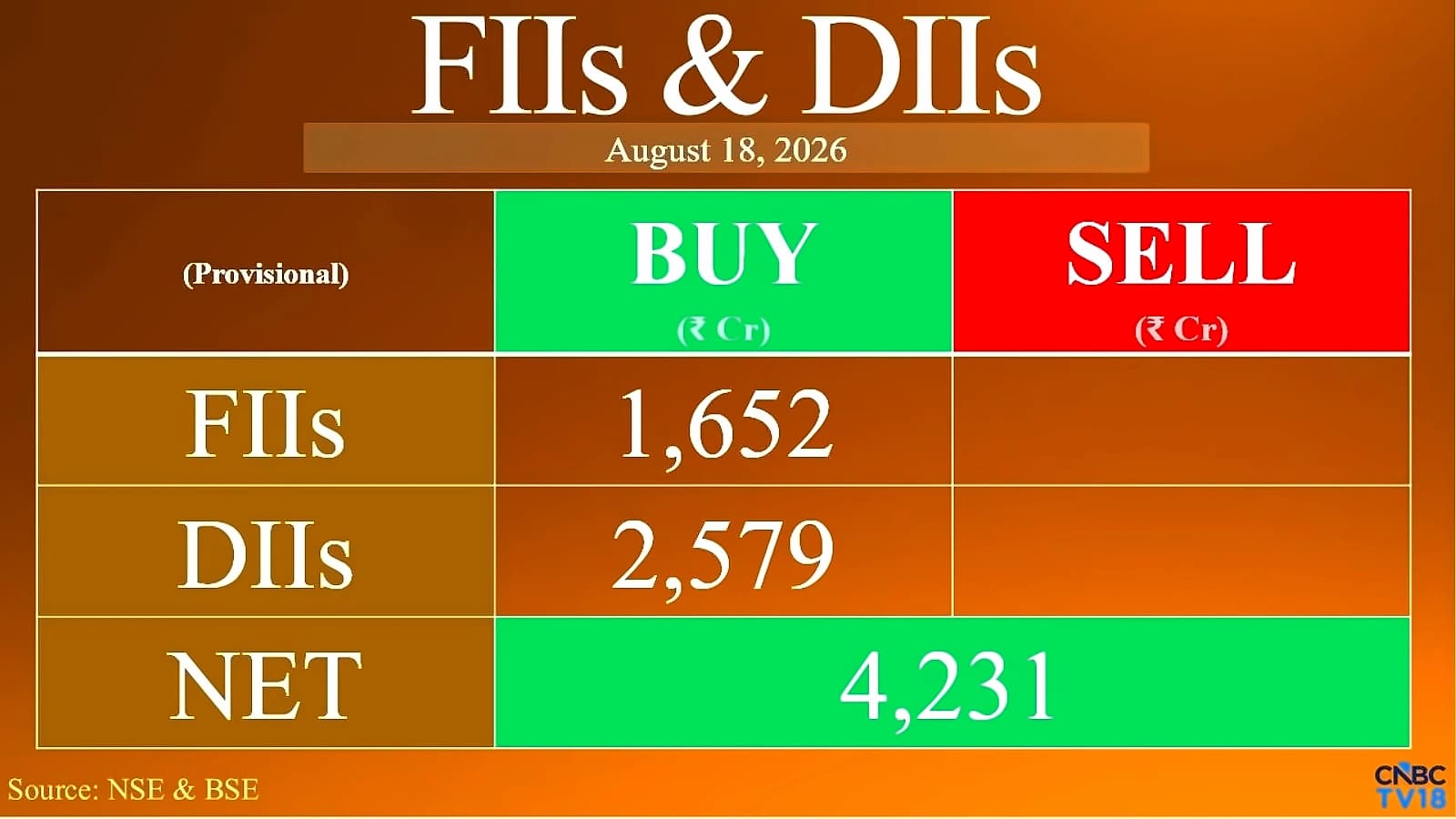
Foreign institutional investors reversed their selling trend on Wednesday, purchasing shares worth ₹1,617.45 crore on a net basis after heavy selling on Tuesday. According to provisional exchange data, FIIs bought equities worth ₹13,580.40 crore and sold shares worth ₹11,962.95 crore on September 23, resulting in net buying of ₹1,617.45 crore. This represents a sharp turnaround from Tuesday's net selling of ₹3,809.99 crore, when foreign investors stepped up selling pressure. Domestic institutional investors continued their strong support, with DIIs providing net inflows of ₹2,341.46 crore by buying equities worth ₹14,404.90 crore and selling shares worth ₹12,063.44 crore. Together, FIIs and DIIs were net buyers of ₹3,958.91 crore in Indian equities on Wednesday, as per CNBC TV18.
Indian equity benchmarks extended their opening gains on Wednesday, with the Nifty ending at a two-week high as crude prices declined and talks between the US and Iran boosted sentiment. The Sensex rose 299 points to end at 74,828, while the Nifty gained 118 points to close at 23,447. The Nifty Bank advanced 333 points to 56,549, while the Midcap index rose 433 points to 62,396. Market breadth favoured advances, with the advance-decline ratio at 2:1, as 35 Nifty stocks ended higher with economy-facing stocks leading the gains. Metal stocks were among the top Nifty gainers, with Tata Steel, JSW Steel and Hindalco rising around 3% each, while SAIL gained 6% after a price hike boosted certain steel stocks. Bajaj Finance ended 3% higher after reacting to a positive brokerage note, and PB Fintech surged 5% on expectations of an IRDAI paper.
The Nifty has entered oversold territory and the daily RSI has started recovering from these levels, indicating scope for a technical rebound. As reported by Goodreturns, Dr. Ravi Singh, Chief Research Officer from Master Capital Services Ltd, expects the 23,000-23,100 zone to act as immediate support. From current levels, Nifty could rebound towards 24,600, with a sustained move above this level potentially triggering further recovery towards the 21-day EMA near 24,000. However, caution remains warranted as the broader trend is still weak, with Friday's gains offsetting earlier losses in IT and Tata group stocks while strong demand for domestic IPOs continued to draw liquidity from the secondary market.
Foreign Portfolio Investors have intensified their selling of Indian equities, with FPIs withdrawing nearly ₹21,000 crore through exchange sales in September, reversing the positive flow trend seen in July and August. According to V K Vijayakumar, chief investment strategist at Geojet Investments, this comes after foreign investors returned to Indian equities in July and August, when they invested ₹20,200 crore and ₹29,631 crore respectively. However, primary-market investments remained positive at ₹2,703 crore this month, taking the year-to-date tally to ₹48,550 crore. This divergent pattern explains the primary-market boom despite tepid secondary-market performance, with FPI inflows through the primary market route falling 41 per cent to ₹70,822 crore in FY26 from ₹1.21 trillion in FY25, as per Sebi data. As per Dheeraj Gaur, Chief Investment Strategy Officer at Choice Wealth, the latest selling is attributed to three key factors -- higher US interest rates and yields, elevated crude oil prices amid geopolitical tensions, and weakness in the Indian rupee. The Federal Reserve has raised rates to 3.75-4%, with the narrowing yield differential between India and the US reducing the relative attractiveness of Indian assets.

Domestic institutional investors have emerged as crucial market stabilizers during the latest Fed rate hike cycle, with DIIs acquiring shares worth ₹12,504 crore in September while foreign investors sold equities worth ₹10,825 crore during the same month. According to Dalal Street Investment Journal, the U.S. Federal Reserve rate hike triggered concerns that higher yields in the U.S. could attract funds away from emerging markets, putting pressure on Indian equities. Despite this support, the Nifty 50 plunged 6.4%, marking its sharpest decline during a Fed rate hike cycle in recent times. The Fed rate hike has once again raised concerns for emerging markets as higher U.S. interest rates make dollar-denominated assets more attractive to global investors, with the U.S. dollar strengthening and bond yields moving higher, increasing pressure on emerging-market currencies. The Indian rupee also depreciated following the Fed's decision but recovered from its sharp decline amid possible intervention by the Reserve Bank of India and fresh inflows. As per V K Vijayakumar, Chief Investment Strategist at Geojet Investments, FIIs have the option to invest in many markets, while DIIs and retail investors are focused on the Indian market. Valuations in the Indian market are not attractive enough for FIIs, with more importantly, when the US bond yields are very attractive (10-year yield at 5%), they will prefer this risk-free high return to the risky investment in Indian stocks.
Despite foreign investor outflows, domestic institutional investors continue to provide strong support through systematic investment plans. Net SIP inflow has risen 21% year-on-year to ₹32,297 crore in August, staying in the ₹31,000-32,000 crore range through FY27 so far. According to The Times of India, total SIP inflows during April-August have reached ₹1.6 lakh crore, up 15% year-on-year. The data clearly presents a two-way market scenario, with foreign investors resuming selling amid global and macroeconomic concerns, while domestic investors continue to provide support through regular SIP investments. As per Neeraj Gaurh, Director & Fund Manager at Anand Rathi AMC, domestic investors are anchoring on a normalizing nominal GDP growth path of 10-10.5%, resilient manufacturing activity, and robust credit growth running at an 18% two-year high. DIIs recognize that this market is driven by earnings growth (projected in the double digits for FY27) rather than multiple expansion. However, as Somil Mehta, Head of Retail Research at Mirae Asset Sharekhan notes, while domestic buying absorbs supply, it primarily supports a market that compounds in line with double-digit earnings rather than driving sharp re-ratings or aggressive multiple expansion. The improving fundamentals of the Indian economy and improving earnings prospects are supporting a new category of long-term SIP investors who appear unperturbed by short-term market volatility.