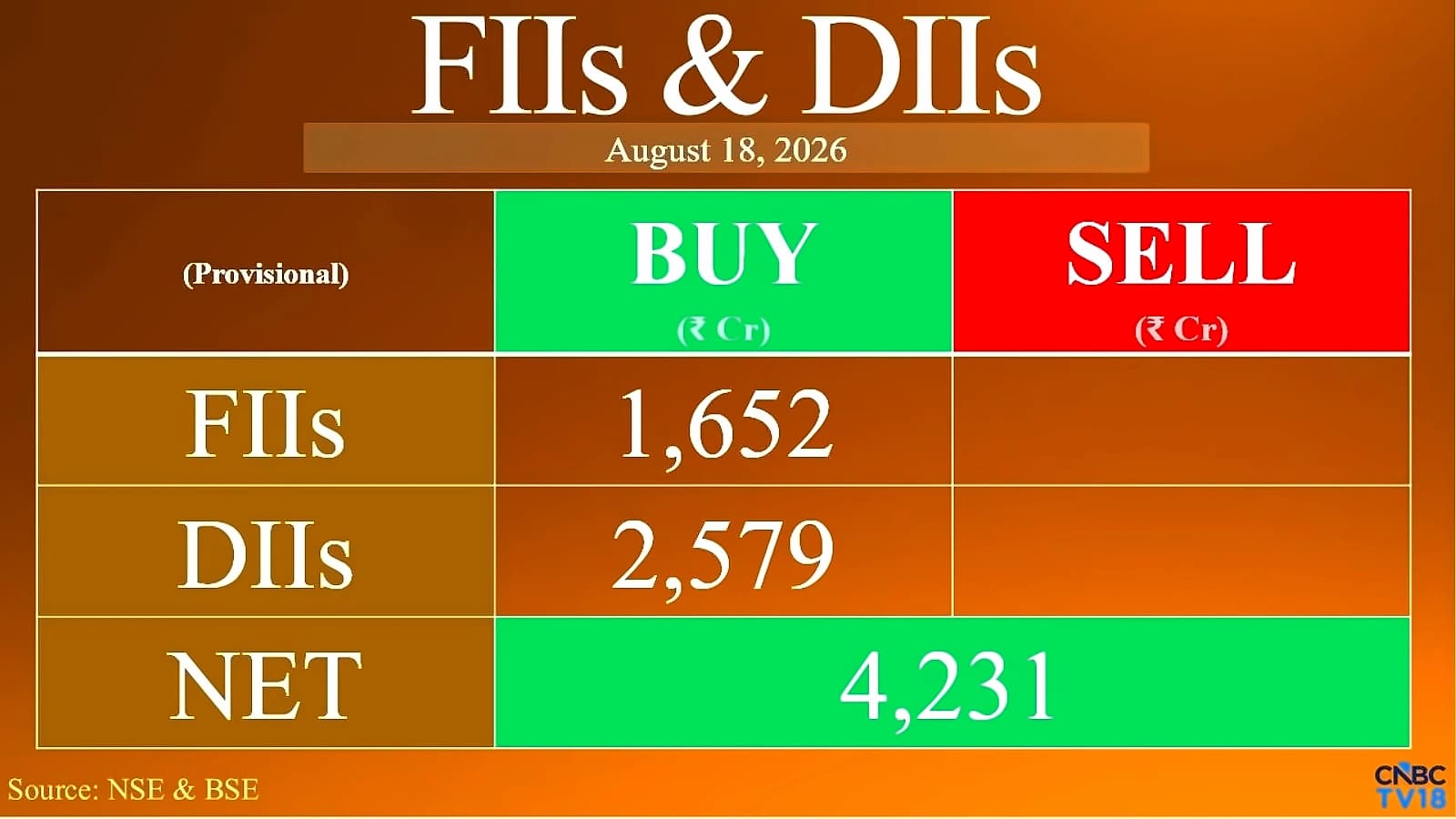
Foreign institutional investors turned net buyers for the first time in recent sessions on September 1, recording net purchases of ₹1,143.38 crore after heavy selling the previous day. According to provisional data, FIIs bought shares worth ₹17,807.53 crore and sold ₹16,664.15 crore during the session, marking a significant turnaround from the ₹7,985.88 crore net outflow recorded on August 28. Despite this recent buying, the two sessions together still leave FIIs as net sellers by about ₹6,843 crore, highlighting the volatile nature of foreign investor sentiment in recent weeks. The session-level breakdown shows foreign institutional investors bought equities worth ₹17,807.53 crore but sold shares worth ₹16,664.15 crore, while domestic institutional investors remained firmly net buyers, purchasing Indian equities worth ₹1,846.94 crore during the same trading session.
Indian equity benchmarks ended higher after the Closing Auction Session (CAS), with the Nifty holding above 24,000 following a volatile session. The benchmark indices finished above their respective 3:15 pm levels after the auction, supported by the ₹2,990.32 crore combined institutional buying from FIIs and DIIs. The rupee strengthened during the session, rising 27 paise against the US dollar intraday to touch a two-month high, providing additional support to market sentiment. However, market breadth remained weak, with two stocks declining for every one that advanced, indicating selective buying patterns among investors. Among Nifty stocks, ITC was the top gainer, while Maruti Suzuki led the losers after its August sales came in below estimates. Bajaj Auto gained nearly 2% following strong August sales, while Reliance Industries extended its advance and closed nearly 2% higher.
Foreign institutional investors (FII) outflows from India are expected to continue through 2026, according to Adrian Mowat, Investor from Hong Kong SAR. As reported by CNBC TV18, Mowat sees little at present to suggest a reversal of the current trend. The expert notes that India does run a current account deficit and requires external funding, which creates additional vulnerability to rising global yields and risk-free rates. However, recent market data shows signs of stabilization, with FPIs investing around $2.12 billion in July 2026 after record net equity outflows of about $19.6 billion in FY26. This suggests that while long-term outflows may persist, short-term flows have begun to turn positive. As of 2026, Foreign Portfolio Investors (FPIs), formally classified as FPIs, remain major participants in Indian equities, with their activity continuing to influence market liquidity, valuations and institutional ownership alongside strong domestic investor participation.
According to Mowat's analysis reported by CNBC TV18, rising risk-free rates are emerging as a key headwind for equities, particularly emerging markets that require external funding. The expert explains that global bond yields could move back towards pre-quantitative easing levels, which could put more pressure on stocks, real estate and infrastructure. Currently, the Secured Overnight Financing Rate (SOFR) is about 3.6%, while the median price for US 10-year bonds is closer to 5.3%, still quite a bit higher than the current 4.7% level. This environment continues to create challenges for emerging market investments, with rising risk-free rates creating pressure across multiple asset classes including real estate and infrastructure sectors. FII activity can be influenced by India's economic growth outlook, company earnings, valuations, interest-rate expectations, currency movements, policy changes and global risk appetite, making their participation in Indian markets particularly sensitive to these global factors.
Brent crude climbed above $92 a barrel, putting pressure on stocks sensitive to higher oil prices. Asian Paints and BPCL fell as much as 4%, while IndiGo declined nearly 4% after an increase in jet-fuel prices. Sugar stocks fell as much as 6% after the government reduced the stock-holding limit. Among positive performers, Godrej Agrovet jumped more than 6% following a positive brokerage note, while Graphite India gained over 4% after GrafTech cut graphite-electrode capacity. Adani Group stocks also gained, with Adani Ports rising more than 3%. Havells dropped 6% following UltraTech's entry into the wires segment, while KEI Industries fell to a 17-month low. EPL fell more than 8% after promoter Epsilon Bidco sold its entire stake, while Ujjivan Small Finance Bank declined over 5% after its managing director and chief executive sought early retirement.