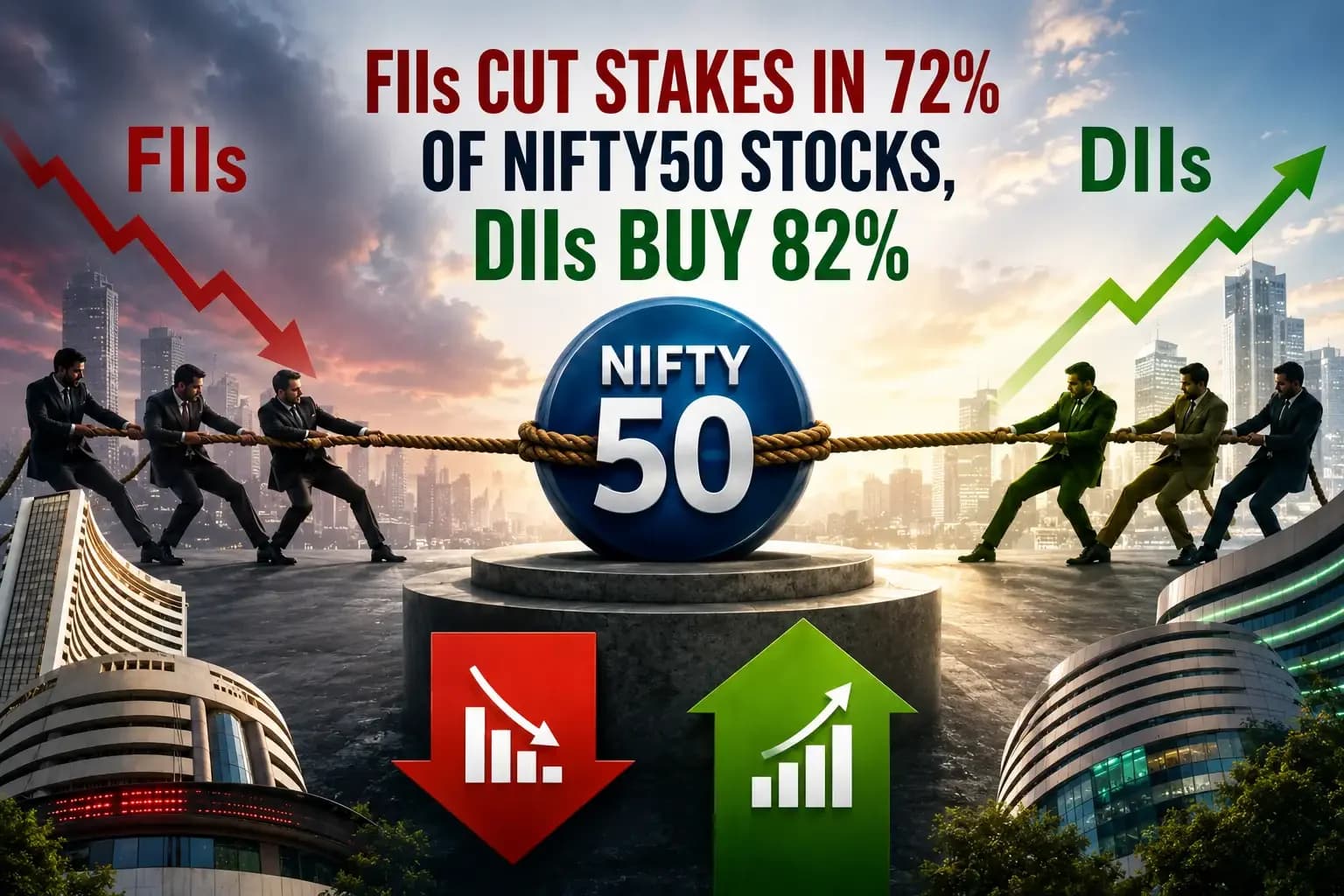
Domestic institutional investors (DIIs) continued their remarkable market dominance for the ninth consecutive quarter, with their holdings in Nifty 500 companies reaching a record 21% in the June 2026 quarter, according to a note by Motilal Oswal Financial Services (MOFSL). This represents a significant shift in market dynamics, as foreign institutional investor (FII) holdings declined to 17%, marking a stark contrast in investment patterns. The shift has been driven by $166 billion of domestic institutional inflows over the past 22 months, which comfortably offset $58 billion of cumulative FII outflows. As per MOFSL, it took domestic funds to net infuse funds worth about $166 billion in Indian stocks to offset $58 billion worth of net selling by foreign portfolio investors (FPIs) over the past 22 months. The milestone caps nine consecutive quarters of rising DII ownership, with DIIs investing $22.8 billion in Indian equities in Q2CY26 alone, backed by a steady stream of systematic investment plan (SIP) inflows averaging around $3 billion every month. According to Prime Database Group, promoters bought shares worth ₹36,336 crore during the quarter, the most in four years since June 2022, driving their ownership in NSE-listed companies to a two-year high of 41.36%.
The banking sector is witnessing a subtle shift in foreign investor preferences, with FIIs reducing stakes in large private lenders while simultaneously increasing holdings in mid-sized and smaller private banks. According to ACE Equities data, HDFC Bank saw the sharpest reduction with FII shareholding falling by 2.18 percentage points to 41.82%, while Axis Bank followed with holdings declining by 2.09 percentage points to 42.05%. ICICI Bank, the country's second-largest private lender, saw FII ownership reduce by 0.69 percentage points to 33.79%. This rotation reflects a preference for banks with specific growth triggers and attractive fundamentals, as these institutions have delivered strong credit and deposit growth while maintaining or improving margins during Q1 FY27. As per Aishvarya Dadheech, Founder and CIO of Fident Asset Management, larger banks reported robust advances and deposit growth in Q1 FY27, with AUM growth of 15% for HDFC Bank and 19% each for Axis Bank and ICICI Bank. Early signs of net interest margins bottoming out, coupled with valuations that remain well below historical averages, could shift investor preference back towards larger lenders over the near to medium term.
According to the MOFSL report, DII holdings in private companies rose to an all-time high of 21.8%, up 200 basis points year-on-year in the June 2026 quarter, with their holdings in PSU companies standing at 17.3% (up 140bp YoY). On a year-on-year basis, DIIs increased their holdings across Private Banks, Telecom, Real Estate, Technology, Healthcare, Insurance, Automobiles, PSU Banks, NBFC-Lending, Retail, and Capital Goods sectors, while FIIs raised stakes in Metals, PSU Banks, NBFC-lending, Capital Goods, and Logistics. Sectorally, while domestic institutions increased their allocation most to industrials, they decreased their allocation the most to information technology stocks, which was also the least favoured sector by foreign investors. The technology sector has experienced a significant shift, with FIIs reducing their stake in Infosys by 6.4 percentage points while DIIs increased their holdings by 4.2 percentage points. Foreign ownership also declined in Tech Mahindra by 4.6 percentage points, HCL Technologies by 3.5 percentage points, and Tata Consultancy Services by 2.4 percentage points. The top 5 sectoral holdings of DIIs in the Nifty 500 accounted for 59.6% of the total allocation - BFSI (29.4%), automobiles (7.9%), consumer (7.6%), capital goods (7.4%), and oil & gas (7.3%).
Market experts note that fund managers running large, diversified or flexicap funds face practical challenges in deploying capital, with large investments naturally gravitating towards liquidity-driven sectors such as banking, financial services and insurance (BFSI), autos, IT and telecom. As per Hari Shyamsunder, vice-president & senior institutional portfolio manager–India equities, Templeton Global Investments, "Rising ownership tells us where the domestic money is being absorbed but active weights versus relevant benchmarks would tell us more about what DIIs genuinely believe." However, some sector choices reflect practical considerations, with DIIs remaining relatively cautious on sectors with uncertain earnings or high capital intensity, including energy (especially upstream oil & gas), metals and mining, and capital goods. According to Umeshkumar Mehta, chief investment officer, SAMCO Mutual Fund, if the macro environment shifts through a credit slowdown, regulatory tightening or a liquidity squeeze, a portfolio dependent on a handful of sectors will see sharper drawdowns than one that is diversified not just across sectors but also across different types of companies within each sector. The risk lies not in the allocation itself but the macro environment - if growth disappoints, asset quality deteriorates or the interest rate cycle turns adverse, financials could face headwinds given their significant index weight.
Indian promoters significantly boosted their stock purchases in the June quarter, driving their ownership in listed companies to a two-year peak of 41.36%, according to Prime Database Group data. Pranav Haldea, managing director of Prime Database Group, noted that "there is no one who knows more or better about the business and its valuation than the promoters. Thus, their decision to buy shares is always a positive signal." As per Feroze Azeez, joint CEO of Anand Rathi Wealth, promoter buying reflects confidence from management, while declining FII ownership should not be viewed as negative as it is driven by multiple global factors. Attractive valuations after continuous selling during market highs in 2023 and 2024 signal that the market may have bottomed out. The Nifty 50 rose 5.2% during the quarter despite ongoing US-Iran conflict driving crude oil prices to nearly $120 a barrel. Shah of Kotak observed that while FPI ownership has continued to decline due to sustained foreign selling, this has largely been absorbed by domestic investors, including mutual funds, PMS investors and promoters themselves.