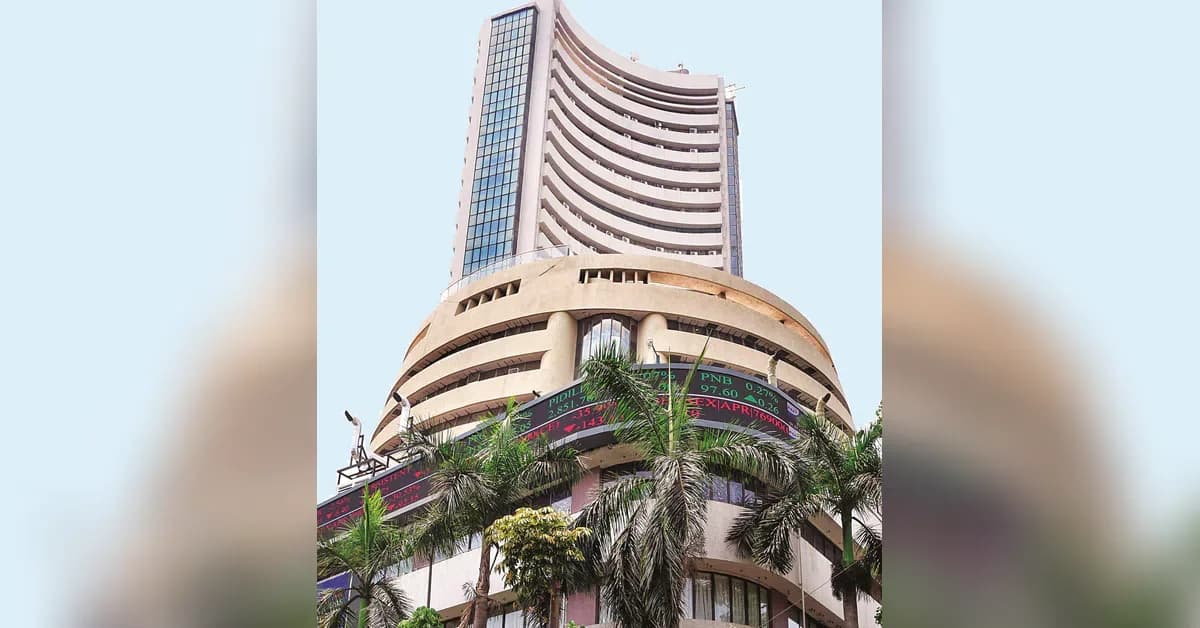
India's stock market value has crossed the $5 trillion mark, reclaiming the sixth position globally from South Korea. According to The Economic Times, the country's market capitalization stood at $5.03 trillion ($5,003.43 billion) on Wednesday, up from $4.86 trillion ($4,864.90 billion) on February 12, just before Washington and Tehran agreed to end their conflict. The rebound has placed India ahead of South Korea, whose market cap had crossed $5 trillion in early June, and Taiwan, which had overtaken India as the fifth biggest market in stock market value with $5.15 trillion ($5,155.62 billion) on Wednesday. The US, China, Japan, Hong Kong and Taiwan remain ahead of India in market size.
Brent crude was trading at $79.32 on Wednesday, representing a 15.5% decline over the last six trading sessions. As reported by Business Standard, this sharp reduction in oil prices has been a key catalyst for the market rally, with the decline providing significant relief to energy-dependent sectors and broader market sentiment. The oil price movement has been a primary driver of the current market optimism, with the sharp correction in crude oil prices being a key factor in the recent rally.
The benchmark Sensex is 10.1% away from its all-time closing high, while the Nifty is 8.5% away from its record level. According to Business Standard, the gains have been primarily driven by a rally in the broader mid and smallcap stocks, with the Nifty Midcap 100 rising 0.52% and the Nifty Small Cap 100 up 0.79%. The broader market performance has been exceptional, with the BSE MidCap 150 index jumping 16% and the BSE SmallCap 250 index surging 23% since April, while the BSE Microcap 250 index surged 26%. Despite this strong performance, the total market capitalization remains 5.5% lower than the start of 2026 and 13% below its record high of $5.7 trillion achieved in September 2024.
Market breadth on Wednesday was particularly strong, with 2,323 stocks advancing against 1,956 declining, as reported by Business Standard. The broader market performance has been supported by recent optimism about a permanent resolution to the West Asia geopolitical crisis, with the Nifty Midcap 100 0.7% away from its new closing high and the Nifty Small Cap 100 5.3% away from its record level. This broad-based participation indicates widespread investor confidence in the current market environment, with the sharp decline in India VIX indicating easing risk perception as geopolitical tensions moderated.
The market optimism has been fueled by the US and Iran agreeing on a framework to end their war, with a 60-day window established to discuss pressing issues including Iran's nuclear programme. According to Business Standard, as part of this agreement, the US would end its blockade of Iran, and the Strait of Hormuz, the key chokepoint for oil flows, would be reopened. However, The Economic Times reports that foreign portfolio investors have been paring exposure to Indian equities since October 2024, weighed down by the lack of core AI plays, relatively slower earnings growth and richer valuations compared with regional peers. In contrast, Taiwan and South Korea have recorded the sharpest gains in market capitalisation across Asia in 2026, driven by strong global investor demand for AI-linked companies with deep semiconductor capabilities.