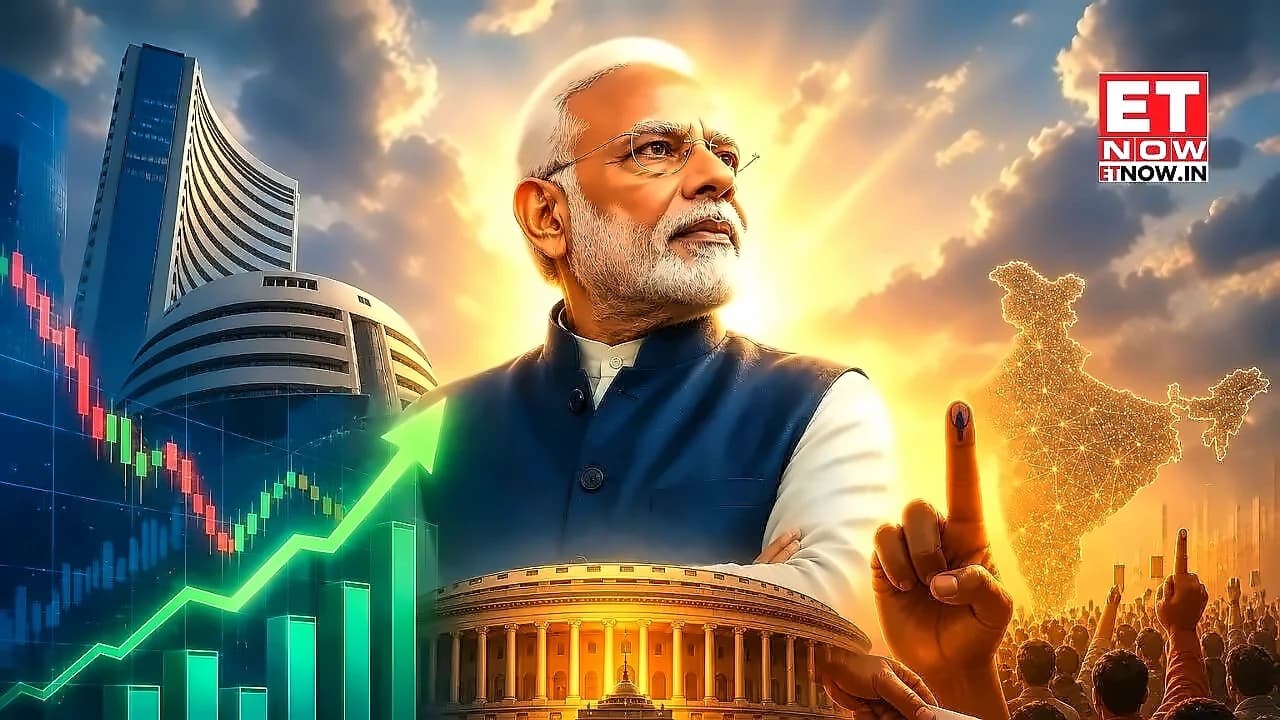
The Indian stock market is expected to open with a gap-up on Monday following the BJP's improved performance in the 2026 state assembly elections. According to reports from Live Mint, the Gift Nifty is trading upside, signaling a positive opening for the Indian indices. The market is particularly focused on the BJP's performance in West Bengal, Assam, and Puducherry, where the party is leading against its closest rivals, Mamata Banerjee's Trinamool Congress and the Indian National Congress respectively. As per Business Today, Indian equities are likely to react positively in the near term if exit polls, particularly the BJP's projected breakthrough in West Bengal, are validated on May 4, 2026. Exit polls suggest the BJP could emerge as the single largest force in West Bengal with around 159 seats, above the majority mark of 148, while the TMC is projected near 127 seats. A stronger-than-expected BJP showing could boost sentiment for infrastructure, railways, power and eastern India capex themes.

Prediction markets on Polymarket show the West Bengal election remains extremely close, with traders placing bets worth more than $2 million on the outcome. According to current trends, the BJP holds around 51-52% probability, while the TMC follows closely at 47-49%, indicating that the outcome could swing either way. This close gap in probabilities highlights strong uncertainty among traders, with the tight race attracting more activity as participants attempt to predict the outcome. Unlike one-sided contests, tight races often attract more activity as both parties have strong support bases, and no clear winner has emerged even in market-driven predictions. The high-value trades indicate that global participants are closely tracking political developments in West Bengal and are willing to put significant money behind their expectations, despite restrictions on such platforms within India.
The BJP's victory in state elections has significantly strengthened its position in Parliament. According to Kotak Institutional Equities, the NDA currently has a strong majority in Rajya Sabha, with the recent defection of seven AAP parliamentarians to BJP further bolstering BJP's strength in the Upper House. The likely increase in BJP's strength in respective state legislative assemblies may further increase NDA's strength in the next Rajya Sabha election cycles. Given their current strength in both Houses, the NDA has the requisite strength to pass most of its legislative agenda, other than Constitutional Amendments, that require two-third majority.
The West Bengal election results are particularly crucial for market sentiment, as reported by Live Mint. Sandeep Pandey, Co-founder of Basav Capital, noted that the market had mixed expectations about West Bengal results, but positive trends could lead to a spike in Indian stock markets. The Bangladesh border infiltration has remained a major challenge for maintaining social harmony in West Bengal, and after the BJP's victory, border security is expected to receive greater prominence, potentially reducing anti-Indian activities abetted by Bangladesh, Pakistan, and China. Ishan Tanna of Ashika Capital said better Centre-state alignment in Bengal could improve project execution and policy implementation, which may support capex-linked sectors. As per Business Today, investors will closely watch whether the ruling party at the Centre can wrest West Bengal from the Trinamool Congress and make meaningful inroads into opposition-ruled Kerala and Tamil Nadu, where the BJP currently has a limited presence.
While state elections typically carry less structural significance than national polls, they remain important in shaping perceptions around policy continuity. According to Kotak Institutional Equities, the durability of any rally will be tested quickly, as the trajectory of crude oil remains the single largest short-term risk variable. The firm expects markets to trade in a range, with election enthusiasm fading relatively quickly as attention reverts to earnings delivery, oil price trajectory and its implications for India's macro environment. Market expert Ajay Bagga said state election outcomes rarely have a lasting impact, noting that "the market may react for a day or two, but then it goes back to oil prices, FPI flows and the rupee. Those remain the three big variables." Ponmudi R, CEO of Enrich Money, noted that current market positioning suggests a degree of continuity is already priced in, with market reaction likely to be measured rather than directional if outcomes align with exit polls.