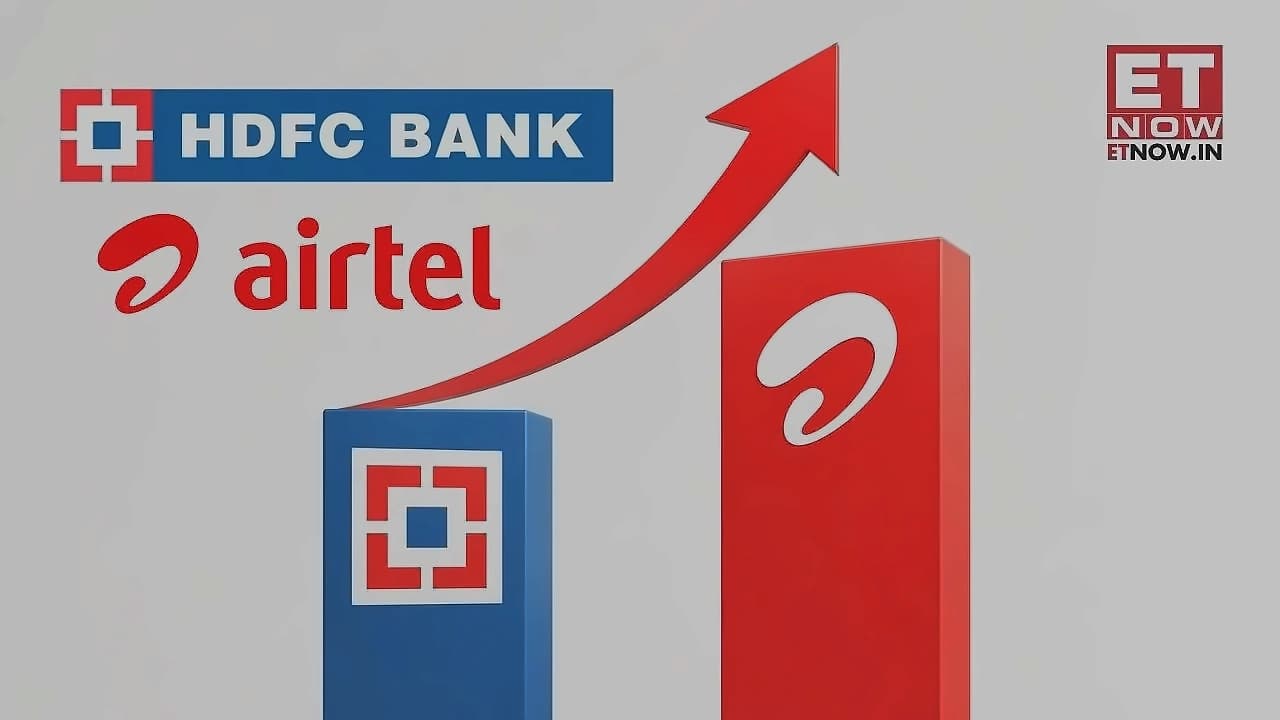
Bharti Airtel briefly overtook HDFC Bank on Monday to become India's second most valuable company in terms of market capitalisation, with the telecom operator's market cap reaching a high of ₹11.9 lakh crore during intraday trading. However, HDFC Bank's shares rebounded, pushing it back to the second spot by market close, with the bank's market value at ₹11.83 lakh crore compared to Bharti Airtel's ₹11.81 lakh crore. Bharti Airtel shares gained as much as 2.6% before ending 1.8% higher at ₹1,938.1, while HDFC Bank shares ended 0.1% higher at ₹768.55 after declining as much as 2.1% earlier in the day. The market leadership change reflects strong investor confidence in Bharti Airtel's growth trajectory, with Airtel shares gaining 270% over the last five years compared to HDFC Bank's 49% returns during the same period. Reliance Industries retained the top spot at ₹18.06 lakh crore.
The market leadership change reflects strong investor confidence in Bharti Airtel's growth trajectory, with Airtel shares rising 270% over the last five years compared to HDFC Bank's 49% returns during the same period. As reported by GoodReturns, Bharti Airtel has demonstrated superior long-term performance while HDFC Bank has faced pressure from merger impacts, rising competition from public sector banks, and recent concerns around the resignation of its chairman. Meanwhile, the reshuffle in market cap rankings follows the underperformance of traditional heavyweights such as information technology and banks. TCS, which previously held the second spot, has seen its market value eroded by almost half amid uncertainty over AI-related disruption. The top 10 list includes ICICI Bank, State Bank of India, Tata Consultancy Services, Bajaj Finance, Larsen & Toubro, Hindustan Unilever, and Life Insurance Corporation of India.
Bharti Airtel reported mixed Q4 FY26 results that were largely in line with market expectations, with consolidated revenue and EBITDA coming in 1-3% higher than UBS and wider analyst consensus estimates. Africa operations showed strong revenue growth of 41% year-on-year or 17% in constant currency, while India Home broadband revenue increased 9.5% quarter-on-quarter. However, India mobile revenue grew only 8% year-on-year and just 0.6% sequentially, which UBS described as slightly below its forecast. The company demonstrated strong operational performance with revenue from operations surging 15.6% to ₹55,383.2 crore in Q4 FY26 from ₹47,876.2 crore a year ago. India revenue grew 7.7% to ₹39,566 crore on a year-on-year basis, with India mobile revenue recording an 8.3% rise led by higher realisations and an expanding customer base, with ARPU increasing to ₹257 during the quarter compared to ₹245 a year ago.
Bharti Airtel declared a dividend of ₹24 per share for FY26, significantly higher than ₹16 per share in FY25 and above consensus expectations of ₹20, signalling rising confidence in cash generation. The company also announced a share swap deal to increase its holding in Airtel Africa by acquiring ICIL's 16.31% stake through issuing 146.7 million new Airtel shares to ICIL, implying equity dilution of about 2.4%. Bharti Airtel plans to set up 56 edge data centres over the next 18-24 months as part of its business scaling strategy, with Executive Vice Chairman Gopal Vittal announcing strong focus on investing in data centres and strengthening the optical fibre cable network. Goldman Sachs continues to rate Bharti Airtel as a Buy, though it has trimmed its 12-month target price to ₹2,210 from ₹2,250, reflecting weaker prospects in towers and direct-to-home segments.