Fitch Ratings has affirmed India's Long-Term Issuer Default Rating at BBB- with a stable outlook, retaining the country at the lowest investment grade for the 20th consecutive year. According to Fitch's latest assessment on August 11, 2026, the rating agency projects 6.4% GDP growth in FY27, slower than the 7.4% average of the past three years. India's sovereign rating has remained at BBB- since 2006, one notch above sub-investment grade. The agency noted that the economy stayed resilient despite the West Asia energy shock, but flagged potential fiscal pressures from recent youth protests over leaked medical exams and job scarcity. Fitch emphasized that India's rating reflects its robust growth outlook and solid external finance fundamentals, with a strengthening record of delivering macroeconomic stability and improving policy credibility.
The Finance Ministry has informed the Parliamentary Standing Committee on Finance that the ongoing conflict in West Asia may have fiscal implications during 2026-27 (FY27). According to the committee's report presented in Parliament, the Finance Ministry's Department of Economic Affairs stated that as the evolving West Asia conflict begins to exert pressure on economic activity, it may have fiscal implications during the upcoming fiscal year. The government has set a target to lower its fiscal deficit to 4.3 per cent of GDP in FY27 from 4.4 per cent of GDP last year. Fitch's analysis suggests that India's projected 6.4% growth still keeps public debt on a declining path from 56.1% of GDP in FY26 towards the 50% goal by March 2031. The agency noted that the general government deficit is forecast to decline to 7.3 per cent of GDP in FY27 from 7.5 per cent in FY26, with the central government expected to achieve its 4.3 per cent FY27 budget deficit target despite higher fertiliser subsidies and excise duty cuts.
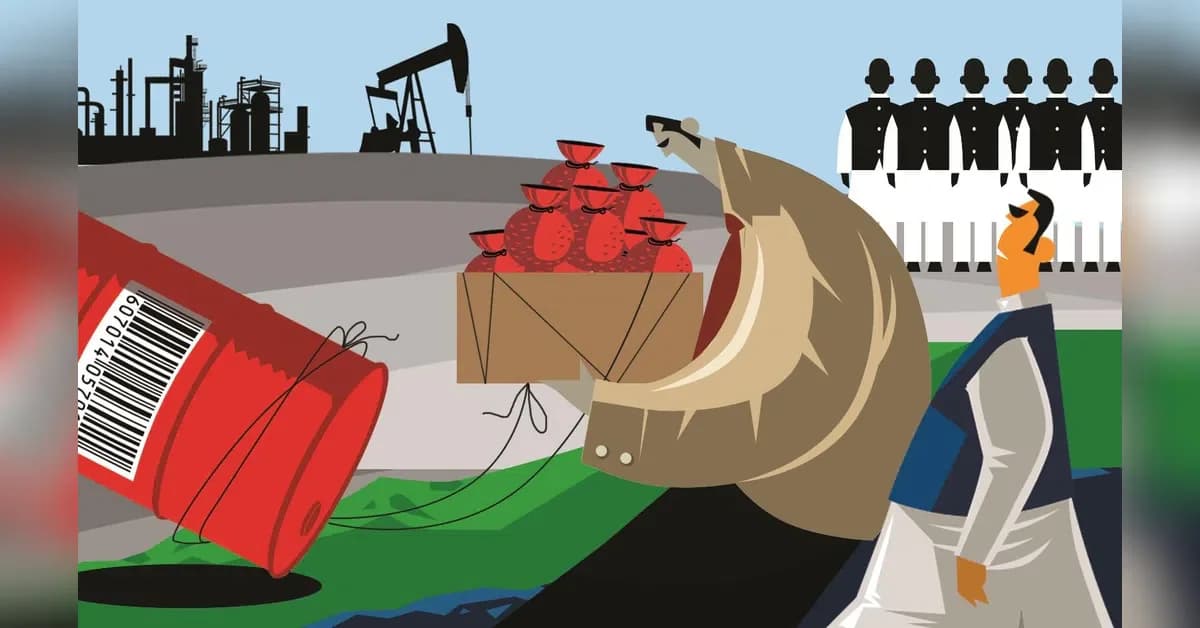
Chief Economic Adviser V Anantha Nageswaran's analysis presented to the committee showed that the fiscal deficit may be around 4.3-4.4 per cent of GDP if crude oil prices rise to $90 a barrel. However, if crude oil prices rise and remain close to $130 a barrel, the fiscal deficit will increase to 5.6 per cent of GDP, as reported by the committee. India imports 87% of its crude oil, of which 46% transits through or near the Strait of Hormuz, which is blocked because of the US-Iran war that began on February 28. The Finance Ministry noted that the West Asia war could lead to a "triple whammy" of surging crude oil prices, market volatility and maritime delays. The CEA's stress scenario, where crude remains at $130 for two to three quarters, had projected growth falling to around 6.4 percent, inflation rising towards 5.5 percent, the current-account deficit widening to about 3.2 percent and the fiscal deficit increasing to 5.6 percent from the Budget target of around 4.4 percent.
A parliamentary panel has recommended a Strategic Energy Mitigation Framework to protect the economy from oil shocks above $90 a barrel. The panel's recommendation cited scenario analysis provided by Chief Economic Adviser V Anantha Nageswaran, which showed that crude price of up to $90 a barrel would be consistent with the government's FY27 macroeconomic assumptions, including real GDP growth of around 7-7.4 percent and inflation of about 2 percent. The Centre has acknowledged that the West Asia conflict may have fiscal implications FY27 but pointed to the Economic Stabilisation Fund as a buffer against external shocks. In its action-taken response to the Standing Committee on Finance, presented in Parliament on August 12, the finance ministry cited recent fiscal consolidation, a conservative gross tax revenue buoyancy assumption of 0.8 and the creation of the ₹1-lakh-crore Economic Stabilisation Fund in the Public Account as reasons for fiscal stability. Fitch noted that the weakness is mitigated by debt financed in deep domestic markets, with limited foreign participation and a low foreign-currency share of 2.5 per cent.
Fitch flagged only a slight widening of the current account deficit to 1.4% of GDP in FY27 from 0.6% in FY26, giving forex reserves cover of $733 billion (7.4 months of external payments). The agency noted that capital outflows picked up in the June quarter of FY27, but reversed after RBI and government measures. The government's FY26 debt-to-GDP ratio stood at 58.2 percent, above its earlier target of 56.1 percent, and the Centre is seeking to bring the ratio down to 55.6 percent in FY27. The Union Budget FY27 targets bringing India's debt-to-GDP ratio down to 50% by March 2031, with the current FY27 Budget pegging the ratio at 55.6%, down from 56.1% in FY26. Fitch estimates India's medium-term potential growth at 6.4%, driven by public capex, a private investment pick-up and favourable demographics. The agency noted that the median of debt-to-GDP ratio of 'BBB' rated economies is 57%, making India's high debt level of 84.4% of GDP in FY26 a structural weakness.