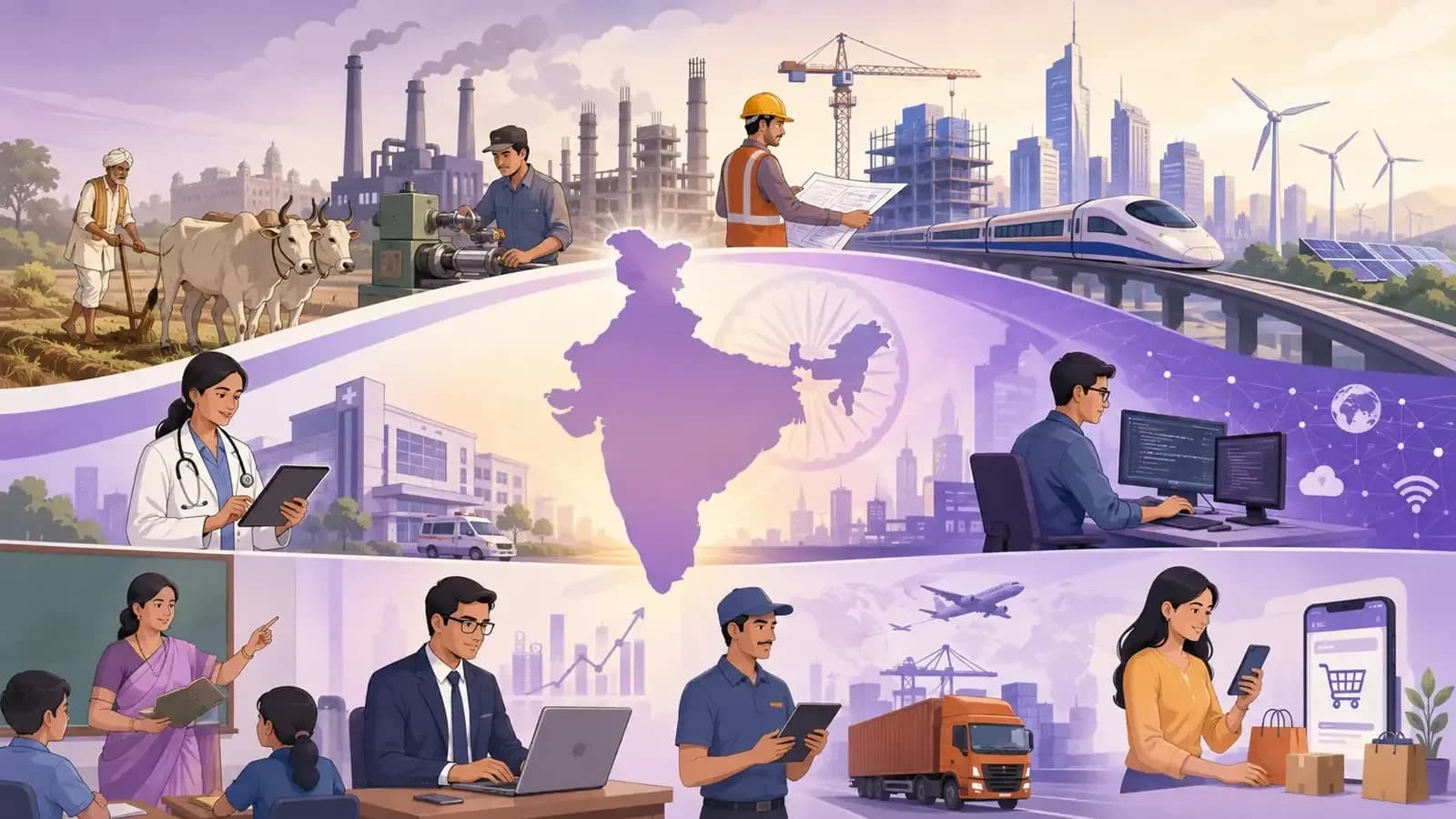
According to the Periodic Labour Force Survey (PLFS), the composition of India's workforce reveals significant wage disparities across employment categories. Regular workers account for only 23.6% of the total workforce in 2025, with over half employed in government or public enterprises. The self-employed sector represents 56% of the workforce, while casual workers make up the remaining portion. Regular workers earn an average of ₹22,699 monthly, substantially higher than self-employed workers at ₹14,861 and casual workers at ₹10,000 assuming 22 working days per month. The wage differential between regular workers and casual workers reaches 7.4 times, highlighting the premium for formal employment.
Economic data from the KLEMS database reveals a significant shift in labour intensity across sectors. Labour per unit of capital has declined steadily over time across all major sectors, with manufacturing and services showing rapidly converging ratios. This trend suggests that the cost of generating new employment is comparable across both manufacturing and services sectors. The evolution of artificial intelligence is expected to further intensify capital intensity, creating challenges for policymaking while presenting opportunities for India's technological advancement and global competitiveness.
Among major services sectors, several areas show potential for job creation and quality employment. Construction, trade, hotels and restaurants, education and health represent relatively labour-intensive segments that could provide substantial employment opportunities. The first three categories contain larger components of unskilled work, while education and health involve skilled workforce requirements. An ageing population globally and in India would create additional opportunities in these sectors, potentially making India a hub for health and education services while providing AI-proof employment opportunities in the medium term.
A new report by Kantar and DB Corp reveals that Tier-2 and Tier-3 cities are becoming India's next major consumption engine, with their affluent population rising 76% over the past six years. Nearly one in three urban Indians now lives in Tier-2 and Tier-3 cities, making them one of the largest and fastest-growing consumer markets in the country. The shift is driven by rising incomes, a young population, growing digital adoption and increasing demand for premium products and services. The share of NCCS A households in Urban Bharat has increased from 26% to 40% over the last six years, signalling stronger purchasing power across categories including automobiles, FMCG, personal finance, education and e-commerce. Digital adoption is reshaping consumer behaviour, with one in three consumers shopping online and digital payments, online banking, investments and e-commerce now widely used across smaller cities.

The convergence of labour intensity between manufacturing and services sectors indicates that policy focus should shift toward supporting quality service delivery rather than traditional manufacturing-led employment generation. The analysis suggests that services could emerge as the powerhouse for creating jobs in the new era of automation. The growing affluent population in Tier-2 and Tier-3 cities, combined with around 33% of Urban Bharat's population being below 24 years, creates significant opportunities for quality employment and consumption-driven growth. Education remains another major spending priority, with more than 27% of households spending over 10% of their income on education, highlighting strong focus on long-term financial and social mobility. This approach addresses fundamental challenges of job market fairness while capitalizing on India's service sector potential and the shift in consumption patterns beyond metropolitan markets.