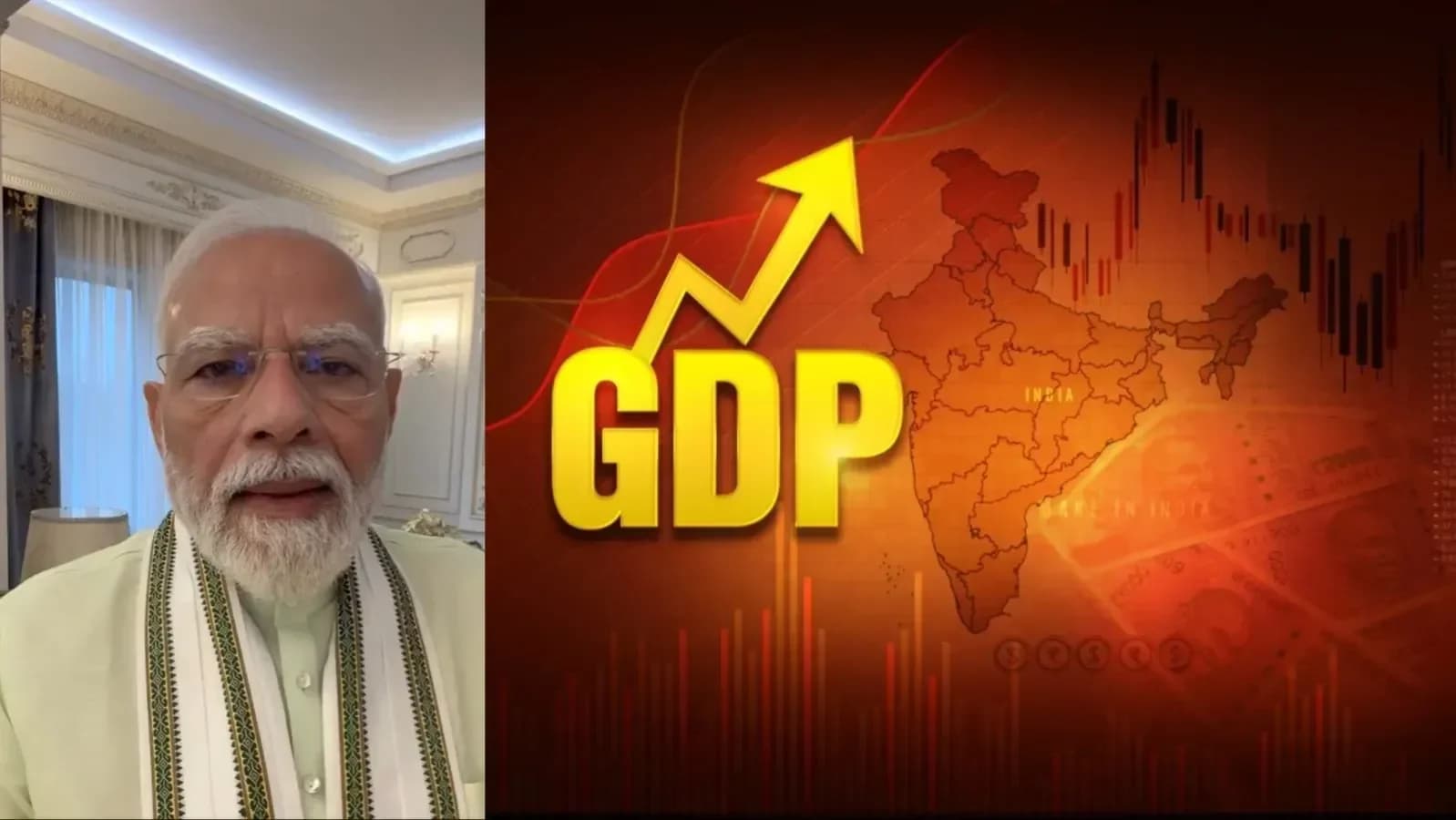
Prime Minister Narendra Modi hailed India's 7.7% GDP growth in FY26 as a testament to the country's economic strength, attributing the performance to 'the inherent strength of our economy, the success of reforms and the hard work of 140 crore Indians'. Speaking on social media platform X, Modi emphasized that 'India's growth momentum remains strong!' and committed to further enhancing 'Ease of Living, Ease of Doing Business' and creating opportunities for youth. The Prime Minister's statement came as the government released the latest GDP data on Friday, June 5, with the report coming from the Ministry of Statistics and Programme Implementation (MoSPI). The 7.8% Q4 growth contributed significantly to the full-year FY26 performance, which achieved 7.7% GDP growth compared to the 7.1% expansion recorded in 2024-25. Modi added that the government would continue pushing reforms to improve both the business environment and quality of life, stating 'We shall leave no stone unturned to further 'Ease of Living,' 'Ease of Doing Business' and increase opportunities for our youth.'
The 7.8% GDP growth was primarily driven by a surge in services sector output, with particular strength in trade, hotels, transport, communication, broadcasting and storage-related services, which expanded 12.5% year-on-year, marking its fastest pace in 12 quarters according to Business Standard. Financial, real estate and professional services followed with growth of 10.4% for a third consecutive quarter. Agricultural sector emerged as a major contributor with farm growth accelerating to 3.6% from 1.7% in the previous quarter, supported by a stronger rabi harvest. The construction sector also remained robust, expanding 8.4%, reflecting sustained infrastructure development. Manufacturing growth moderated to 7.3%, slipping back into single-digit territory after posting double-digit growth for five consecutive quarters. Gross Value Added (GVA), which strips out the impact of indirect taxes and subsidies to map the true picture of economic activity, surged by 7.9% in the January-March quarter, significantly beating the 7.3% consensus estimate and indicating exceptionally solid underlying productive momentum across sectors.
Real GDP, measured at constant prices, reached ₹323.12 lakh crore for the 2025-26 period, compared to ₹299.89 lakh crore in the previous year, creating a clear economic base. At constant prices, real GDP for the January-March quarter is estimated to have been at ₹87.77 lakh crore, compared with ₹81.40 lakh crore in the corresponding period of the previous fiscal year. This rise shows firm expansion and reflects broad activity across sectors, highlighting how policy support and investment may have helped growth. Nominal GDP, looking at current prices, hit ₹346.4 trillion for the full 2025-26 year, up from ₹318.07 lakh crore earlier, showing an 8.9% growth. The quarterly figure points to strong momentum at the end of the year and suggests that domestic demand stayed resilient. Real GVA is estimated at ₹294.91 lakh crore in the year 2025-26, against ₹273.36 lakh crore in FY 2024-25, registering a growth rate of 7.9% compared to 7.3% growth rate in 2024-25. Nominal GVA is estimated to attain a level of ₹314.87 lakh crore during FY 2025-26, against ₹288.54 lakh crore in 2024-25, showing a growth rate of 9.1%. As per Business Standard, both Gross Fixed Capital Formation (GFCF) and Private Final Consumption Expenditure (PFCE) have exhibited more than 7.5% growth rate in FY 2025-26, indicating robust investment and consumption patterns.
The actual GDP growth rate of 7.8% surpassed the consensus estimate of 7.5% among analysts, indicating that economic performance exceeded market expectations for the quarter. According to NDTV Profit, this positive surprise in growth rates reflects stronger-than-anticipated economic momentum in the final quarter of the fiscal year. The 7.7% full-year growth also exceeded the earlier Second Advance Estimate of 6.8%, demonstrating that actual economic performance outpaced initial projections throughout the fiscal year. The March-quarter growth rate was well above the Reserve Bank of India's estimate of 7% and also exceeded the 7.2% forecast by economists surveyed by Reuters and Bloomberg. The 7.8% Q4 growth contributed significantly to the full-year FY26 performance, which achieved 7.7% GDP growth compared to the 7.1% expansion recorded in 2024-25. The faster pace in 2025-26 points to stronger economic health, with a sustained growth rate above 7% considered high for large economies and capable of supporting job creation, income growth, and higher tax revenues.
Defence Minister Rajnath Singh reinforced India's position as the world's fastest-growing major economy, stating that at a time when many countries are facing economic uncertainty, India continues to stand out as the world's fastest-growing major economy. As per Singh's statement on X, 'India's economy grew by 7.7 per cent in FY 2025-26, with growth accelerating to 7.8 per cent in the fourth quarter, underscoring its resilience and underlying strength built over the last 12 years through the mantra of Reform, Perform and Transform.' He emphasized that under the leadership of Prime Minister Narendra Modi, India has combined economic growth with stability, confidence, sustainability and credibility. Singh noted that 'His unwavering commitment to nation-building, focus on innovation, infrastructure, and entrepreneurship, and ability to steer the country through unprecedented global challenges have transformed India into a confident, resilient, and globally respected economic power.' As India moves towards the vision of Viksit Bharat, this growth story continues to create new opportunities and strengthen the aspirations of 140 crore Indians, according to Singh's post on social media platform X. However, as Business Standard notes, risks from the West Asia crisis, higher oil prices and a weak monsoon cloud the outlook despite the strong Q4 performance.