For 75 years, India has operated under a persistent statistical shadow regarding household income data. According to reports from Business Standard, since 1950, the National Sample Survey (NSS) has produced respected household statistics on consumption, employment, health, debt and education, but income has remained the conspicuous gap. Every attempt to map income distribution has collapsed under the weight of a recurring paradox: Households consistently reported income figures that, when aggregated, fell far below their consumption and savings, exposing deep-seated methodological cracks. The NSS made experimental attempts to collect income data alongside consumer expenditure in its ninth round in 1955 and 14th round (1958-59), and tried again as part of the Integrated Household Survey in the 19th round (1964-65) and 24th round (1969-70), all of which were abandoned after reported income came in lower than the sum of reported consumption and savings.

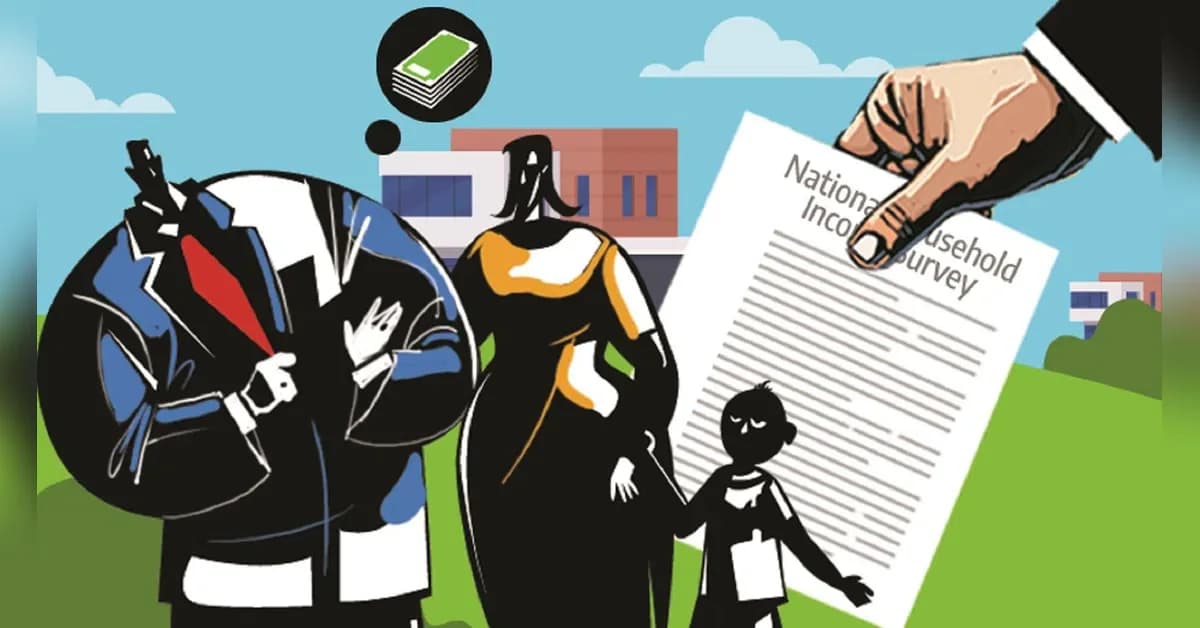
The National Household Income Survey (NHIS) 2026 represents the National Statistics Office's first dedicated attempt to measure income distribution in India. As reported by Business Standard, the survey's fieldwork began in April 2026 and runs through March 2027 across roughly 450,000 households. The survey is guided by a Technical Expert Group chaired by former International Monetary Fund (IMF) executive director (India), Surjit S Bhalla, and uses computer-assisted personal interviewing while drawing on statistical instruments used in Australia, the US, Canada, and South Africa.
According to the ministry's pre-testing report conducted across 15 regional offices in August 2025, significant obstacles remain for the survey's success. As reported by Business Standard, 95% of respondents found the schedule sensitive, with an equally high percentage uncomfortable disclosing income. Only 22% of respondents had a good understanding of the survey's purpose, and most refused outright to answer the question on income tax paid. The report revealed that salary details, income from financial assets, income tax paid, and expenditure incurred on jewellery are the most sensitive items, with respondents taking an average of 100 minutes per household to complete the survey.
Former acting chairman of the National Statistical Commission P C Mohanan highlighted the complexity of measuring Indian income, noting that when NSS started, the economy was so informal that monetary transactions were limited. As reported by Business Standard, in rural areas, much of the income comes from agriculture and other activities — not regular salaries, with self-employment comprising 45-50% of employment with no proper accounts. The survey faces challenges in capturing multiple income sources, with respondents often engaged in three to four jobs in rural areas and two to three occupations in urban areas, making recall difficult for households with complex employment structures.
According to N R Bhanumurthy, director of Madras School of Economics, a pan-India household income survey could fundamentally reshape public policy design and delivery. As reported by Business Standard, reliable household income data is essential for understanding employment patterns, poverty levels, and government intervention effectiveness. The survey's success is particularly important given that India currently has only around 3 to 4% of its population filing income tax returns, placing a disproportionately heavy burden on formal taxpayers. Bhanumurthy emphasized that whole public policy is basically redistribution – you tax the people and you spend on people that is required – that happens only if you have income data.