
India's economy demonstrated strong momentum in the third quarter of FY 2025-26, with 7.8% growth according to the new GDP series data. As reported by The Economic Times, this represents a marginal slowdown from 8.4% in the previous quarter but exceeded ET poll estimates of 7.4%. The Economic Survey's growth projection for FY27 has been revised upward to 7-7.4% under the new GDP series, up from the earlier projection of 6.8-7.2% for fiscal year 2027. This follows robust growth of 7.4% in FY26, which exceeded the Reserve Bank of India's (RBI) 7.3% forecast and marked India's emergence as the world's fourth-largest economy, surpassing Japan. The growth momentum was driven by strong investment, manufacturing expansion, and central bank rate cuts totaling 1.25% in 2025, which stimulated credit and demand.
According to the latest projections from CEA Nageswaran, India is positioned to become the world's third largest economy by the end of this decade, ranking third only to the US and China. According to The Times of India, India currently holds the fifth largest economy position based on International Monetary Fund (IMF) estimates from October 2025. The country has consistently achieved the status of the world's fastest-growing major economy for some time now, with experts noting that this reinforces India's position as one of the fastest-growing major economies globally. Real GDP growth has risen from 6.4% pre-COVID (FY12–FY20) to 7.4% in FY26, supported by resilient private consumption and a surge in investment.
India's renewable energy expansion faces significant headwinds despite rapid capacity additions. Curtailment of solar output, estimated at 2.3 TWh in late 2025, stems from grid absorption limits and inflexible coal plants, with 30 solar and wind projects facing curtailment between March and August 2025, potentially incurring losses of up to ₹700 crore. According to HomeStocksNews, transmission delays are stranding 50 GW of capacity, causing project losses of up to ₹700 crore. India's rapid addition of 38 GW of solar capacity in 2025 alone has propelled non-fossil fuel sources to 50% of installed capacity, but this growth is outpacing critical grid infrastructure. The country requires ₹2.4 lakh crore for transmission expansion by 2032 to integrate 600 GW of renewables, with transmission project timelines potentially extending from two to three years due to right-of-way challenges.
CEA Nageswaran provided specific projections for FY 2026-27, stating that nominal GDP growth is expected to reach around 11%. As reported by The Economic Times, he emphasized that the economy will cross the $4 trillion mark comfortably in 2026-27. However, he noted that the timing of achieving specific relative positions depends on multiple factors, including exchange rates and growth rates in other countries. The revised GDP figures show that economic output for the full year FY26 is expected to be around 7.6%, reflecting resilience even as sequential quarterly growth eased. Despite challenges, India faces the challenge of sustaining growth to meet Prime Minister Modi's 2047 development goal, which experts say requires consistent 8% growth. The country's transmission infrastructure needs significant acceleration, with only 1,998 ckm of transmission lines added by August against a target of 15,382 ckm.
The CEA highlighted several favorable supply-side conditions supporting the economic outlook, including robust rabi crop sowing, comfortable foodgrain stocks and easing global commodity prices, which are likely to keep inflation stable going forward. According to The Economic Times, Nageswaran noted that improved policy certainty following progress on trade agreements including talks with the United States and European Union is expected to support exports and capital flows. On fiscal policy, the government plans to continue consolidation, with the fiscal deficit for 2025-26 estimated at about 4.5% of GDP while maintaining elevated public investment. Private final consumption expenditure (PFCE) grew 7.0% in FY26, while gross fixed capital formation (GFCF) rose 7.8%, reflecting sustained capital formation.
The CEA highlighted that India's exchange rate performance has not been favorable in 2025-26, which has impacted the country's economic ranking projections. According to The Times of India, Nageswaran stated that this unfavorable exchange rate movement will naturally have an impact on India's relative positioning. However, India's trade diversification efforts are gaining traction, with the India-EU trade deal, finalized in 2025, and agreements with the UK, New Zealand, and Oman aiming to reduce reliance on the U.S. market, which accounts for 18% of Indian exports. These measures align with broader efforts to integrate into global value chains amid rising protectionism. India has revised its GDP series with 2022-23 as the new base year, replacing 2011-12, with the updated data and back-series, aiming to provide a more accurate picture of India's economic performance.
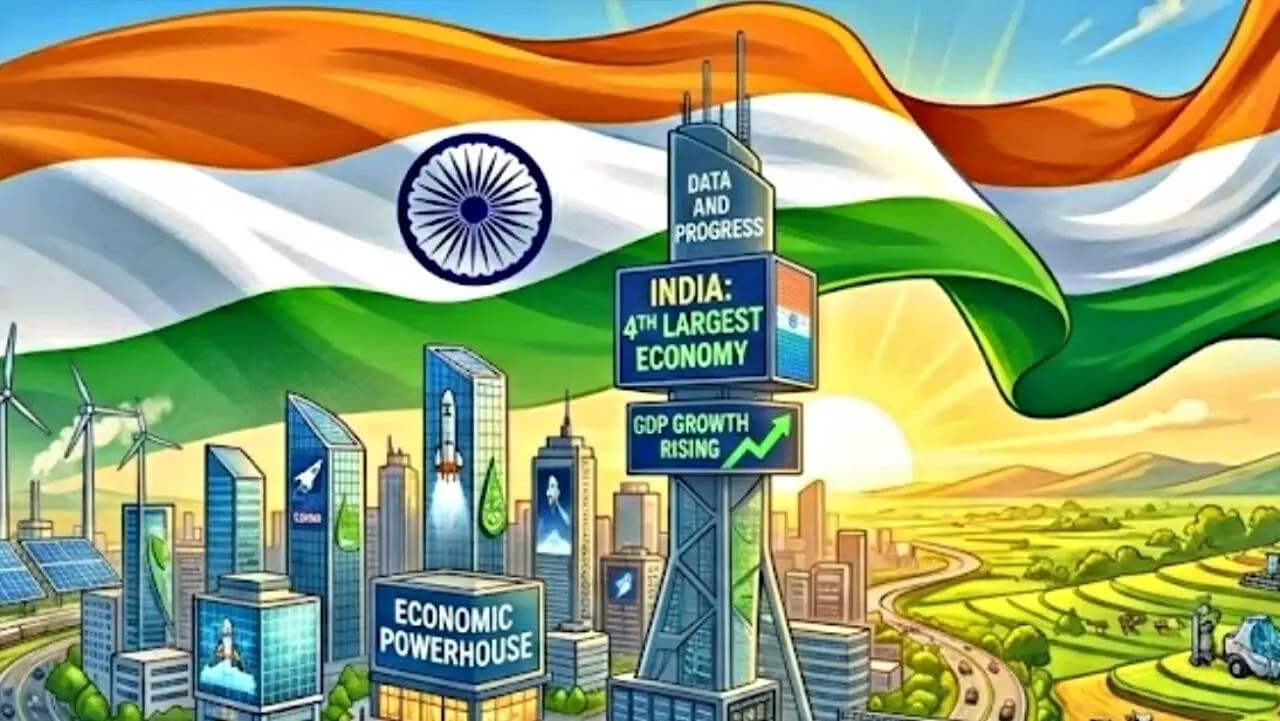
India's post-COVID growth performance has been recognized as among the best globally, particularly within G20 economies. As reported by The Economic Times, CEA Nageswaran emphasized that India is on course to becoming the top three or top four largest economies in the world. Key indicators such as year-on-year growth in two-wheeler sales point to sustained consumer activity, while the momentum in both consumption and investment suggests the outlook for the economy remains strong. The nation has updated its economic data with a new base year to 2022-23, with the Ministry of Statistics and Programme Implementation's data revision including adoption of "double deflation" and expanded coverage of modern economic sectors. Despite external headwinds including 50% U.S. tariffs on Indian exports weighing on labor-intensive sectors such as textiles and gems, India's economic trajectory remains a balancing act between domestic strength and external uncertainties.