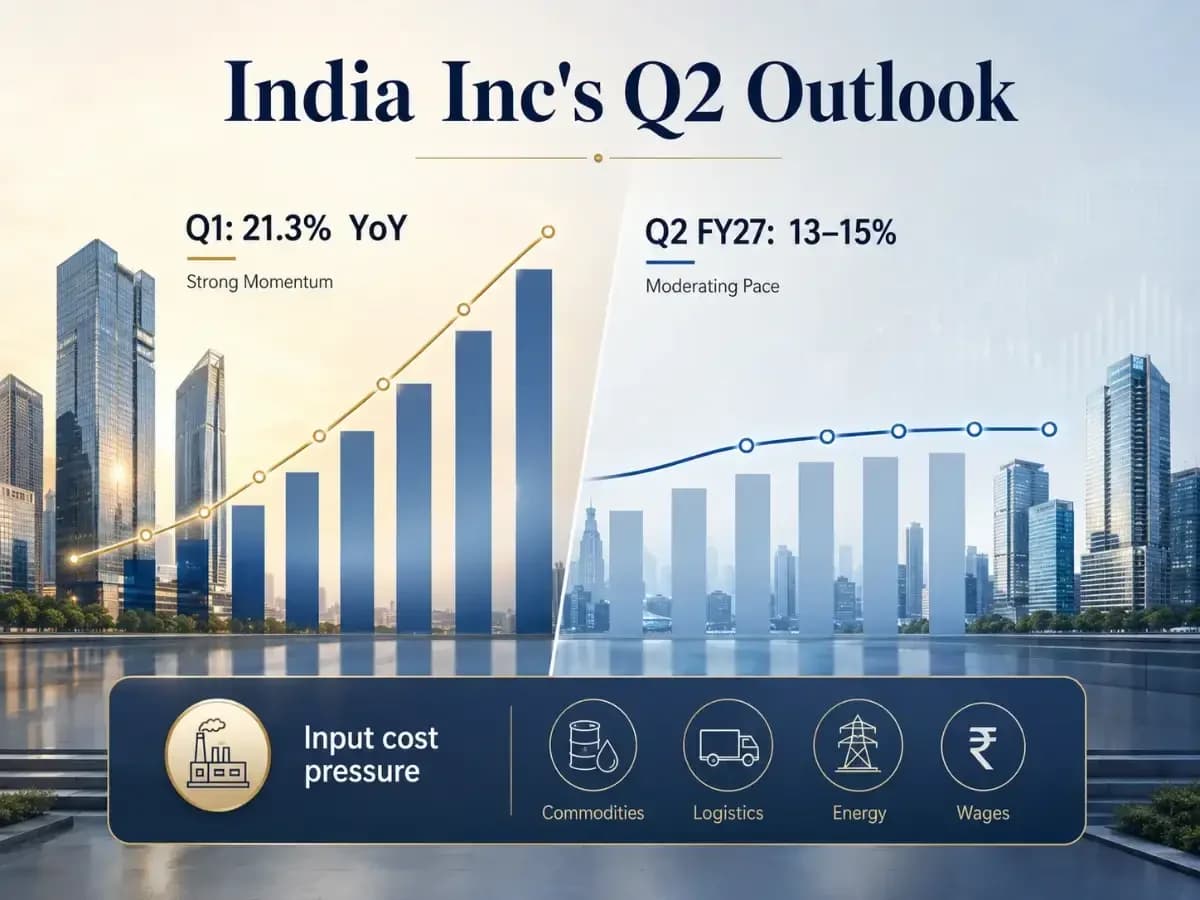
India Inc's revenue is estimated to have grown 11-11.5% year-on-year in Q1FY27, marking the fastest pace in eight quarters and the highest in two years, according to Crisil Intelligence. This compares with 9.6% revenue growth in the preceding March quarter, underscoring the resilience of corporate India in the face of supply disruptions and rising input costs triggered by the West Asia conflict. The analysis covers more than 400 companies across 47 sectors, excluding banking, financial services and oil and gas, representing nearly half of India's listed market capitalisation. As per Crisil Intelligence, domestic demand held up reasonably well despite uncertainties around crude oil and gas affecting fuel, freight, packaging and feedstock costs. The combined quarterly revenue is estimated at ₹14.9-15.1 trillion, demonstrating the scale of corporate performance during this challenging period.
For much of the past two years, revenue growth across India Inc was largely volume-driven, but the latest quarter marks a shift towards pricing-led gains. "For much of the past two years, revenue growth was powered largely by volume. But this time around, pricing was the primary driver, contributing more to revenue growth than volume in sectors such as aluminium, steel, cement, airlines, fertilisers and gems and jewellery," said Sehul Bhatt, Director, Crisil Intelligence. The pricing impulse was broad-based, helping sectors navigate higher input costs effectively. Growth was not uniform but broad-based enough to prop up the aggregate number, with improved realisations in metals, cement, chemicals, tyres, fertilisers and parts of the consumer basket offsetting weaker sectors. Airlines offered one of the sharpest examples of this trend, with revenue estimated to have increased 18-20% even though passenger volumes fell 3-5%, as fares rose 23-25% amid higher aviation turbine fuel costs. In cement, prices contributed about 4 percentage points to growth, while volumes added around 3 percentage points.

Automotive sector emerged as one of the strongest performers with revenue estimated to have grown 22-24% year-on-year, helped by GST-led demand momentum, strong passenger vehicle and two-wheeler sales, commercial vehicle demand, exports, and selective price increases. Passenger vehicle retail sales rose 25% year-on-year, while commercial vehicle sales grew 15%. Aluminium emerged as the standout performer with revenue estimated to have surged 51-53% year-on-year, as supply disruptions tightened availability and pushed up global prices, with aluminium prices rising 27% year-on-year. Steel revenue is estimated to have grown about 15% year-on-year, supported by higher prices, steady domestic demand and better exports. Power generation remained largely insulated from external disruptions and is likely to have recorded revenue growth of 8-10%, supported by an estimated 8% increase in peak power demand. Telecom services revenue grew 10-11%, supported by premiumisation, data monetisation, migration to postpaid plans and subscriber upgrades, with Ebitda margins estimated to have risen by 50-80 basis points. However, export-oriented industries such as textiles and processed food faced disruptions due to higher freight rates and longer shipping schedules.
Despite the strong top-line performance, profitability across India Inc was subdued, as companies were able to pass through only part of the cost escalation. Crisil estimates that aggregate Ebitda margins contracted by 75-100 basis points year-on-year in the June quarter, with aggregate Ebitda margin falling to 19-19.5% from 20.2% a year earlier. Industrial diesel prices rose nearly 50% and commercial LPG rates jumped around 75%, according to Crisil Intelligence. Airlines faced the most severe impact with an estimated ~1,000 basis points decline in Ebitda margin due to aviation turbine fuel-led cost escalation and softer passenger traffic. Tyre manufacturers are also likely to see margins shrink by 200-300 basis points owing to rising natural rubber, carbon black and synthetic rubber costs. Fertiliser companies faced higher input costs for gas, ammonia, sulphur and phosphoric acid, while pharmaceutical firms grappled with rising raw material, power and logistics expenses alongside pricing pressure in the US market. As per Crisil Intelligence, sectors with significant exposure to crude oil, natural gas, imported inputs and logistics witnessed the sharpest pressure on profitability.
Looking ahead, Crisil Intelligence believes three key factors will shape the trajectory of corporate performance: the extent of further price increases and their impact on demand, the ability of companies to protect volumes while recovering higher costs, and the pace at which pressures in fuel, freight, feedstock and packaging begin to normalise. The evolution of the southwest monsoon will also be critical, given its implications for rural demand and food inflation. "For sectors with significant exposure to these cost drivers, margin recovery will depend on both the stability of replacement costs and the ability to pass on higher expenses without impairing demand," Crisil noted, cautioning that geopolitical developments will remain a key variable for Indian corporates in the quarters ahead. Higher-cost inventory already in the system could keep replacement costs elevated and trigger another round of margin pressure before profitability begins to fully normalise.