Goldman Sachs has raised India's GDP growth forecast to 6.8% for calendar year 2026 from 6.5% earlier, following the US-Iran peace deal that has led to lower global oil prices and eased supply chain disruptions. According to Goldman Sachs' economics research team, the firm also raised its FY27 GDP growth forecast by 40 basis points to 6.5%, while EY pegged GDP growth in 2026-27 at 6.6-6.8%. As reported by The Times of India, Goldman Sachs also lowered its headline CPI inflation forecast for CY26 by 0.2 percentage points to 4.4% year-on-year and cut its current account deficit forecast by 0.2 percentage points to 1.1% of GDP. EY estimated that the Centre's fiscal deficit will be around 4.4% of GDP, against the budgeted level of 4.3%, while inflation will be around 4.5%. Considering the recent geopolitical developments, if global crude prices settle at relatively lower levels and shipments through the Strait of Hormuz normalise, the positive momentum of India's growth prospects is likely to be restored, according to EY.
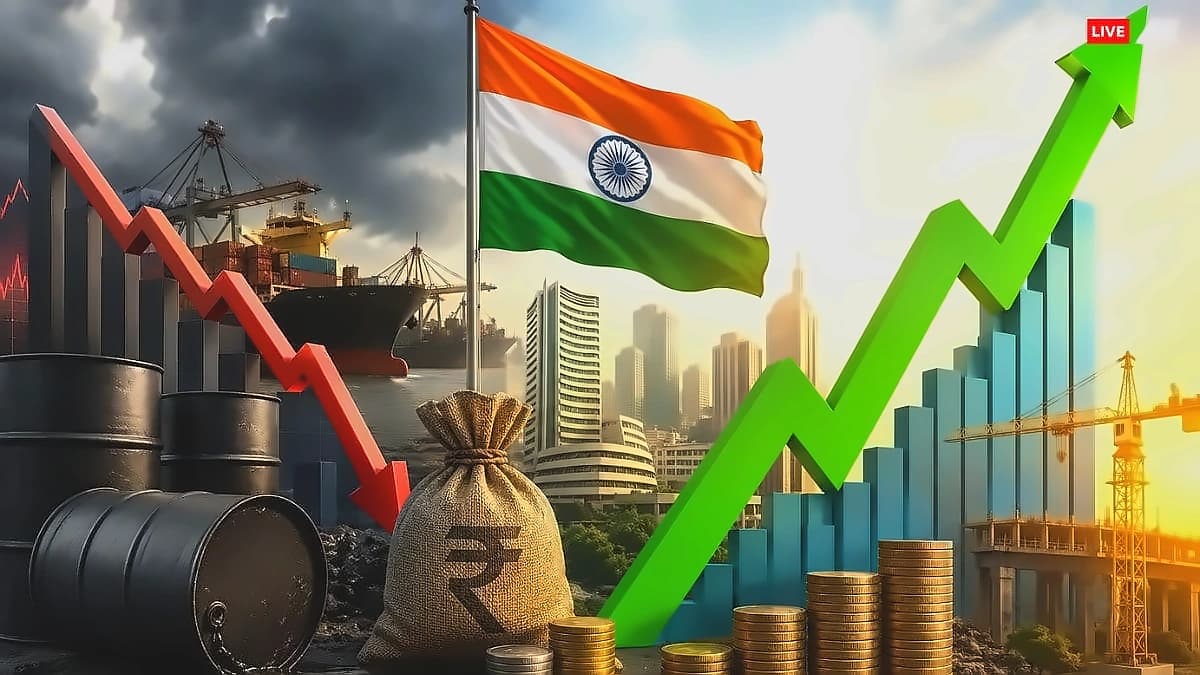
India's banking sector is positioned for a potential re-rating as asset quality remains resilient, though loan growth may remain moderate, according to Kotak Institutional Equities. Asset quality is unlikely to be a concern in the near term, with both public and private sector banks expected to report lower slippages, though banks may increase coverage buffers as they transition towards expected credit loss (ECL) norms. Valuations remain attractive despite recent outperformance, with scope for multiple expansion and earnings compounding, as noted by Kotak. Retail loan quality has strengthened compared to FY23 and pre-COVID levels, supported by tighter underwriting standards since FY24, with unsecured lending expected to see the sharpest improvement following prior stress.
The peace-driven correction in commodity markets is easing fiscal pressures, with the sharp fall in global urea prices and lower crude benchmarks expected to reduce upside risk to the fertilizer subsidy bill. According to Goldman Sachs' latest report, lower crude oil prices have also been accompanied by a decline in petrochemical product prices. Although the earlier increases in polymer prices are still likely to lift core goods inflation in the near term, we now expect the impact to be limited (vs. our earlier expectations), with a lower likelihood of incremental price increases across the core goods basket, as noted by Goldman Sachs. Goldman Sachs also lowered its retail inflation forecast for FY27 to 4.9% from 5.1% earlier, as softer energy prices have lowered the risk of increases in petrol and diesel prices while easing cost pressures across petrochemical products. Goldman Sachs said that consumption will take some hit in the June and Sept quarters due to oil price hikes implemented earlier, but the overall inflationary impact is expected to be more contained than previously anticipated.
The improved oil outlook has strengthened India's external sector projections, with Goldman Sachs lowering its current account deficit forecast for CY26 by 0.2 percentage points to 1.1% of GDP. As reported by Business Standard, the firm now expects a balance-of-payments surplus of 0.7% of GDP in 2026, compared with 0.6% previously. The improved oil outlook has also strengthened India's external sector projections, with the country's well-established petroleum refining ecosystem remaining a key strength, enhancing energy security, supporting exports of petroleum products, and helping mitigate external vulnerabilities. EY Economy Watch projects a current account deficit at 1.5% of GDP for FY27, with a moderation in global energy prices and improved external conditions expected to support the external sector.
Despite recent underperformance in Indian equities, experts remain optimistic about India's long-term growth prospects. Seth R. Freeman, Senior Managing Director at GlassRatner Advisory & Capital Group, noted that India continues to achieve high growth and that trajectory will be sustained, as reported by NDTV Profit. He attributed recent volatility to extraordinary global developments including the war and AI-related investments that are soaking up global liquidity. Freeman believes that domestic investors have cushioned the impact of foreign institutional investor (FII) outflows this year and predicted that overseas capital would return once valuations become sufficiently attractive. He also cautioned that periodical flare ups will occur related to the United States-Iran conflict, and investors should not expect a quick resolution. Among Indian market sectors, Freeman remains constructive on healthcare and automobiles, as being well positioned for long-term growth, while Goldman Sachs' growth projection for India is slightly lower than the Reserve Bank of India's (RBI's) estimate of 6.6% for FY27, but its inflation forecast is lower than the 5.1% projected by the central bank for the current financial year.