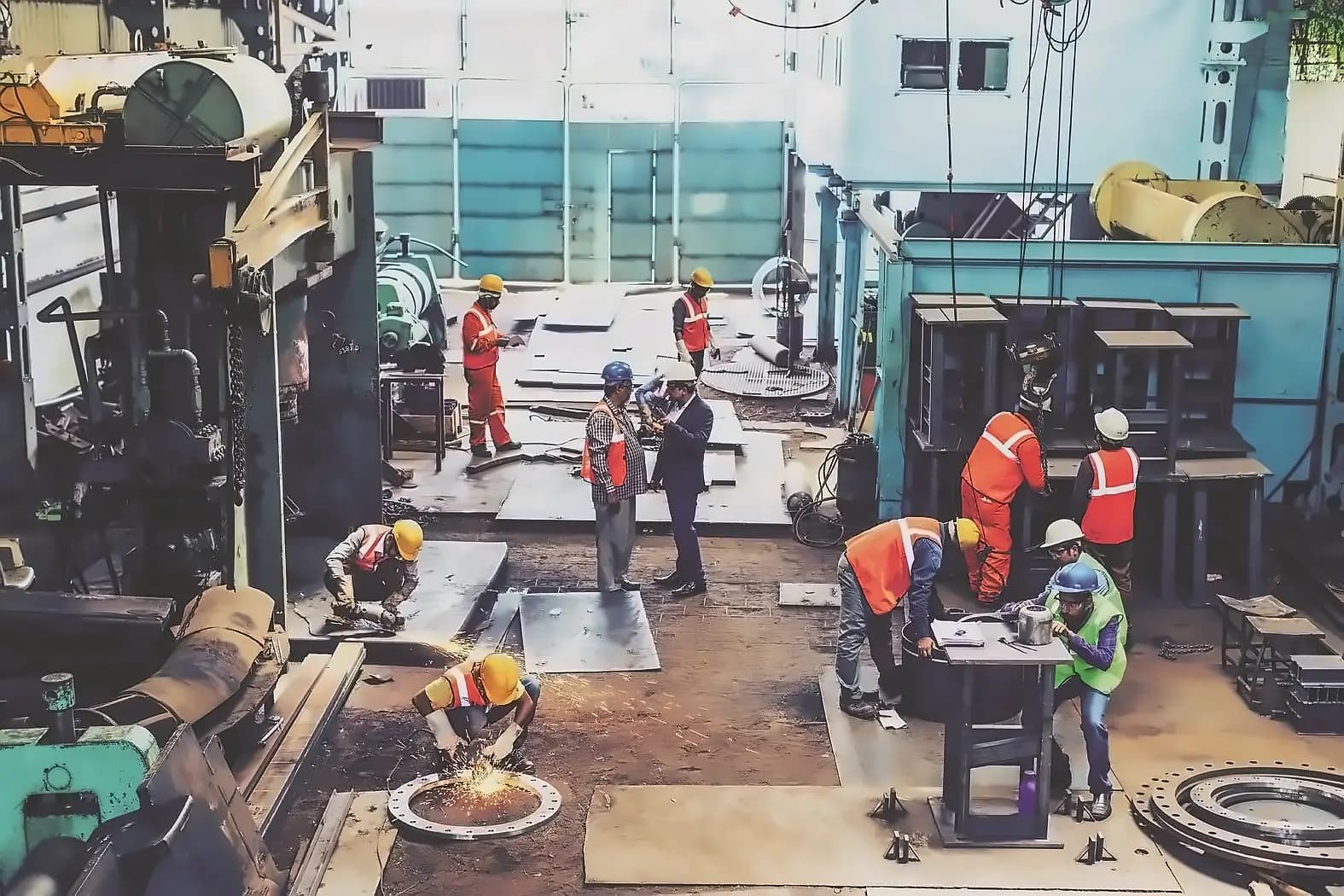
India's manufacturing sector faces a stark productivity divide, with a small minority of large establishments dominating output while thousands of smaller units struggle with debt and low productivity. According to a recent study in a NSO journal using data from the Annual Survey of Industries (ASI) 2022-3, large factories employing over 200 workers account for 10.4% of total operational units but generate nearly 72% of the country's manufacturing gross value added (GVA) amounting to ₹15.9 lakh crore and provide 63% of industrial jobs. In contrast, smaller factories employing up to 50 workers make up over 71% of all operational units but contribute only 10% to overall manufacturing GVA.
The productivity gap coincides with a significant debt burden on smaller establishments, as factories with up to 10 workers carry a formal loan-to-GVA ratio of 85%, compared with around 39% for factories that have more than 200 workers. According to the study, this indicates that while small units leverage significant formal credit relative to their size, low capacity utilisation and limited scale prevent them from translating that capital into proportionate output. The manufacturing sector's GVA was estimated at around ₹22 lakh crore in 2022-3.
The ASI study reveals significant gender disparities in manufacturing employment, with merely 11% of the overall manufacturing workforce being female. The share rises marginally from 8.5% in factories employing up to 10 workers to 11.5% in large units with more than 200 workers. This gender representation gap highlights the challenges faced by smaller manufacturing units in attracting and retaining female workers in the industrial sector.
A key driver behind the productivity divide is the sharp disparity in shop-floor enablers, with units with up to 10 workers representing 36.3% of operational factories but yielding only 2% of output. The study finds that across all operating factories, a mere 2.7% maintain an active R&D unit, while only 6.7% provide formal skill training to workers. Large units show significantly higher adoption rates, with nearly 12% operating R&D facilities and 20% offering formal training, compared to just 0.6% and 2.5% respectively among micro units.

To accelerate industrial growth, policy experts frequently recommend facilitating the scaling up of smaller units through targeted technology upgradation, cluster-based supply chain linkages with larger firms, and easier credit access. The study suggests that scaling up smaller units could help bridge the productivity gap and improve overall manufacturing competitiveness in the Indian economy.