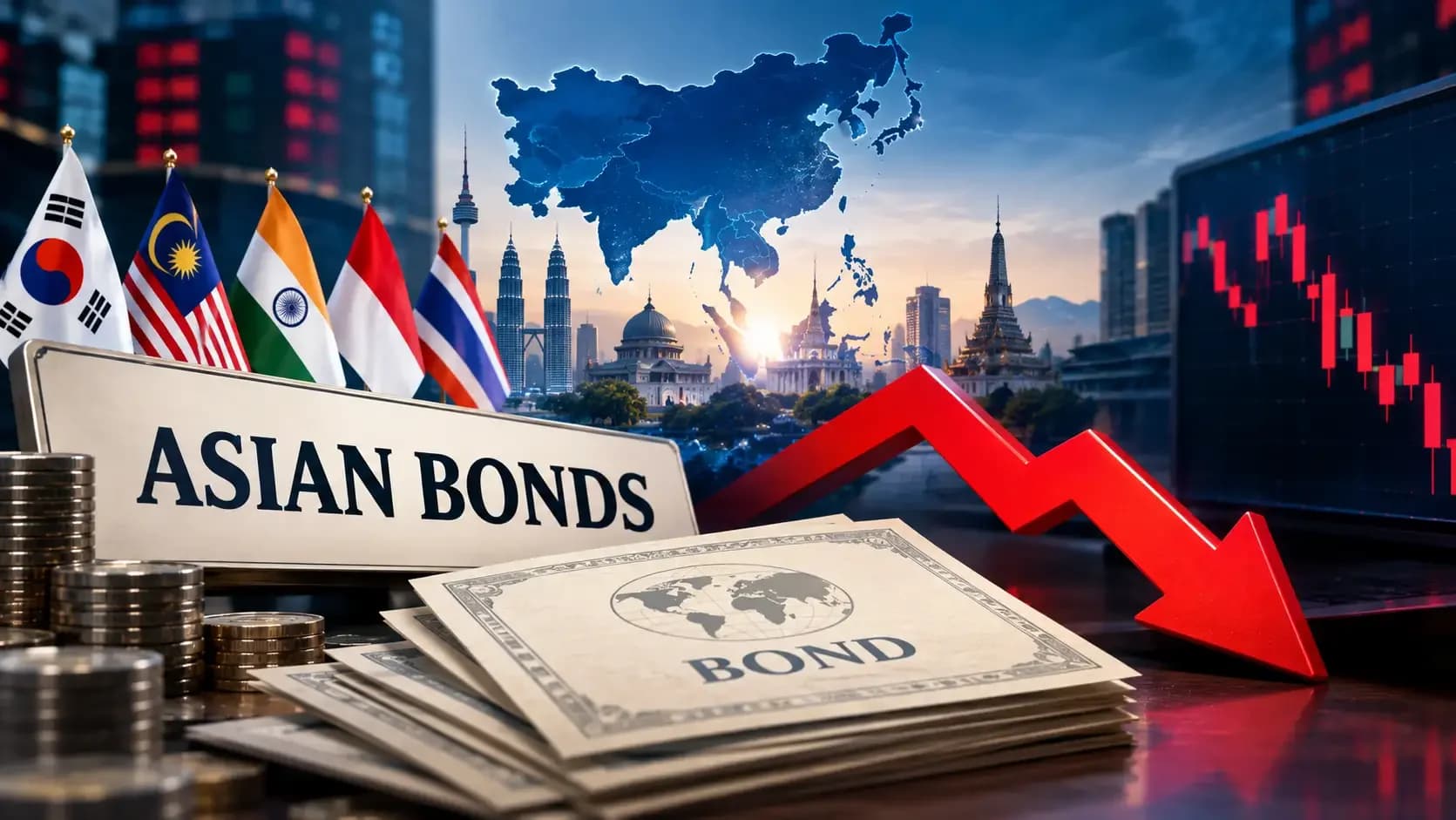
Foreign investment in local bonds throughout Asia fell to a four-month low in July as investors turned choosy amid the economic fallout from Middle East conflict that drove up oil prices. According to Reuters, foreigners bought a net $2.03 billion worth of local bonds in India, Indonesia, Malaysia, South Korea and Thailand - their smallest monthly net purchase since March. The slowdown came despite continued foreign demand for emerging-market debt globally, with Asia becoming less attractive as many economies are vulnerable to higher energy costs. As noted by The Economic Times, the decline came despite strong global demand for emerging-market debt, highlighting growing differences in investor preferences across Asia.
Indian bonds drew $3.04 billion in foreign inflows for a second consecutive monthly gain, supported by New Delhi's decision to scrap capital gains tax in early June on income from interest or sales of government securities for overseas investors. As reported by The Economic Times, this marked India's second consecutive monthly gain despite regional headwinds. The 'others' investor category, which includes insurers, pension funds, corporates and the central bank, bought bonds for nine straight sessions, favouring longer-dated notes, while state-run banks stepped in as value buyers whenever oil jolted yields higher. The tax change improved the attractiveness of Indian government bonds for foreign investors and helped support demand despite broader concerns surrounding emerging Asian markets.
Rising oil prices significantly dampened domestic sentiment, with Brent crude futures climbing 0.6% to $91.60 a barrel in Asian trade, extending gains into a fourth day after U.S. President Donald Trump said no talks with Iran were under way and Iran said the Strait of Hormuz remained blocked. The five-month Iran war has disrupted shipping through the Strait of Hormuz, a key route for Gulf energy exports, boosting costs for importers and fuelling growth concerns. In Asia, China's factory activity contracted in July, while India's manufacturing growth also slowed to its weakest pace in nearly five years, according to private surveys. For India, the world's third-largest oil importer, India imports 90% of its oil needs, and higher oil prices threaten its currency, growth, fiscal position and inflation. Higher energy costs, softer manufacturing activity and geopolitical uncertainty have encouraged investors to become more selective across regional bond markets.

While India and South Korea recorded positive inflows, Malaysian bonds saw $1.38 billion in outflows as investors kept cautious ahead of state elections, and foreign investors sold $268 million in Thai debt securities amid worries over slowing economic growth. Notably, Indonesian bond inflows plummeted to a four-month low of $40 million after central bank Governor Perry Warjiyo stepped down unexpectedly, raising concerns about the institution's independence. As noted by Reuters, the leadership change raised investor concerns about Bank Indonesia's independence and contributed to greater caution toward Indonesian assets, though the relatively high yields offered by Indonesian debt helped limit the risk of larger capital outflows. Emerging-market equities, however, recorded $7.8 billion in outflows during the month, according to IIF data.
Indian government bonds showed little movement on Wednesday, trading in a tight range as higher oil prices countered support from softer U.S. Treasury yields. The 10-year U.S. Treasury yield fell about 1.5 basis points to 4.69% in Asian trade, offering some relief to domestic debt, but rising crude offset that in the second half. Market participants are now awaiting the Reserve Bank of India's August policy minutes and Federal Reserve policy minutes for fresh direction, with traders holding back until crude prices settle. As a private-bank trader noted, "Traders are holding back until crude settles, while some banks are buying around 6.85%-6.82%. Only participants with steady inflows are deploying funds; speculators are staying out." India's overnight indexed swap rates traded mixed, with the one-year swap falling 1.75 bps to 5.8075% and the two-year little changed at 6.0475%, though the liquid five-year rate gave up 2.25 bps to 6.3975%. The Indian rupee slid to a late-July low of 95.7525 per dollar, while the benchmark Nifty 50 extended its losing run to seven sessions, its longest in 11 months.