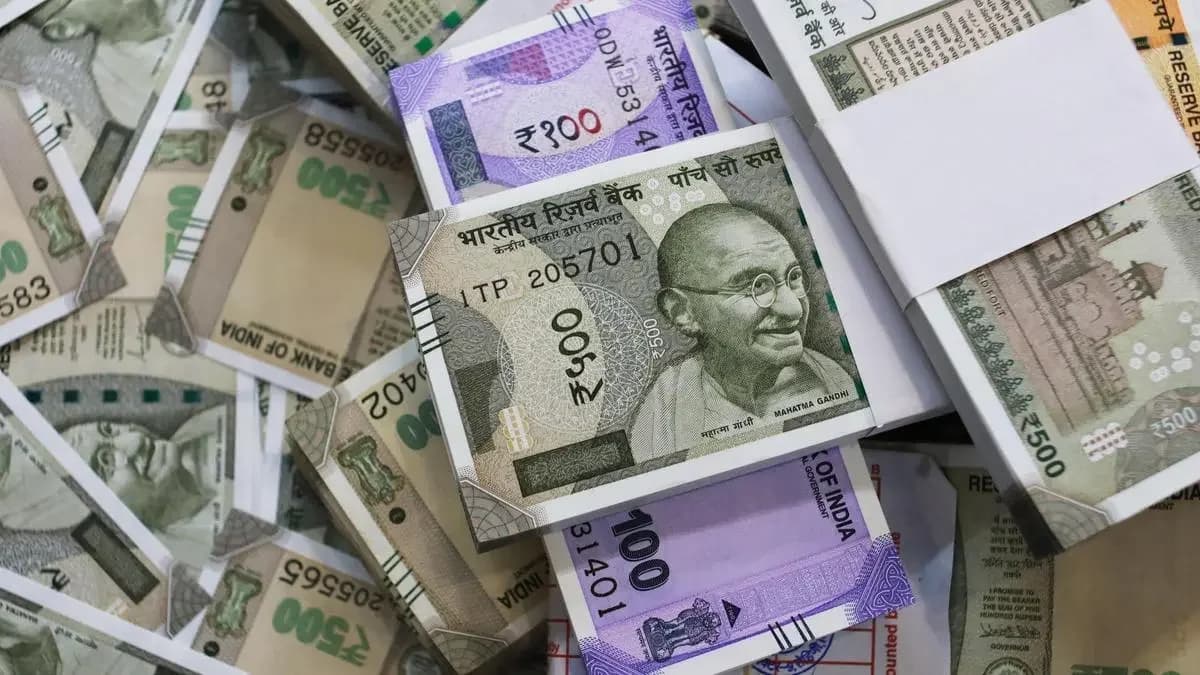
The Indian rupee declined to 96.81 per US dollar on Thursday, marking a dangerous approach to historic lows as the currency opened at 96.81 and traded in a volatile range. This represents a further deterioration from Wednesday's close of 96.53, with the rupee showing sustained pressure amid escalating geopolitical tensions. The currency pressure is being driven by Brent crude prices surging back above $100 per barrel as the US and Iran intensify attacks across the Middle East, with markets pricing in the risk of supply disruptions following continued hostilities. US President Donald Trump imposed 10% tariffs on goods purchased from India and 16 other countries over the issue of the use of forced labour in the production of such items, adding to the currency's distress. As per Business Standard, the domestic currency has been under pressure amid the ongoing Middle East crisis that is driving oil prices steadily higher and dollar index above 101 mark. Risk aversion in global markets and a negative trend in domestic equities further dented investor sentiments, with heightened geopolitical tensions supporting the dollar as safe haven demand further pressurizing the local unit.
Indian equity markets witnessed severe volatility with BSE Sensex crashing over 700 points to trade near 75,653.80 and NSE Nifty 50 dropping below the key support level of 23,700 to trade at 23,627.90. According to Business Standard, this represents a sharp decline from the previous session's levels, marking the fifth consecutive session of decline for both benchmark indices. According to The Hindu BusinessLine, foreign institutional investors turned net buyers, purchasing equities worth ₹1,650.16 crore on Tuesday, providing some support despite the broader market weakness. Among the major losers were Maruti Suzuki India, Kotak Mahindra Bank, Infosys, Tata Consultancy Services (TCS), Mahindra & Mahindra, and Bharat Electronics. Profit booking in information technology, automobiles, and financial services further contributed to the decline. Market experts attributed much of the weakness to investor disappointment over banking sector earnings, particularly HDFC Bank's quarterly performance which disappointed investors because of weaker-than-expected net interest margins. The banking sector remains one of the largest contributors to benchmark indices, making its performance crucial for overall market direction.

The Reserve Bank of India's rupee-support measures launched in early June have mobilised $20.72 billion through July 17, with foreign currency non-resident deposits accounting for about $17.5 billion of the total. As reported by Reuters, this strong initial response is significantly above what news reports suggested and belies the prevailing narrative that banks were struggling to raise deposits amid higher US rates. The current programme has attracted funds at a much faster pace than a similar RBI scheme in 2013, when roughly $10 billion was mobilised in the first seven weeks. Economists at BofA suggest that if current trends are extrapolated using the fund mobilisation pattern seen in 2013, India could be on course to attract around $80 billion under the scheme. According to The Hindu BusinessLine, on Wednesday, traders said that state-run banks were offering dollars around 96.50-96.55 levels, most likely on behalf of the RBI. Despite the recent weakness, traders expect the RBI to continue smoothing excessive volatility, with the central bank's recent measures to attract FCNR(B) deposits having already generated sizeable foreign currency inflows that could strengthen forex reserves.
Brent crude prices have surged back above $100 per barrel as the US and Iran intensify attacks across the Middle East, with markets pricing in the risk of supply disruptions following continued hostilities. The latest surge comes as oil prices fell below $90 on July 21 as traders responded to a proposed 10-day US-Iran ceasefire, with Brent crude falling 0.9% to $88.44 per barrel and WTI declining 0.9% to $82.50. However, oil prices rose as the US struck Iran and Iran struck US facilities in Kuwait, Bahrain and Jordan, with the Houthis also threatening to target vessels carrying oil from Saudi Arabia in the Bab el-Mandeb. As per Mirae Asset ShareKhan, forex traders said crude oil prices remain elevated amid concerns over the security of oil shipments through the Red Sea and Strait of Hormuz. According to HDFC Securities, renewed concerns over U.S. tariff rhetoric have further dampened sentiment, with spot USDINR remaining on a bullish track and near-term support pegged at 96.10. Market experts suggest that diplomatic talks between the two nations may prevent a sharp fall in the rupee, while any RBI intervention may also support the currency at lower levels.
The rupee weakness is being compounded by elevated global bond yields that are limiting support for emerging market currencies. According to a Bank of Baroda Research report, sovereign bond yields remained high in July as investors reassessed inflation risks amid the surge in crude oil prices and the conflict in West Asia. While India's benchmark 10-year government bond yield has risen only modestly this month compared with major global peers, the report cautioned that a further escalation in geopolitical tensions and another spike in oil prices could push domestic yields higher. Higher bond yields generally translate into higher borrowing costs and can support the US dollar by keeping interest rate expectations elevated, adding another headwind for currencies such as the rupee. With crude prices continuing to rise and geopolitical risks showing little sign of easing, analysts expect the rupee to remain under pressure in the near term, despite the RBI's successful inflow strategy. Forward premiums rose through the session, with the one-month premium climbing to 3.20 per cent and the one-year premium to 2.96 per cent.
Despite equity market volatility, investors in Sovereign Gold Bonds (SGBs) continued to enjoy healthy returns, with recent data indicating that several SGB series have generated returns ranging between 34 per cent and 44 per cent, despite periodic corrections in international gold prices. However, recent changes in tax treatment have somewhat reduced the attractiveness of new investments compared with earlier issuances. In another significant corporate development, Hyundai Motor India announced the integration of nearly 30,000 electric vehicle charging points into its myHyundai mobile application, reaffirming its plan to expand its fast-charging infrastructure to 600 charging stations by 2030. Market participants are now focusing on the next round of quarterly earnings from major listed companies, with analysts believing upcoming financial results from banking, IT, automobile, and manufacturing companies will provide clearer indications regarding corporate profitability during the current financial year.